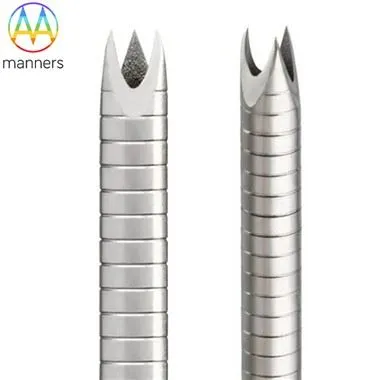
Precision Tolerance Control For Custom Medical Needles
Sep 20, 2026
Industry Pain Points
Custom medical needle manufacturing faces severe precision tolerance challenges that plague medical device manufacturers globally. Most standard needle products feature fixed dimensional parameters, failing to match the personalized requirements of minimally invasive catheters, cardiovascular intervention devices, and urinary endoscopic equipment. Common practical problems include inconsistent tube wall thickness, eccentric needle tips, unstable kerf width after laser cutting, and poor overall dimensional uniformity. Substandard tolerance control directly leads to clinical risks: oversized needle outer diameter causes tissue puncture damage, undersized inner diameter affects liquid delivery and blood circulation efficiency, and uneven kerf width results in unbalanced flexibility and torque performance of needle tubes. Additionally, many small and medium manufacturers lack micron-level detection capabilities, leading to batch product inconsistencies, frequent customer returns, and failure to meet ISO13485 medical device quality certification standards, restricting market access for custom needle products.
Working Principle of Precision Tolerance Customization
The core principle of custom needle tolerance control relies on micro-precision mechanical processing and laser fine cutting technology, combined with material mechanical property matching. Medical custom needles are mainly made of 304, 316L stainless steel, 17-7PH stainless steel, and Nitinol shape memory alloy. Different materials have distinct ductility, hardness, and thermal deformation coefficients, which determine the processing tolerance range. The manufacturing process adopts closed-loop precision control: high-precision tubing with an outer diameter range of 0.20mm to 20mm is selected as the base material, and laser cutting equipment with a minimum kerf width of 0.012mm is used for pattern processing. Through computer numerical control system calibration, the equipment realizes synchronous adjustment of cutting speed, laser power, and focal length, eliminating dimensional errors caused by thermal expansion and mechanical vibration. The tolerance control principle takes clinical application performance as the core, ensuring that the needle tube's pushability, torque transmission, and kink resistance remain stable within the customized dimensional range.
Classification of Core Manufacturing Equipment
Custom needle precision tolerance manufacturing equipment is divided into three core categories. First, precision tubing finishing equipment, including CNC high-precision tube straightening machines and wall thickness calibration machines, which correct raw material bending and wall thickness deviation to ensure the basic dimensional accuracy of needle tubes. Second, medical-grade laser cutting equipment, including dedicated hypotube laser cutters with micro-kerf control function, supporting continuous spiral cutting, intermittent spiral cutting, radial cutting and other personalized pattern processing, achieving 0.012mm ultra-fine kerf control. Third, micron-level detection equipment, including laser dimension measuring instruments, eccentricity detectors, and wall thickness testers, used for full inspection of finished products to screen out unqualified products with excessive tolerance errors. Different equipment combinations correspond to different customization needs: simple dimensional customization only requires finishing and detection equipment, while complex pattern and tolerance integrated customization needs full-process laser cutting precision equipment.
Standard Operational Guidelines
The first step of custom needle tolerance customization is demand confirmation, sorting out customer 2D/3D drawings, sample parameters and clinical application scenarios, and clarifying key tolerance indicators such as outer diameter, inner diameter, wall thickness, and cutting kerf width. The second step is raw material screening, selecting matching metal materials according to usage scenarios-stainless steel for conventional intervention needles and Nitinol for flexible minimally invasive needles. The third step is equipment parameter debugging, setting targeted laser power, cutting speed and positioning accuracy according to customized tolerance standards, and conducting trial cutting and tolerance testing. The fourth step is formal batch processing, adopting segmented processing to avoid continuous processing thermal deformation affecting tolerance accuracy. The fifth step is full inspection and calibration, using precision detection equipment to verify all dimensional indicators, and reprocessing unqualified products. The sixth step is packaging and filing, adopting standard carton packaging or customized packaging, and retaining tolerance detection data for quality traceability.
Practical Industry Experience
Years of custom needle manufacturing practice prove that tolerance error is most likely to occur in laser cutting and tip grinding links. In actual production, real-time temperature control of processing equipment must be maintained, as long-term continuous operation will cause equipment thermal expansion and lead to 0.02-0.05mm dimensional deviation. For ultra-fine needles below 1mm outer diameter, low-speed low-power cutting is adopted to prevent tube wall collapse and eccentricity caused by excessive laser energy. For shape memory alloy custom needles, natural cooling processing is used instead of rapid cooling to avoid material structural deformation and tolerance drift. In addition, batch production must implement first-piece inspection system, and mass production can only be carried out after confirming that the first product meets tolerance standards, which can effectively reduce batch scrap rate and improve customization yield.
Summary and sublimation
Precision tolerance control is the core competitiveness of custom needle manufacturers and the fundamental guarantee for the clinical safety of medical custom needles. Custom needle manufacturing is not simple dimensional processing, but systematic customization integrating material characteristics, processing technology and clinical performance. Every micron-level tolerance adjustment is closely related to the puncture safety, operational stability and service life of medical devices. High-standard tolerance control can effectively solve the pain points of poor product consistency and low clinical applicability of traditional custom needles, and lay a solid foundation for the popularization of personalized medical intervention equipment.
Future Development Suggestions
In the future, custom needle manufacturers should accelerate the upgrading of intelligent precision equipment, introduce automated online detection systems to realize real-time monitoring and automatic correction of processing tolerance. It is necessary to establish a complete tolerance parameter database for different materials and application scenarios, form standardized customization processes, and shorten the customized product delivery cycle. At the same time, manufacturers should strengthen technical cooperation with medical device research and development institutions, optimize tolerance design according to the latest clinical medical needs, and develop ultra-precision custom needle products suitable for neurological intervention, vascular minimally invasive surgery and other high-precision scenarios to enhance core market competitiveness.