Precision Dispensing Pain Points & Luer Lock Needle Solving Logic
Oct 04, 2026
1. Industry Pain Points
Modern industrial micro-dispensing and high-speed glue dispensing processes face widespread precision and stability bottlenecks that restrict production efficiency and product yield. Traditional dispensing needles mostly adopt luer slip friction connection structures, which are prone to loose connection and needle displacement under long-term high-pressure operation and equipment vibration, resulting in glue leakage and uneven dispensing volume. In micro-dispensing scenarios with inner diameters below 0.8mm, ordinary needle tubes have rough inner walls and irregular flow channels, easily causing fluid turbulence, back pressure accumulation, and frequent needle clogging, which leads to production shutdown and cleaning delays. In addition, low-precision needle tubes often produce fluid trailing and wire drawing after dispensing, forming glue burrs on product surfaces, seriously affecting the appearance and assembly accuracy of precision electronic components, medical devices, and automotive parts. Most ordinary precision needles on the market have high procurement costs and poor customization adaptability, failing to meet the personalized micro-dispensing demands of small-batch and multi-variety industrial production.
2. Working Principle of Luer Lock Stainless Steel Dispensing Needle
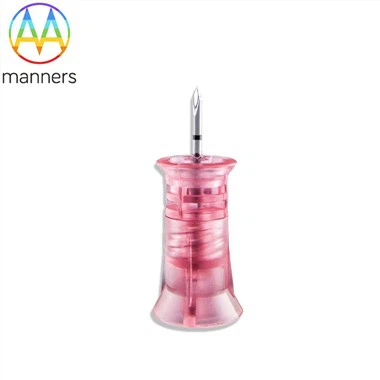
The core working principle of stainless steel dispensing needles with luer lock lies in the dual optimization of structural locking design and fluid flow channel engineering. The standard 6% luer taper matching structure is combined with a threaded locking collar, which realizes spiral locking connection with dispensing syringes and valves, completely solving the looseness and displacement problems of traditional friction insertion structures. The inner part of the needle adopts a smooth conical integral flow channel, which changes the turbulent flow state of fluid in ordinary straight needles, forms a stable laminar flow transmission state, and uniformly disperses fluid pressure to reduce back pressure generation. Adopting phosphor bronze substrate with electroless nickel plating and stainless steel integrated molding technology, the needle tube maintains high structural rigidity and dimensional stability. The thin-wall precision design realizes the miniaturization of the needle outlet while ensuring structural strength, precisely controlling the fluid output volume and cutting off residual fluid tension, thereby eliminating trailing and wire drawing phenomena.
3. Equipment Classification & Applicable Scenarios
According to gauge specifications and inner diameter parameters, luer lock stainless steel dispensing needles are divided into three core categories. First, large-gauge models (18G-22G) with inner diameters of 0.4-0.8mm, suitable for high-flow dispensing of high-viscosity fluids such as silica gel, sealant, and epoxy resin, and widely used in automotive sealing and hardware bonding processes. Second, medium-gauge models (23G-27G) with inner diameters of 0.2-0.4mm, applied to conventional precision dispensing of adhesive and ink, matching semi-automatic dispensing equipment for electronic component packaging. Third, fine-gauge micro needles (28G-30G) with inner diameters of 0.1-0.2mm, dedicated to ultra-micro dispensing of low-viscosity fluids such as glue solution and reagent, applicable to medical device production and micro-electronic precision processing. All models support customized inner diameter and appearance size processing according to 2D/3D drawings and samples, covering personalized industrial production demands.
4. Standard Operation Guidelines
The standardized operation of luer lock dispensing needles is divided into four core steps to ensure dispensing accuracy and service life. First, pre-installation inspection: check the needle inner wall for burrs, blockages, and thread integrity, and confirm that the needle gauge matches the fluid viscosity and dispensing accuracy requirements. Second, locking installation: align the needle luer lock interface with the dispensing valve interface, rotate the threaded collar clockwise until fully locked, and gently pull to verify no looseness to avoid pressure leakage. Third, parameter debugging: adjust equipment dispensing pressure and speed according to the needle inner diameter, adopt low-pressure pre-dispensing for fine-gauge needles to prevent pipe burst and fluid splashing, and set high-speed stable operation for large-gauge needles to improve production efficiency. Fourth, post-use maintenance: clean the residual fluid inside the needle with professional cleaning solvent immediately after operation, avoid fluid solidification and blockage, and disassemble and store the needle in a dry and dust-free environment.
5. Practical Application Experience
In long-term industrial batch production, the matching use of luer lock stainless steel needles can effectively improve product yield by 8%-15%. In automated robotic dispensing production lines, the locked structure can resist equipment vibration and pressure impact, ensuring consistent dispensing volume of each product and avoiding batch quality differences. For high-viscosity easy-clogging fluids, the smooth conical flow channel can reduce clogging frequency by more than 60%, greatly reducing downtime maintenance time. In micro-dispensing experiments, the thin-wall design effectively shortens the fluid cutoff time, completely solving the wire drawing problem in high-frequency intermittent dispensing. In addition, the ISO13485 certified material meets medical and food-grade production standards, which can be safely applied to medical reagent filling and cosmetic raw material dispensing processes, with stable chemical resistance and no fluid contamination.
6. Summary and Improvement
Luer lock stainless steel dispensing needles solve the core pain points of traditional dispensing equipment such as unstable connection, easy clogging, poor precision, and high cost through structural innovation and material optimization. Its standardized locking structure, smooth flow channel design, and high-precision customization capability make it a core accessory for modern precision dispensing production. In actual production, standardized installation and maintenance operations are key to giving full play to product performance. Enterprises should match needle specifications according to fluid characteristics and production accuracy requirements to maximize production efficiency and product quality.
7. Industry Prospect Suggestions
With the continuous upgrading of industrial intelligent manufacturing and micro-precision processing technology, the demand for high-precision, high-stability, and customizable dispensing accessories continues to rise. In the future, luer lock stainless steel dispensing needles will develop towards ultra-fine inner diameter customization, intelligent matching with automated equipment, and multi-scenario material adaptation. It is suggested that production enterprises strengthen precision processing technology research and development, expand customized specification systems, and improve product compatibility with intelligent dispensing systems. Processing enterprises should replace traditional ordinary needles with standardized luer lock precision needles to reduce production quality risks and comprehensively improve the level of refined production.