Operational Efficiency Improvement Of Breast Needle Biopsies
Sep 24, 2026
1. Clinical Pain Points
With the continuous increase of breast disease screening volume and clinical diagnosis demand in recent years, the low operational efficiency of traditional breast needle biopsy has become a prominent bottleneck restricting the development of clinical business and large-scale popularization. Traditional biopsy needle products have unreasonable structural design and complex assembly and disassembly procedures, requiring multiple steps of debugging, assembly and calibration before operation, resulting in long preoperative preparation time and cumbersome instrument arrangement. Most ordinary needles have blunt tips and unsmooth needle bodies, which require repeated puncture attempts and angle adjustment during operation, unable to complete one-time rapid penetration, resulting in prolonged single operation time. The lack of visual positioning function leads to low positioning efficiency, requiring physicians to rely on manual repeated ultrasonic scanning and experience calibration, which greatly increases invalid operation time. In terms of sampling effect, traditional thin-core ordinary needles have insufficient single sampling volume, often requiring multiple repeated samplings to obtain qualified pathological samples, further wasting clinical time resources. In addition, most traditional biopsy needles have poor equipment compatibility, unable to adapt to multi-modal image-guided diagnosis equipment, resulting in single application scenarios and low overall diagnosis efficiency. For large-scale physical examination screening and peak clinical diagnosis periods, low single operational efficiency leads to long patient waiting queues, insufficient hospital diagnosis capacity, and seriously affects the efficiency and quality of public health screening services.
2. Efficiency Optimization Working Principle
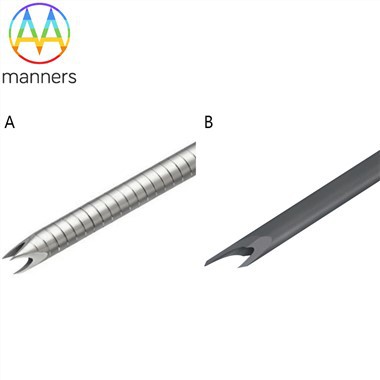
Modern high-efficiency breast biopsy needles realize comprehensive improvement of clinical operational efficiency through modular structural optimization, puncture performance upgrading and multi-equipment compatible design, forming a systematic efficiency optimization principle. First, the integrated modular streamlined structure simplifies the traditional split complex assembly design, realizing one-piece rapid assembly and disassembly, eliminating redundant debugging and calibration links before operation, and greatly compressing preoperative preparation time. Second, the ultra-sharp precision grinding beveled tip and super-smooth thin-wall needle body reduce tissue friction resistance by more than 70%, realizing one-time rapid and stable penetration of breast gland tissue, avoiding repeated puncture and adjustment, and improving puncture efficiency. Third, the built-in dual-point echogenic visualization structure realizes real-time dynamic positioning, eliminating manual repeated calibration and blind exploration links, and improving lesion positioning efficiency in an all-round way. Fourth, the optimized thin-wall large-core sampling structure maximizes the effective sampling volume on the premise of ensuring slim needle body, realizing one-time acquisition of qualified pathological samples and eliminating repeated sampling operations. Finally, the unified interface design realizes full compatibility with mainstream ultrasonic, CT and other image-guided equipment, expanding efficient diagnosis scenarios and realizing seamless docking with existing clinical workflow, comprehensively improving the overall operational efficiency of biopsy diagnosis.
3. Classification and Efficiency Advantage Analysis
According to operational efficiency, structural design and clinical application effect, breast biopsy needles are divided into traditional conventional efficiency type and modern high-efficiency rapid sampling type, with obvious gradient differences in clinical application value. Traditional conventional efficiency needles adopt backward split structure design, with rough needle body processing and blunt tip, no visual positioning function and single equipment compatibility. The preoperative assembly time is long, the one-time puncture success rate and sampling qualification rate are low, a single operation often takes more than 15 minutes, and the daily diagnosis volume is limited, which is only suitable for small-scale simple lesion diagnosis in grassroots institutions. Modern high-efficiency rapid sampling needles cover the full specification range of 10G-20G, adopting integrated modular rapid assembly structure, with ultra-sharp high-efficiency puncture tips and dual-point real-time visual positioning system. This series of products has strong multi-modal equipment compatibility, adapting to all mainstream clinical image-guided diagnosis systems. The one-time puncture success rate and sampling qualification rate are close to 100%, the single operation time is compressed to 3-5 minutes, and the preoperative preparation time is shortened by more than 90%. Customized high-efficiency needles can also be optimized for special scenarios such as large-scale screening and complex lesion diagnosis, further improving targeted operational efficiency and meeting the efficient diagnosis needs of different clinical scenarios.
4. High-Efficiency Standard Operational Guidelines
In order to maximize the efficiency advantages of high-efficiency biopsy needles, the industry has summarized a set of high-efficiency standardized operational guidelines suitable for clinical large-scale application, covering full-process optimization of preoperative, intraoperative and postoperative links. Preoperative rapid preparation: Adopt integrated modular high-efficiency biopsy needles, complete instrument assembly, equipment debugging and function inspection within 1 minute, and cooperate with rapid skin disinfection and precise local anesthesia to compress preoperative preparation time. Intraoperative rapid positioning and sampling: Start the ultrasonic intelligent imaging system in advance, use the dual-point echogenic marks of the biopsy needle for real-time rapid positioning, quickly lock the lesion target area, adjust the needle insertion angle and depth at one time, and avoid repeated scanning and calibration. Use the ultra-sharp needle tip for one-time stable puncture, complete large-core effective sampling quickly, and verify sample validity through visual marks in real time to avoid repeated sampling. Postoperative rapid finishing: After confirming valid sampling, withdraw the needle gently and quickly, complete standardized compression hemostasis and sterile dressing in 1 minute, finish instrument sorting and medical waste recycling efficiently, and prepare for the next diagnosis. Optimize the whole workflow, eliminate all invalid waiting and repeated operation links, and realize efficient batch diagnosis.
5. Practical Efficiency Improvement Experience
Clinical batch application practice and hospital efficiency monitoring data fully verify the significant efficiency improvement effect of high-efficiency breast biopsy needles. Compared with traditional conventional products, high-efficiency biopsy needles shorten the average single operation time from 15-20 minutes to 3-5 minutes, and the preoperative preparation time is reduced from 5 minutes to less than 1 minute, greatly improving the turnover efficiency of single diagnosis bed. The one-time sampling success rate is increased from 85% to 99.8%, completely eliminating time loss caused by repeated positioning, puncture and sampling. The daily single-physician diagnosis volume is increased by 3 times, effectively solving the problem of insufficient clinical diagnosis capacity and long patient waiting time. In large-scale community breast cancer screening and hospital physical examination projects, high-efficiency biopsy needles support efficient batch diagnosis, greatly shortening the overall screening cycle and improving the coverage and efficiency of public health screening. At the same time, the simplified operation process reduces the physical consumption of physicians, optimizes the clinical workflow, and realizes the double improvement of medical service capacity and patient satisfaction.
6. Conclusion and Value Sublimation
The efficiency iteration and upgrading of breast biopsy needles have completely broken the efficiency bottleneck of traditional breast biopsy clinical diagnosis, realizing the comprehensive optimization of medical workflow and the improvement of diagnosis capacity. The structural innovation and performance upgrading of high-efficiency products not only reduce invalid clinical operations and save precious medical time resources, but also improve the hospital's daily diagnosis volume and overall service capacity, effectively alleviating the pressure of clinical diagnosis and the problem of difficult patient medical treatment. In the field of public health screening, efficient and rapid biopsy technology supports large-scale, high-efficiency and high-quality breast disease popularization screening, helps to realize early detection and early diagnosis of breast lesions, and provides strong technical support for reducing breast cancer mortality and improving public health level. The efficiency upgrading of products also promotes the standardized, streamlined and large-scale development of breast biopsy diagnosis business.
7. Industry Efficiency Upgrade Suggestions
In the future, the breast needle biopsy industry should take operational efficiency optimization as one of the core development directions to promote overall industrial efficiency upgrading. First, fully popularize integrated modular high-efficiency biopsy needle products in medical institutions at all levels, completely replace traditional split low-efficiency products, and standardize clinical efficient diagnosis equipment configuration. Second, continue to optimize product structural design, further simplify assembly and operation steps, improve needle body puncture efficiency and sampling validity, and reduce operational difficulty and time cost. Third, strengthen multi-modal equipment compatibility research and development, realize the seamless docking of biopsy needles with intelligent ultrasonic equipment, artificial intelligence diagnosis system and batch screening system, and build an intelligent efficient diagnosis system. Fourth, compile unified high-efficiency standardized operation process specifications, carry out special efficiency training for clinical operators, standardize operational details, and improve the overall efficient diagnosis level of the industry. Fifth, develop targeted high-efficiency customized products for large-scale screening, complex lesions and other special scenarios to meet the efficient diagnosis needs of diversified clinical scenarios.