Safety Control Of Breast Needle Biopsies
Sep 24, 2026
1. Clinical Pain Points
Breast needle biopsy is a minimally invasive clinical operation with high safety requirements, but the uneven product quality and non-standard operation in the industry have brought many potential safety hazards to clinical diagnosis, becoming a key pain point restricting the safe development of the industry. In terms of product quality, a large number of low-end unqualified biopsy needles in the market adopt inferior ordinary stainless steel materials, with unqualified biocompatibility, rough needle body processing, obvious burrs and sharp edges, which are easy to scratch breast soft tissue, capillaries and peripheral nerve tissues during needle insertion and withdrawal, causing intraoperative bleeding, local hematoma and persistent postoperative tenderness. Some products have unstable structural hardness, which is easy to deform or even break under the pressure of dense breast tissue, leading to needle body residue and major medical safety accidents. In terms of structural design, most traditional low-cost biopsy needles lack zero forward throw anti-displacement structure, and the needle body is prone to offset sliding during sampling, which easily damages deep normal glandular tissue and vascular plexus, increasing the risk of postoperative tissue adhesion and local infection. In addition, irregular sterile packaging and incomplete disinfection process of some products will lead to bacterial residue on the needle surface, inducing postoperative puncture site infection and inflammatory reactions. For special groups such as patients with coagulation dysfunction, diabetic patients and lactating women, the above safety hazards will be further amplified, greatly increasing the risk of adverse clinical reactions and affecting patient life safety and medical quality.
2. Safety Design Principle of High-Quality Biopsy Needles
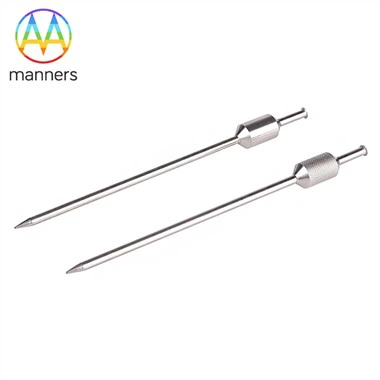
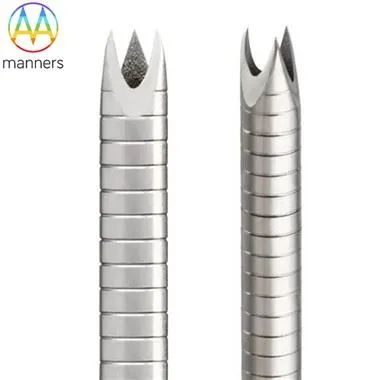
High-quality medical-grade breast biopsy needles realize full-dimensional, full-process safety protection through strict material selection, precision structural design and standardized sterile production, with systematic safety design principles covering material safety, structural safety and application safety. In terms of material safety, formal qualified products strictly adopt imported medical-grade 304 and 316 stainless steel, which have passed strict biocompatibility testing, with no cytotoxicity, no allergic reaction and no chemical residue, and can stably adapt to human breast soft tissue environment without causing inflammatory rejection. The material has high tensile strength and structural toughness, which can resist tissue extrusion pressure without deformation or fracture during puncture and sampling. In terms of structural safety, all needle bodies are integrally formed by precision die-casting and polished in multiple processes, with smooth and burr-free surfaces to avoid tissue scratching and friction damage. The core zero forward throw anti-displacement structural design fixes the relative position of the stylet and cannula, ensuring that the needle body remains completely stable during sampling, eliminating deep tissue damage caused by sliding displacement. The ultra-sharp beveled tip is designed with humanized chamfering to avoid excessive sharp edge piercing blood vessels. In terms of application safety, all products undergo high-temperature high-pressure sterilization and independent vacuum sterile packaging, with strict quality inspection procedures to ensure zero bacterial and microbial residue, meeting international medical device safety standards.
3. Classification and Safety Performance Comparison
According to safety performance indicators, certification standards and clinical applicable safety levels, breast biopsy needles in the market are divided into ordinary civil safety type and high-precision medical certified safety type, with huge differences in comprehensive safety performance. Ordinary safety biopsy needles adopt common industrial stainless steel materials with low production process standards, only meeting basic puncture and sampling functions. The needle body has poor smoothness, unstable hardness and no anti-displacement structure, with hidden dangers of tissue scratching, needle body deformation and sampling offset. The product lacks professional medical certification, with uneven sterile effect, and is only suitable for simple superficial lesion screening in primary institutions with low safety requirements. High-precision medical safety biopsy needles are industry high-standard products, using high-purity 316 medical special stainless steel, with ultra-smooth mirror polishing treatment on the needle body surface, zero burr and zero sharp edge. Equipped with mature zero forward throw anti-displacement structure and dual-point echogenic visual positioning function, it can avoid accidental tissue damage from both structural and operational dimensions. All products have passed ISO13485 medical device quality management system certification, ISO9001 international quality certification and SGS safety testing, with stable and reliable product performance, zero infection risk and extremely low trauma rate. In addition, customized safety needles can optimize needle body hardness, tip chamfer angle and surface anti-adhesive coating according to special patient groups and complex lesion environments, further improving targeted safety protection performance.
4. Standard Safety Operation Guidelines
To fully guarantee the clinical safety of breast needle biopsy, the industry has formed a complete set of standardized safety operation guidelines covering preoperative evaluation, intraoperative standard operation and postoperative safety observation, realizing full-process safety control. Preoperative safety evaluation and preparation: First, complete systematic preoperative examination of patients, detect coagulation function, blood routine and breast tissue basic conditions, screen contraindications such as coagulation disorders and local skin infection, and formulate personalized biopsy schemes for special patients. Strictly select qualified medical certified biopsy needle products, check the product packaging integrity, sterile validity period and appearance quality to avoid using unqualified expired products. Complete standardized skin disinfection, sterile towel laying and local anesthesia to eliminate intraoperative infection risks and pain stimulation. Intraoperative safety standard operation: Select the optimal needle gauge according to lesion depth, tissue density and patient physical condition, avoid blind use of oversized needles. Adopt slow, uniform and stable needle insertion mode, use ultrasonic visual real-time monitoring to accurately avoid subcutaneous blood vessels, nerve plexus and normal glandular tissue. Keep the needle body stable during sampling, avoid violent pushing, pulling and shaking, strictly control single sampling depth and range, and reduce unnecessary tissue damage. Postoperative safety observation and nursing: After sampling, withdraw the needle gently, perform standardized local compression hemostasis for 3-5 minutes to avoid hematoma formation. Apply sterile breathable dressing to the puncture site, observe the patient's vital signs, local bleeding and swelling in real time, and deal with abnormal reactions in time. Inform patients of postoperative safety precautions, restrict strenuous exercise and local extrusion within 24 hours, and guide regular reexamination to prevent delayed infection and complications.
5. Practical Safety Management Experience
Years of clinical safety management practice and multi-center big data verification show that standardized selection and use of ISO-certified high-precision medical safety biopsy needles, matched with standardized safety operation processes, can achieve ultra-high clinical safety levels. The intraoperative accidental injury rate and postoperative adverse reaction incidence are reduced to less than 0.5%, far lower than the industry average level of ordinary products. The ultra-smooth burr-free needle body completely eliminates tissue scratching and vascular rupture bleeding, and the zero forward throw anti-displacement structure fundamentally avoids deep normal tissue damage and latent injury. The professional sterile production and vacuum packaging technology ensure zero postoperative infection rate in routine biopsy operations, and the product structural stability completely avoids medical accidents such as needle body deformation and residue. For high-risk special patients such as diabetic patients, coagulation dysfunction patients and postoperative recurrent lesion patients, the use of customized safety biopsy needles and targeted safety operation schemes can effectively avoid all kinds of potential safety hazards, realizing zero adverse events in special crowd diagnosis. Unified product safety quality standards and full-process standardized operation specifications have built a perfect clinical safety risk prevention and control system, greatly improving the safety bottom line of breast biopsy diagnosis.
6. Conclusion and Value Sublimation
Safety is the core bottom line and basic premise of the clinical application of breast needle biopsy technology, and also the core benchmark for measuring product quality and clinical service level. High-quality medical-grade breast biopsy needles rely on high-standard material selection, humanized safety structural design and strict medical quality certification, building a full-dimensional safety protection system covering product production, clinical operation and postoperative recovery. It completely eliminates various potential safety hazards such as tissue injury, bleeding, infection and medical accidents in traditional biopsy operations, ensures the safety, stability and reliability of breast lesion diagnosis, and provides patients with safe and reassuring minimally invasive medical services. The popularization and application of safety biopsy products and standardized safety management processes have standardized the industry development order, eliminated low-quality backward products, and promoted the standardized, safe and high-quality development of the breast biopsy medical device industry and clinical diagnosis business.
7. Industry Safety Optimization Suggestions
In order to further improve the overall safety level of the breast needle biopsy industry, the industry needs to carry out comprehensive optimization and upgrading from standard construction, product iteration, talent training and supervision mechanism. First, strictly implement and further upgrade ISO13485 and ISO9001 medical quality certification standards, take SGS safety testing indicators as the unified industry benchmark, completely eliminate unqualified low-quality products with substandard materials and unsafe structures, and standardize market competition order. Second, establish a full-life cycle safety supervision system for biopsy needles, covering product research and development, production, packaging, transportation, storage and clinical use, to ensure safety and quality control in all links. Third, strengthen professional safety training and assessment for clinical operators, popularize standardized safety operation processes and risk prevention and control knowledge, and improve the safety operation level and emergency response capacity of medical staff. Fourth, accelerate the innovative research and development of multi-functional safety products, develop anti-adhesive, anti-bacterial, anti-breakage and anti-trauma integrated high-safety biopsy needles, and further improve product safety performance. Fifth, establish a clinical adverse reaction feedback mechanism, optimize product design and operation standards in a targeted manner according to clinical practical safety data, and continuously improve the industry safety system.