Needles For Intraosseous Vascular Access: Confirming Position Without Aspiration
Nov 22, 2026
A dry syringe is the most misunderstood finding in intraosseous practice. Operators are taught to aspirate for marrow, and when nothing returns they conclude that the needle is misplaced, pull it out and start again on the other leg. In reality a negative aspirate is common, expected and uninformative on its own. Confirming position requires a set of signs rather than a single test, and the reliability of Needles For Intraosseous Vascular Access depends on how that set is applied.
The Myth That Aspiration Proves Placement
The idea that marrow must appear in the syringe comes from early descriptions of the technique, when aspiration was the only confirmation available. It survives because it is memorable and because a positive aspirate is genuinely convincing. The problem is the negative case: a needle sitting perfectly in a vascular marrow cavity can produce nothing at all, particularly in small children, in hypovolaemic adults and in patients whose marrow has a high fat content.
Removing a correctly placed needle has consequences. The second attempt may fail, the patient loses minutes, and the operator becomes reluctant to trust the technique again. Worse, the removed needle leaves a cortical defect that can leak if a new needle is placed nearby. Teaching that a dry aspirate is a normal variant, and that the decision to reposition should rest on flow behaviour rather than on the syringe, prevents a large share of unnecessary reinsertions.
Why Marrow Does Not Always Return
Marrow is a semi-solid tissue threaded with sinusoids, not a pool of liquid. A needle bevel may sit against trabecular bone, may open into a sinusoid that collapses under negative pressure, or may be plugged with marrow fat and bone dust. Negative pressure also collapses the thin-walled venous channels that give the cavity its flow. In practical terms, aspiration is a test of whether a sinusoid happened to be adjacent to the tip, not a test of whether the tip is in the cavity.
Patient factors shift the odds further. Children often yield a small marrow return, whereas elderly patients with fatty marrow may yield none. A patient in profound shock has low intramedullary pressure, so even a well-placed needle resists aspiration. Operators who understand this stop treating the syringe as a verdict and start treating it as one data point among several, which is exactly how other blind procedures are taught.
What does that leave the operator with? A decision rule. If the needle stands firm, the flush runs with ordinary resistance and the skin over the site stays flat, treat the placement as sound and use it. Removing a working line because a syringe was dry converts a normal variant into a second puncture, and the second attempt is not always the better one.
Signs and Devices That Confirm Position
The first sign is mechanical: the needle stands unsupported in bone, resists gentle lateral pressure and does not wobble. The second is hydraulic: a slow flush of 0.9% saline meets steady resistance without subcutaneous swelling, and the plunger returns slowly when released rather than springing back. The third is functional: the patient's response to a small bolus, whether a change in heart rate or a reported taste of saline, indicates that the drug has reached the central circulation.
Imaging adds certainty when it is available. Ultrasound can show the needle tip within the cortex and detect a subperiosteal collection during a flush. Plain radiography confirms depth and excludes far-cortex penetration, and it is worth obtaining when the site is distal or the patient is very small. None of these methods is mandatory in a cardiac arrest, but each is useful in the awake patient where a failed infusion would mean another procedure.
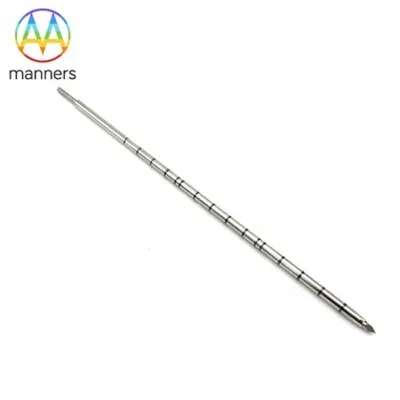
Hardware shapes what can be confirmed. A needle built as an injection and puncture instrument, with a stainless steel cannula supplied as 15G or custom size, holds its shape through repeated flushes and keeps its depth markings legible under a dressing. Where a service needs a hub to match an older driver, 2D/3D drawing or sample customization delivers one in standard carton packaging or in client-specific pouches, so that the confirmation sequence can be rehearsed with the device that will actually be used.
A Confirmation Checklist for the Bedside
After the stylet is removed and before the first drug, run the same four checks every time. The needle should stand firm with no lateral movement. A 10 ml syringe of 0.9% saline should flush with moderate, steady pressure and no swelling at the site. Aspiration after the flush should return a small amount of blood-tinged fluid, or nothing, without a change in the resistance profile. The hub should remain dry, with no leakage around the insertion point.
If any check fails, stop and reassess rather than pushing harder. Resistance that increases during the flush suggests the tip is in cortex; swelling suggests extravasation; leakage suggests the needle has backed out. In all three cases the answer is to secure or replace the needle before infusing anything that matters. Written on a card and attached to the driver case, this checklist takes twenty seconds and prevents the complication that ends intraosseous programmes.
Cases Where Confirmation Changed the Plan
A district ambulance crew treated a collapsed teenager with a presumed overdose and placed a proximal tibial needle that aspirated easily. The flush, however, produced immediate swelling over the anteromedial shin. The crew removed the needle, moved to the distal femur and achieved painless flow; the first site had been drilled obliquely through cortex rather than into marrow. Without the flush test the patient would have received naloxone into the subcutaneous tissue and the error would have been invisible.
The opposite case is equally instructive. An elderly patient in cardiogenic shock produced no aspirate at all, and the operator nearly removed a good needle. A slow flush met normal resistance, the hub stayed dry, and a small bolus produced a measurable change in blood pressure. The line was secured and used for the next forty minutes. Both cases turn on the same lesson: the decision belongs to the pattern of signs, not to the syringe alone.
Confirmation Is a Process, Not a Syringe
Confirmation begins with site selection, continues through the drilling and ends with the first observation after the first bolus. A programme that treats it as a single test will always produce operators who remove good needles and keep bad ones. A programme that treats it as a process produces operators who can explain why they believe the needle is in marrow, which is the standard any invasive procedure should meet.
Documentation is part of that process. Recording the site, the needle length, whether aspirate returned, the flush behaviour and the patient response takes less than a minute and creates the data that lets a service improve. When Needles For Intraosseous Vascular Access are specified with clear depth markings and consistent hub geometry, that documentation becomes simpler and the confirmation sequence becomes reproducible across shifts, teams and hospitals.
Toward Objective Placement Sensing
The obvious next step is a needle that reports its own position. Prototype devices measure pressure at the tip, detect the change in compliance when cortex is crossed, and can distinguish marrow from cortex from soft tissue by resistance signature. Some drivers already log insertion force, and the data are good enough to identify an overshoot after the event even if they cannot prevent it in real time.
Until those devices are routine, the practical answer is training that reflects reality. Mannequins should include models that produce no aspirate, because that is what a proportion of real patients do. Instructors should teach the flush test with the same emphasis as the drill, and assessment should require the candidate to justify placement using at least three signs. Skills built that way survive contact with a real patient, which is more than can be said for a technique learned from a single successful aspiration. Confirmation, in the end, is a habit of looking for more than one kind of evidence and of being willing to say why a placement is believed to be correct.