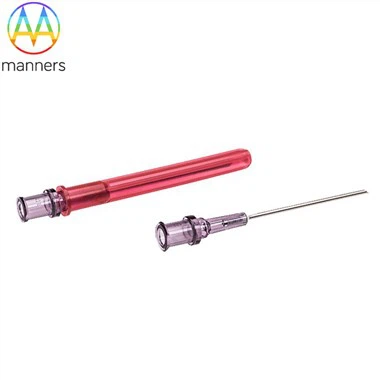
Material Science Of The Tuohy Epidural Needle—Why Choose 304 And 316 Stainless Steel?
Jul 20, 2026
https://en.wikipedia.org/wiki/Tuohy_needle
In the R&D and mass production of the Tuohy epidural needle, material selection is never a mere commercial compromise; it is a decision rooted in biosafety, mechanical strength, and clinical applicability. Medical-grade stainless steel, the world's most widely used implantable and contact material, dictates the needle's performance during epidural space penetration. Our facility offers two primary alloy options for custom Tuohy epidural needles: Stainless Steel 304 and Stainless Steel 316. Both are austenitic stainless steels known for being non-magnetic, highly ductile, and possessing excellent work-hardening characteristics.
Stainless Steel 304 contains approximately 18% chromium and 8% nickel (the 18-8 type), making it the most common medical-grade stainless steel. In Tuohy epidural needle manufacturing, 304 stainless steel exhibits good overall corrosion resistance and sufficient rigidity to withstand axial pressure when passing through skin, subcutaneous tissue, and interspinous ligaments without buckling. It offers high cost-efficiency and suits most standard epidural puncture scenarios. However, its pitting corrosion resistance is somewhat limited in chloride-rich environments (e.g., frequent exposure to sweat, concentrated saline irrigation, or specific disinfectants). This limitation necessitates the use of the higher-grade Stainless Steel 316.
Stainless Steel 316 incorporates 2%-3% molybdenum into the 304 matrix. This minor alloy modification significantly enhances the stability of the passive film, drastically improving resistance to crevice and intergranular corrosion in physiological environments. For Tuohy epidural needles demanding higher safety margins-particularly those intended for long-term use or repeated simulation training-316 is the superior choice. Our production lines accommodate customer-specific material requests and provide third-party material test reports verifying compliance with standards such as ASTM A269 or ISO 13485.
Beyond chemical composition, the physical dimensions of the material are critical. Tuohy epidural needles typically utilize capillary tubes with outer diameters ranging from 0.25mm to 30mm (clinically common sizes are 14G–20G, equating to ~1.6mm–0.9mm OD). Wall thickness must be precisely calculated to balance "sufficient internal diameter for catheter passage" against "adequate wall thickness to resist bending." Through cold drawing combined with online bright annealing, we relieve internal metal stresses, ensuring needle straightness (≤0.5mm/1000mm) and concentricity (≤0.02mm) meet medical-grade precision, preventing breakage or deflection caused by uneven stress distribution during insertion.
Biocompatibility represents another critical threshold in material selection. In accordance with the GB/T 16886 (ISO 10993) series standards, our raw materials and finished Tuohy epidural needles undergo biological evaluations including cytotoxicity, sensitization, and intracutaneous reactivity tests. 304 and 316 stainless steels exhibit excellent inertness within the human body, rarely triggering tissue proliferation or immune responses. Coupled with final passivation or electropolishing treatments that lower surface free energy, protein adhesion and platelet aggregation are minimized. It is these often-invisible material details that underpin the industry reputation of the Tuohy epidural needle as a device that is "sharp yet tissue-sparing, strong yet resilient."