Manufacturing Process Stability Of Disposable Nerve Block Needles
Aug 28, 2026
Pain Points Batch quality instability of nerve block needles is a hidden risk affecting clinical anesthesia safety and dilution effect adaptation. Many low-quality products have unstandardized processing techniques, with uneven needle lumen, residual micro-burrs and inconsistent rigidity. Unqualified swaging and grinding processes lead to unsmooth needle walls, which cause unstable injection speed during lidocaine injection, resulting in uneven diffusion of manually diluted anesthetics and inconsistent anesthesia effect. Incomplete laser cutting and electropolishing treatment leave surface impurities, which may trigger local tissue irritation after puncture. In addition, irregular sterilization processes lead to potential microbial contamination risks, and non-standard packaging affects the long-term storage stability of sterile needles, bringing persistent hidden dangers to clinical standardized nerve block operations.
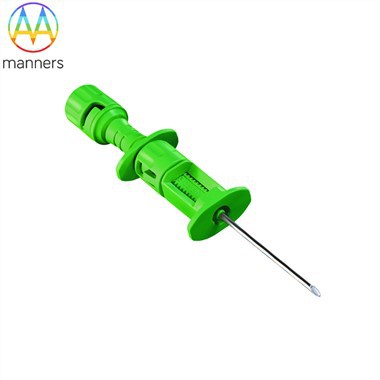
Core Principle The clinical applicability of nerve block needles is determined by full-process precision manufacturing and strict post-processing technology. High-quality medical stainless steel is used as the base material, and multiple core processes including necking, swaging, fine grinding, laser cutting, laser marking and electropolishing are adopted to realize precise control of needle shape, lumen size and surface smoothness. Necking and swaging ensure uniform needle diameter and stable structural rigidity to avoid bending during puncture; laser cutting realizes precise shaping of needle tip; fine grinding and electropolishing remove all surface burrs and impurities to form a smooth sterile inner and outer wall, ensuring stable and uniform flow of manually diluted lidocaine with different concentrations. Terminal sterilization treatment eliminates microbial residues, and standardized packaging ensures long-term sterile storage of finished needles.
Device Classification According to manufacturing precision and process standards, medical nerve block needles are divided into standard batch products and high-precision customized products. Standard products cover 8G–26G conventional gauges, adopting unified full-process standardized processing, suitable for routine clinical nerve block and matching conventional 0.8%–1.7% manually diluted lidocaine. High-precision customized products are produced according to customer 2D/3D drawings or samples, with optimized process parameters for special needle length, radian and lumen precision, suitable for special anatomical puncture scenarios and ultra-low/high concentration lidocaine matching. All products undergo independent sterilization treatment, and support standard carton packaging or personalized packaging customization to meet different institutional management needs.
Operational Guidelines Clinical operators need to establish batch quality verification and standardized use specifications. Before batch use of new needles, conduct random inspection on needle surface smoothness, lumen patency and structural rigidity to exclude unqualified products. Match process-stable standard needles with conventional diluted lidocaine concentrations for daily routine anesthesia. For special scenarios requiring extreme concentration preparation and difficult puncture, select high-precision customized needles to ensure coordinated stability of instrument performance and drug diffusion. Strictly implement sterile operation during dilution and injection, avoid needle contamination, and discard disposable needles uniformly after use to prevent secondary utilization and cross-infection.
Real-World Experience Clinical batch comparison data shows that fully processed high-precision nerve block needles have stable injection flow, which can perfectly adapt to various manually diluted lidocaine concentrations, with consistent anesthesia effect in the same scenario. In contrast, products with incomplete polishing and unstandardized swaging processes have fluctuating injection speed, leading to local drug accumulation or insufficient diffusion, and increasing postoperative pain and block failure rate. Medical institutions that insist on selecting high-process standard needles have significantly improved the repeatability and safety of nerve block operations. Customized processed needles solve the adaptation problems of special puncture positions and special concentration drugs, filling the technical gap of conventional products in difficult clinical scenarios.
Conclusion Full-process precision manufacturing technology is the core guarantee for the stable clinical performance of nerve block needles. Standardized processing links ensure the smoothness, rigidity and sterile safety of the needles, and provide stable instrumental conditions for the popularization of manual lidocaine proportional dilution technology. High-quality nerve block needles can maximize the accuracy of manual drug preparation, realize efficient and safe matching of instruments and drugs, and lay a solid foundation for the standardized development of regional anesthesia.
Outlook & Suggestions Manufacturers should further optimize intelligent process control, improve batch consistency of needle processing, and strengthen sterilization and packaging quality inspection. Medical procurement departments should take processing technology and batch stability as key evaluation indicators to eliminate low-process products. Clinical teams should establish product quality feedback mechanisms to timely optimize needle selection and drug dilution matching schemes, and continuously improve the refinement level of clinical anesthesia operations.