Intraosseous Infusion Needle Powered Insertion Mechanism Explained
Nov 22, 2026
Meta description: Explore the powered insertion mechanism of Intraosseous Infusion Needle that enables controlled, force-free entry into bone marrow for emergency infusion.
Why Power-Assisted Insertion Is Designed
Traditional intraosseous insertion methods often require strong manual pressure and rotation, which depend heavily on the provider's hand strength and experience. In emergency situations, tired providers, gloved wet hands and dense cortical bone can reduce success and safety. The Intraosseous Infusion Needle adopts a small power driver to create a controlled insertion experience. The design purpose is simple: give the clinician complete control while removing the need for raw force during emergency medullary access.
Working Mechanism Breakdown
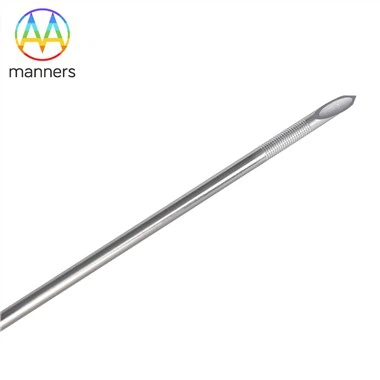
The specially designed cutting IO needle is matched to the compact power driver. When activated, the driver delivers steady driving motion to advance the cutting needle through subcutaneous soft tissue and cortical bone. The cutting profile of the needle carves a clean path through the bone instead of punching or shattering it. The operator can pause or stop the motion at any moment. A clear loss-of-resistance sensation confirms arrival inside the medullary cavity. At this point, the power driver can be removed, leaving the catheter as a stable conduit toward central circulation.
Material and Specification Support for Powered Operation
Medical stainless steel forms the needle body to withstand the driving force without bending or tip breakage. Classified as an injection and puncture instrument, the standard size is 15G. Custom sizes can be produced following customer 2D drawings, 3D models or samples. Customisation can adjust needle length, cutting tip shape and gauge to suit different bone thickness and patient populations. Standard carton packaging or custom sterile packaging options are available for global supply.
Insertion Sequence with Power Driver
First, confirm the patient's indication and select a valid insertion site. Prepare the skin and assemble the needle onto the power driver. Stabilise the limb and maintain perpendicular alignment. Activate the driver to advance the needle in a controlled manner. Stop immediately after feeling the characteristic give of marrow entry. Disconnect the power driver, verify placement, secure the catheter and connect the infusion set for medications, fluids or blood products.
Safety Advantages of Controlled Power Insertion
The biggest safety advantage is the elimination of uncontrolled impact or excessive manual force. This reduces risks of trans-cortical perforation, bone fracture and adjacent neurovascular injury. The operator retains continuous tactile feedback and can stop before over-insertion occurs. This is especially valuable for paediatric patients, older adults with osteoporosis and patients with thinner or more fragile cortical bone.
Limitations and Operator Responsibilities
The power driver is an assisting tool rather than an automatic safety guarantee. Operators still need correct anatomical knowledge, training and clinical judgement. Improper alignment, wrong needle length selection or ignoring contraindications can still cause adverse events. Providers should verify driver functionality before emergency deployment and follow the manufacturer's procedure instructions strictly.
Clinical Training Focus
Training should teach providers to distinguish normal cortical resistance from the sudden loss of resistance that signals correct placement. Simulation drills help learners practise starting and stopping the power driver appropriately. Training should also cover site selection, contraindications, extravasation recognition and timely transition to standard IV access.
Technology Development Direction
Future improvements for this powered Intraosseous Infusion Needle platform may focus on improved ergonomic driver handles, clearer visual or haptic feedback at penetration, and better compatibility with custom needle variants. As emergency medicine continues to standardise power-assisted IO techniques, this product category will remain a key innovation for safer, faster emergency vascular access.