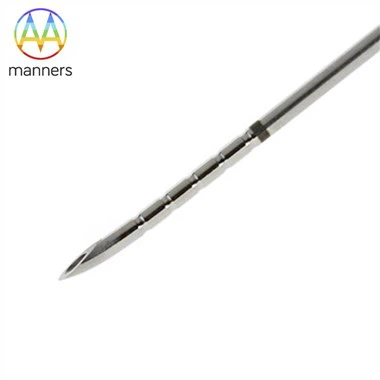
Instrument Design And Technological Innovation
Apr 09, 2026
Instrument Design and Technological Innovation: Laparoscopic Left Lateral Segmentectomy – The "Evolution" of Needle-Shaped Instruments: From "Single Function" to "Intelligent Integration"
The development of needle-shaped instruments is, in essence, a process of "functional integration" and "intelligent upgrade." From the early "pure mechanical puncture" to today's "ultrasound + radiofrequency + sensing" composite functionality, needle-shaped instruments are iterating towards being "finer, smarter, and more minimally invasive." This article will analyze the design breakthroughs of needle-shaped instruments and how these innovations empower the "ultimate minimally invasive" approach in left lateral segmentectomy.
1. Structural Design: The Leap from "Thick Needle" to "Micro-Needle"
Traditional puncture needles typically have a diameter of 18G (approximately 1.2mm), causing significant trauma to liver tissue. The new generation of micro-needles (e.g., 25G or finer) have diameters as small as 0.5mm. They can accurately reach the target under ultrasound guidance via "coaxial puncture technology," with almost negligible damage to the liver parenchyma. In left lateral segmentectomy, micro-needles can be used for "fine marking of intersegmental planes" or "precise ablation of microvessels," making them particularly suitable for pediatric patients or those with poor liver function reserve.
2. Functional Integration: The Breakthrough from "Single Function" to "Multimodal"
Single-function needle-shaped instruments can no longer meet the demands of complex surgeries, making multimodal integrated needles a trend:
Ultrasound + Radiofrequency Integrated Needles: The needle tip is equipped with an ultrasonic transducer, allowing for real-time imaging while simultaneously delivering radiofrequency energy, achieving "see and ablate accurately."
Sensing + Hemostatic Integrated Needles: The needle body contains a pressure sensor that can detect wall thickness, automatically adjusting ablation power to avoid venous rupture.
In animal experiments, a certain multimodal integrated needle improved the success rate of treating tumors adjacent to the hepatic vein from 78% to 96%, while reducing the venous injury rate to 0%.
3. Material Innovation: The Transformation from "Metal" to "Biodegradable/Biomimetic"
Traditional metal needles carry risks of "residue, corrosion, and foreign body reaction." The application of biodegradable materials (e.g., Polylactic Acid - PLA) or biomimetic materials (e.g., Diamond-Like Carbon - DLC coating) makes needle-shaped instruments more biocompatible:
Biodegradable Needles: Completely absorbed within 6-12 months postoperatively, leaving no residue.
Biomimetic Coated Needles: Reduce the friction between the needle body and tissue, decrease puncture resistance, and enhance procedural smoothness.
Clinical data show that in cases using biodegradable hemostatic needles, the postoperative foreign body reaction rate decreased from 3.1% to 0.2%.
4. Future Outlook: The Ultimate "Intelligent" Form of Needle-Shaped Instruments
With advancements in AI and robotic technology, intelligent needle-shaped instruments are expected to achieve "autonomous navigation, automatic adaptation, and real-time feedback":
Integrating preoperative CT/MRI images, AI algorithms plan puncture paths, enabling the needle to automatically avoid obstacles.
Robotic control of the needle body achieves 0.1mm precision, handling complex anatomy.
Real-time transmission of pressure, temperature, and imaging data allows surgeons remote control and adjustment.
If this vision is realized, left lateral segmentectomy will truly enter the era of "unmanned, zero-error" minimally invasive surgery.
Conclusion
In laparoscopic left lateral segmentectomy, needle-shaped instruments have evolved from "auxiliary tools" to "core technology carriers." Whether it's technological principle innovation (precision navigation, safe hemostasis), adaptation to complex scenarios (cirrhosis, adhesions, margin-pushing resection), or instrument design evolution (micro-needles, multimodal, intelligent integration), all demonstrate the power of the "needle" – safeguarding the safety and excellence of minimally invasive surgery with millimeter-level precision. In the future, as materials science, AI, and robotics technologies converge, needle-shaped instruments will continue to propel left lateral segmentectomy towards being "more precise, safer, and smarter."