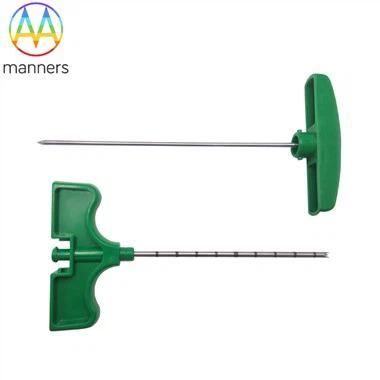
In-Depth Analysis Of Complications And Safety Strategies Of Veress Needle
Jun 01, 2026
Although the Veress needle (manufactured by Manners Technology) is designed to maximize safety, as a "blind insertion" technique, its use still involves inherent risks. Literature indicates that up to 50% of serious complications in laparoscopic surgeries occur during the stage of establishing the pneumoperitoneum and placing the first trocar. A thorough understanding of the mechanisms, manifestations, and prevention strategies of these potential complications is the safeguard for safely conducting laparoscopic surgeries.
Complications
Vascular injury is the most serious and potentially fatal complication. The Veress needle or the first trocar may damage major blood vessels such as the abdominal aorta, inferior vena cava, and iliac vessels, leading to life-threatening massive hemorrhage. The injury often occurs due to excessive needle insertion depth, improper angle, or patient anatomical variations. Prevention strategies are crucial: for non-obese patients, the needle should be at a 45-degree angle to the spinal longitudinal axis and point towards the pelvic direction to avoid the aortic bifurcation. Before puncture, the abdominal wall should be lifted to increase the safety distance. For obese patients, since the umbilicus is relatively lower, vertical (90-degree) puncture is safer. Always perform a suction test immediately after puncture. If bloody fluid is aspirated, be highly vigilant for vascular injury and do not inject air. The needle should be retained in its original position and be prepared for immediate conversion to laparotomy exploration.
Intraluminal organ injury mainly refers to perforation of the intestinal tube or bladder. The small intestine has the highest risk due to its large degree of freedom and proximity to the anterior abdominal wall. The injury may not have been detected at the time, leading to delayed postoperative peritonitis, with serious consequences. Prevention relies on the assessment of the patient's medical history. Patients with a history of abdominal surgery, peritonitis, pelvic inflammatory disease, or endometriosis have a high risk of abdominal adhesions and should be cautious or avoid using the Veress needle compression method. The Hasson open method should be preferred. Before puncture, ensure the bladder is emptied by catheterization. During puncture, operate gently and feel the "double deflation sensation." If the aspiration test extracts intestinal contents or urine, it indicates that the puncture has entered the intestinal tube or bladder. The corresponding principles should be followed for handling.
External pneumoperitoneum is a relatively common but usually non-serious complication. The needle tip does not penetrate the peritoneum but remains between the layers of the abdominal wall (mostly in the preperitoneal space), causing gas to be injected there. The abdomen becomes asymmetrically distended, with high injection pressure and rapid increase in intra-abdominal pressure. This leads to the failure of pneumoperitoneum establishment and may result in extensive subcutaneous emphysema. The key to prevention and identification lies in strictly following the confirmation steps. The hanging drop test and initial low-flow pressure monitoring (with pressure consistently below 10 mmHg) are effective methods for determining whether the needle tip is in the free abdominal cavity. Once external pneumoperitoneum is detected, the gas injection should be immediately stopped, the Veress needle removed, the subcutaneous gas expelled, and consideration given to changing the puncture site or switching to an open method.
Other complications include injury to the liver, spleen, and other solid organs, gastric perforation (no gastric tube was inserted before the puncture), and rare gas embolism caused by gas passing through abnormal pathways into the blood vessels. To prevent gas embolism, the initial gas injection flow rate should be set at a low speed (1 L/min), and the patient's vital signs should be closely monitored.
Systemic Safety Strategies
Systemic safety strategies go beyond individual tools. Firstly, the surgeon's experience and training are crucial. They must master the correct technique and feel under the guidance of simulators or mentors. Secondly, patient selection and assessment is the first step. For high-risk patients, alternative approaches should be chosen decisively. Thirdly, strictly follow the operation protocols, including the correct position, puncture point, angle, and multiple confirmation tests. Fourthly, have emergency plans in place. The surgical team must be familiar with the emergency handling procedures when vascular or intestinal injuries occur, including the immediate preparations for conversion to laparotomy.
As a manufacturer, Manners Technology has laid the material foundation for safe operations by providing highly skilled and reliable Veress needles. However, ultimate safety lies in the hands of the surgeons. By combining sophisticated instruments with rigorous procedures, rich experience, and constant vigilance, the risks associated with the Veress needle can be minimized, allowing the door of minimally invasive surgery to be safely opened.