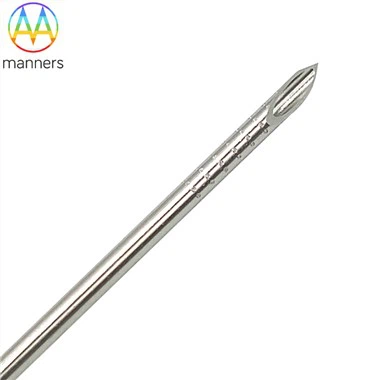
How Electrolytic Polishing And Passivation Give The Super Armor To The H2O2 Transfer Needle
May 28, 2026
For a metal needle that needs to repeatedly pierce rubber plugs and come into prolonged contact with strong oxidizing hydrogen peroxide (H2O2), its surface condition is far more than just "looking clean." The microscopic bumps, cracks, embedded impurities, or uneven oxide layers on the surface could all serve as the starting point of corrosion, a breeding ground for bacteria, or a source of fluid resistance. Manners Technology is well aware of this. In the manufacturing of H2O2 transfer needles, it has elevated the two surface treatment processes of electrolytic polishing and chemical passivation to the core position. Together, they provide the product with an invisible "super armor."
The Machined Surface: A Perilous "Raw Material"
Even after being processed by a high-precision Citizen R04VI lathe and through rotational forging, the metal surface remains "rough" at the microscopic level. Under a microscope, it can be observed that:
- Processing texture and burrs: Turning and forging will leave directional tool marks and microscopic flanging burrs.
- Embedding contaminants: During the processing, tiny abrasive particles or environmental contaminants may be embedded.
- Micro cracks and stress: Cold processing (such as forging) will introduce residual stress and micro cracks on the surface layer.
- Uneven oxide layer: The naturally formed chromium oxide film on exposure to air is thin and uneven.
If such a surface is used directly, when exposed to high concentrations of H2O2, corrosion will occur preferentially at the defect sites; a rough surface will increase fluid resistance, resulting in residual H2O2; micro cracks may expand under repeated stress, eventually leading to fatigue fracture of the needle body.
The First Layer of Protection: Electrolytic Polishing - The "Magic" of Microscopic Shaping
Electrolytic polishing is an electrochemical surface treatment process. Manners operates strictly in accordance with the ASTM B912 standard, immersing the workpiece as the anode into a specific electrolyte solution. By controlling the current, voltage, and time, precise material removal is achieved.
- Working principle: Under the influence of current, the atoms on the metal surface become ionized and dissolve into the electrolyte. Due to the higher current density at the microscopic protrusions, the dissolution rate is faster, thereby achieving selective leveling. The entire process is atomic-level "carving" rather than mechanical grinding.
The revolutionary improvements brought about:
- Ultra-smooth: It can significantly reduce the surface roughness from the Ra value after machining, reaching Ra < 0.4μm or even lower, achieving a mirror-like effect. This greatly reduces the adhesion and flow resistance of hydrogen peroxide solution on the inner wall of the syringe, ensuring complete dose transfer and no residue.
- Elimination of defects: It can effectively remove burrs, microscopic cracks, and embedded impurities, obtaining a pure and uniform metal surface. This eliminates potential stress concentration points and corrosion initiation points.
- Formation of a chromium-rich layer: During the dissolution process, iron elements are easier to be removed than chromium elements, causing the chromium content in the outermost layer of the metal to increase relatively. This lays a perfect foundation for the formation of a more corrosion-resistant passivation film in the next step.
Second Layer of Protection: Chemical Passivation - Creating a Dense "Barrier"
Passivation is a chemical process aimed at actively enhancing the natural oxide film on the surface of metals. Manners immersed the workpieces that had undergone electrolytic polishing into an acidic passivation solution (usually nitric acid or citric acid solution).
- Working principle: The acidic solution first dissolves the unstable outermost oxide layer and free iron particles on the surface. Subsequently, in an oxygen-rich environment, the chromium element in the metal reacts rapidly with oxygen to form a thicker, denser, and more stable chromium oxide (Cr2O3) protective film. This film is only a few nanometers thick but is extremely strong.
Core value:
- Outstanding corrosion resistance: This dense passivation film is chemically inert and can effectively prevent the contact of oxidants such as H2O2 with the internal metal substrate, significantly delaying the corrosion process. For H2O2 transfer needles that are exposed to long-term humid and chemical environments, this is the key to ensuring their service life.
- Improved biocompatibility: The extremely smooth and chemically stable surface is not prone to adsorbing proteins or other biological molecules, reducing the possibility of microbial growth and facilitating cleaning and sterilization.
- Appearance and cleanliness: The passivation treatment can achieve uniform and aesthetically pleasing surface color and further clean the surface.
The "Combined Punch" Effect: 1 + 1 > 2
Electrolytic polishing and chemical passivation are not simply the addition of separate processes; instead, they produce a synergistic effect:
- Polishing provides a perfect base for passivation: The clean and chromium-rich surface obtained through electrolytic polishing enables a more uniform and efficient subsequent passivation reaction, resulting in a higher-quality and more adhesive passivation film.
- Passivation consolidates and protects the polishing results: The passivation film firmly "locks" the perfect surface obtained through electrolytic polishing, preventing it from being re-contaminated or oxidized during subsequent storage and use.
Conclusion
On Manners' H2O2 transfer needle, the two processes of electrolytic polishing and passivation have achieved a leap from "manufacturing" to "finishing," and from "usable" to "excellent." They are not in cleaning products, but in fundamentally reconfiguring and optimizing the surface characteristics of the product. This "super armor" constructed by advanced electrochemical and chemical processes enables a stainless steel needle to calmly withstand the long-term erosion of strong oxidants, endure repeated mechanical punctures, and always maintain the smoothness and purity of the fluid. This is one of the deep technical reasons why Manners products can meet the strict international standards of ASTM and gain the trust of top medical equipment manufacturers such as STERIS and Getinge. The excellence of surface treatment is the most intuitive extension of the intrinsic quality.