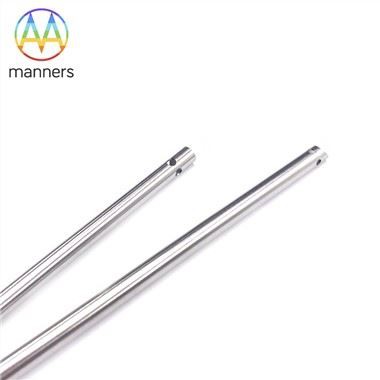
Honed Hub Cannula Technology — Solve Seed Blockage And Unsmooth Seed Transfer
Aug 07, 2026
1. Industry Pain Points Traditional brachytherapy needle hub cannulas have rough inner walls with residual machining burrs, uneven caliber and microscopic tool marks. During seed transfer from the applicator to the tumor site, excessive lumen friction easily causes seed stagnation, jamming, incomplete ejection and offset release. Disordered seed delivery leads to uneven particle spacing, local seed accumulation or missing implantation, resulting in unbalanced tumor radiation dose. Partial areas suffer insufficient radiation to kill cancer cells while normal tissues receive excessive radiation damage. Frequent seed blockage interrupts surgical procedures, increases operational difficulty, and severely affects the stability and repeatability of cancer brachytherapy.
2. Working Principle Mick-type cancer treatment brachytherapy needles adopt professional hub cannula honing process as the core smooth delivery solution. Precision honing technology performs uniform micro-finishing on the entire inner wall of the hub cannula, completely removing microscopic burrs, tool marks and caliber mutations generated by laser cutting and pipe shaping. The honed inner wall forms a smooth, consistent and low-resistance lumen channel, minimizing friction between radioactive seeds and the tube wall. It realizes seamless, continuous and stable seed transfer from the applicator through the hub cannula to the distal needle tip, ensuring one-time complete deployment without retention, jamming or deviation.
3. Product Classification According to honing precision and lumen smoothness, products are divided into standard honed cannula needles and super-honed high-precision cannula needles. Standard honed models complete basic inner wall finishing, eliminating obvious resistance and particle jamming risks, suitable for routine general tumor seed implantation. Super-honed high-precision models adopt multi-stage fine honing and mirror surface treatment, achieving ultra-low-resistance lumen, specially applied for dense seed arrangement, micro-seed implantation and high-standard conformal dose-controlled cancer radiotherapy.
4. Practical Operation Standards Select honing-grade needles according to surgical precision requirements. Routine clinical implantation adopts standard honed cannula needles; precise dense seed distribution surgery must use super-honed high-precision models. Before operation, inspect lumen smoothness to ensure no foreign body obstruction or residual burrs. Stably connect the seed applicator, maintain uniform and slow pushing speed during transfer, and rely on honed smooth channel advantages to ensure stable and accurate seed penetration and deployment.
5. Industry Application Experience Practical clinical verification confirms that hub cannula honing technology completely solves the industry's long-standing seed unsmooth delivery pain point. The honed lumen maintains stable smoothness after repeated high-temperature sterilization and long-term use without roughness attenuation. Barrier-free seed transfer ensures controllable particle spacing and uniform tumor dose distribution, significantly improving the qualified rate of conformal radiotherapy. It effectively reduces surgical interruption caused by seed jamming and improves overall operational efficiency and treatment consistency.
6. Summary Rough lumen structure and unstable seed delivery are key factors leading to poor brachytherapy curative effect. Mick-type brachytherapy needles optimize internal channel performance through professional honing finishing technology, realizing zero-resistance smooth seed transfer. Graded honing products meet differentiated clinical precision needs, providing reliable technical support for standardized and accurate cancer seed implantation and improving the overall level of tumor minimally invasive radiotherapy.
7. Future Prospect Future development will focus on full-length integrated nano-honing and anti-adhesion lumen modification. Manufacturers will realize consistent ultra-smooth lumen from hub to tip, matching intelligent automatic seed implantation equipment. Upgraded honed cannula systems will support programmable quantitative seed release, further promoting the intelligent and standardized development of brachytherapy delivery systems.