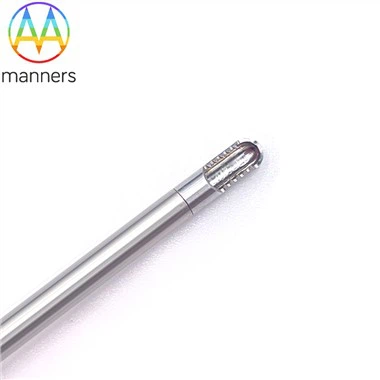
HDR Brachytherapy Needles Manufacturer For Lung Cancer Seed Implants
Nov 28, 2026
Lung seed implantation is one of the few brachytherapy procedures in which the chest wall, the pleura and a moving target all sit within a few centimetres of the needle tip. That geometry turns ordinary tooling questions into clinical ones: which gauge keeps a straight track through low-density parenchyma, how a ground tip behaves at the pleural line, and how a supplier converts a physician's drawing into a reproducible sterile pack. The notes below summarize how an HDR Brachytherapy Needles manufacturer approaches lung work, from gauge selection to final carton.
Why Lung Seed Implants Stall at the Needle Interface
Lung seed implantation looks straightforward on a planning screen: a target volume, a grid of planned positions, and a set of needles that carry seeds to those positions. On the table the picture changes. The target moves with every breath, the rib cage blocks the shortest path, and the pleura sits a few millimetres from the planned trajectory. Most of the practical difficulty lands on the needle itself, not on the plan.
A needle that tracks straight in a phantom can bow once it crosses the chest wall. When it bows, the operator compensates by re-angling the hub, which shifts the whole grid relative to the plan. A second needle inserted afterwards is then referenced to a trajectory that no longer matches the template. The result is a delivered distribution that is close enough to look acceptable in a dose review but looser than the plan predicted.
The pleural crossing compounds both problems: every pass is a small insult that may admit air, so crossings are kept few.
Anatomy, Needle Track and the Physics of a Small Dose Zone
The lung is a low-density medium. A needle pushed through it has little lateral support, so any asymmetry in the tip or any residual bend in the cannula is amplified over depth. A cannula that leaves the hub a fraction of a degree off-axis will drift, and the drift grows with insertion depth. Straightness tolerances therefore matter more in lung work than in a dense organ such as the prostate, where tissue grips the shaft and holds it in line.
The dose side is equally unforgiving. An iodine-125 seed delivers most of its useful dose within a very short radius; the effective treatment range is often described as a sphere roughly 1.6 cm in diameter. Outside that sphere the dose falls away quickly, which is good for sparing nearby structures and for keeping systemic exposure low, but it means a seed placed a few millimetres off target may leave part of the intended volume underdosed while the adjacent pleura or bronchus receives little benefit. Precise mechanical placement is the only way to make a small dose zone reliable.
Because the radiation is confined to the implanted volume, the procedure behaves as an in-body, targeted treatment and has little effect on distant tissue. That property is a large part of the appeal in lung work, where the patient's general condition often limits how much whole-body or large-field treatment can be tolerated.
Gauge Ranges, Tip Geometry and Surface Finish Compared
Gauge choice follows the compromise between stiffness and trauma. A larger cannula tracks straighter and delivers larger seeds or a stylet with less play, but it takes a wider bite of tissue and is harder to advance through the chest wall. The table below shows how a typical production range maps onto lung use. Nominal outside diameters are indicative and shift with wall thickness, so final dimensions always follow the approved drawing.
|
Gauge |
Nominal OD (mm) |
Typical role in lung work |
Recommended finishing route |
|
8G / 11G |
4.19 / 3.05 |
Large-bore delivery, dense or fibrotic trajectories |
Grinding plus electropolishing |
|
13G / 14G |
2.41 / 2.11 |
Main working sizes for seed delivery through the chest wall |
Necking, grinding, laser marking |
|
15G / 16G |
1.83 / 1.65 |
Fine targets near the pleura, reduced track trauma |
Swaging, fine grinding, electropolishing |
|
18G / 20G |
1.27 / 0.91 |
Deep or narrow windows, limited-seed implants |
Laser cutting, fine grinding |
Tip design is the second decision. A short bevel penetrates with less force but deflects more readily in soft tissue; a longer bevel gives a smoother entry and a straighter deep track. Blunt or rounded tips reduce the chance of vessel injury but demand more insertion force, which the operator feels directly. Surface finish closes the loop: an electropolished cannula slides with less friction and shows fewer sites where tissue can catch, while a merely ground surface is cheaper but noticeably draggier over long insertions.
A Step-by-Step Sourcing and Handling Guide
The first step is to fix the drawing. Custom work starts from a customer 2D or 3D drawing or from a physical sample; once the drawing is approved, gauge, length, bevel angle, hub geometry and marking position are locked. Changing any of these after tooling is set is the most common cause of delay in lung programmes.
The second step is material and process confirmation. Medical-grade stainless steel tubing is formed by necking and swaging to create the hub transition and the reduced tip, then ground to final geometry. Laser cutting produces windows or slot features where a design calls for them, laser marking puts scale marks or part numbers on the shaft, and electropolishing removes burrs and smooths the surface. Each process step should be traceable to a lot, because a seed that does not reach its planned position is very hard to investigate without process records.
The third step is inspection discipline. Straightness, cannula length, tip angle, bore continuity and marking legibility are the five characteristics that most often drive complaints in lung work; specifying them on the drawing and measuring them on a sample basis is cheaper than resolving them after a clinical complaint.
The fourth step is packaging. Standard export cartons are adequate for most programmes, but many hospitals ask for customer-specified inner trays, individual protection tubes or labelled pouches so that trays can be opened in a fixed sequence. Packaging is part of the specification, not an afterthought, and should be agreed at quotation stage.
What the Production Floor Teaches About Seed Delivery
Several lessons repeat across lung programmes. The first is that hub concentricity matters more than hub cosmetics. If the cannula is not concentric with the hub bore, the needle will sit at an angle in the template, and no amount of operator skill will recover the planned grid. Swaging followed by a concentricity check catches most of this before finishing.
The second is that laser marking depth influences drag. A deep mark creates a ridge that catches on the pleural surface during withdrawal, and operators report a distinct pull. Shallower marking with a wider character keeps legibility without the ridge. This is a small change with a large effect on the feel of a case.
The third is that electropolishing cannot fix a bad grind. Suppliers who polish over a poor grind produce a shiny needle that still tracks unpredictably, and the defect only appears at depth.
The fourth is documentation. A supplier who can show grinding parameters, marking settings and polishing time per lot resolves a question in a day; one who cannot leaves the clinical team guessing.
Summary of Specifications That Decide the Outcome
For lung seed work, the specification list is short and unforgiving. Gauge must match the target depth and the chest wall thickness; 13G to 16G covers most cases, with larger bores reserved for dense trajectories and finer sizes for targets close to the pleura. Straightness should be specified as a measurable value over the full cannula length, not as a general statement about quality. Tip bevel angle should be fixed on the drawing so that the penetration feel does not change between lots.
Surface finish should be called out as an electropolished condition with a defined inspection method. Marking should be specified for depth and legibility, since both affect drag and traceability. Hub geometry should be controlled for concentricity and for compatibility with the template or guide the team actually uses. Finally, packaging and labelling should be agreed in writing, including how sterile barrier and traceability information is presented on the carton.
None of these points is exotic. The difficulty is that each must be written down before the first lot is produced, and suppliers who quote on gauge and length alone leave the rest to chance.
Where Lung Brachytherapy Tooling Is Heading
Two directions are visible. The first is tighter integration between imaging and tooling: as cone-beam and intraoperative imaging improve, plans become finer, and a finer plan only pays off if the needle can hold a track that matches it. That pushes suppliers toward better straightness control and toward marking systems that let the operator read depth without a separate ruler.
The second is procedure efficiency. Lung cases are sensitive to time at the pleura, so anything that shortens a pass has clinical value: lower-friction surfaces, tip geometries tuned to the tissue being crossed, and hubs that index reliably into a template without re-seating.
Customisation is the third thread: a supplier who can move from a 2D sketch to a validated sample quickly shortens the path from idea to first case.
Conclusion
Lung seed implantation is a small-volume, high-precision procedure, and the needle is where that precision is either kept or lost. Gauge, straightness, bevel geometry, surface finish, hub concentricity, marking and packaging each contribute a measurable share of the outcome. A supplier who treats these as a written specification, and who can prove conformance lot by lot, gives the clinical team something more valuable than a low unit price: a predictable case.