Fine Deposition Technology Of Tapered Metal Dispensing Nozzles
Oct 04, 2026
1. Fine Deposition Precision Pain Points
Fine fluid deposition is the core process of precision electronics, micro-devices and medical product manufacturing, and traditional dispensing needles have prominent precision defects in this process. Straight-tube needles produce instantaneous fluid surge at the outlet, resulting in oversized deposition points, uneven glue thickness and edge burrs, unable to meet micron-level fine processing requirements. Ordinary single-layer needles lack precise flow control ability, and it is difficult to adjust the fluid output state in real time according to deposition accuracy demands, resulting in poor batch product consistency. In micro-gap and micro-area deposition scenarios, traditional needles have large outlet interference range, easy to cause glue overflow and component pollution. In addition, unstable fluid pressure output leads to residual liquid dripping after deposition, forming secondary defects on the product surface, requiring manual trimming and seriously restricting the yield and efficiency of fine processing production.
2. Fine Deposition Precision Principle
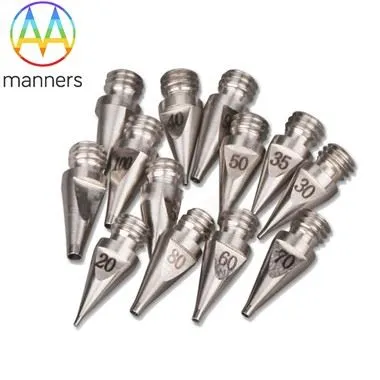
The ultra-high fine deposition performance of tapered nozzles metal dispensing needles is based on gradient pressure stabilization and multi-casing precise limit mechanism. The conical gradual shrinkage flow channel realizes step-by-step buffering and stabilization of fluid pressure, eliminating instantaneous flow surge of straight-tube structures, and realizing uniform and gentle fluid output. The two and three casing nested structures form multi-layer precision limit, which can accurately control the outlet fluid range and deposition thickness, effectively reducing the deposition error range. The ultra-smooth polished stainless steel inner wall ensures zero-resistance fluid flow, avoiding fluid stratification and uneven output, and making the deposited glue layer flat and uniform. The precision tapered tip has small outlet interference volume, which can adapt to micro-area and narrow-gap fine deposition, avoiding glue overflow and component pollution. The stable metal structural rigidity ensures no tiny deformation during high-precision operation, maintaining long-term consistent deposition accuracy.
3. Fine Deposition Product Classification
According to fine deposition accuracy and application scenarios, tapered nozzles are divided into three precision grades. First, conventional fine deposition type (double-casing structure, 0.4–0.8mm inner diameter), suitable for conventional precision coating and component bonding, with deposition thickness error controlled within ±0.03mm. Second, high-precision fine deposition type (three-casing standard taper, 0.2–0.4mm inner diameter), applied for electronic micro-component packaging and surface fine coating, error within ±0.02mm. Third, ultra-fine micro-deposition type (customized micro-taper, 0.1–0.2mm inner diameter), dedicated for medical micro-reagent deposition and chip ultra-precision dispensing, with ultra-low error within ±0.01mm. All precision products pass ISO13485 certification, supporting standardized batch fine processing production.
4. Precision Deposition Operation Guidelines
To ensure ultra-high precision of fine deposition, standardized precision operation specifications must be implemented. Firstly, precision model selection: select corresponding casing structure and caliber tapered nozzles according to product deposition thickness and area requirements, prioritize three-casing combined structure for ultra-fine processing. Secondly, equipment precision debugging: match low-stable dispensing pressure and uniform moving speed according to nozzle taper gradient, avoid high-pressure surge affecting deposition flatness. Thirdly, pre-production trial deposition: conduct trial dispensing on blank materials before formal production, calibrate deposition thickness and range, and fine-tune parameters to eliminate precision deviation. Fourthly, real-time precision control: keep the nozzle vertical and stable during operation, avoid angle deviation leading to uneven deposition, and regularly sample and detect product quality. Fifthly, post-precision maintenance: protect the tapered precision tip after use, avoid collision and deformation, and clean the flow channel thoroughly to ensure no residual fluid affects next precision use.
5. Practical Fine Deposition Experience
In industrial fine deposition production, tapered metal nozzles have completely improved the precision defects of traditional dispensing. In mobile phone micro-component coating production, the three-casing tapered nozzle realizes uniform ultra-thin glue layer deposition, eliminating edge burrs and glue overflow defects, and the product yield is increased from 91% to 99.6%. In medical biological reagent fine deposition experiments, the ultra-fine customized tapered structure accurately controls trace fluid output, realizing zero-difference batch deposition and meeting medical high-standard precision requirements. The gradient pressure stabilization structure solves the post-deposition dripping problem of traditional needles, eliminating manual trimming processes and improving fine processing efficiency by 28%. Long-term batch production verification shows that the deposition consistency of tapered nozzle products is far higher than ordinary straight-tube needles, which fully meets the refined production demands of high-end manufacturing.
6. Precision Technology Summary
Tapered nozzles metal dispensing needles rely on gradient taper flow guiding and multi-casing precision limit technology to solve multiple precision pain points in fine fluid deposition process. The graded precision product design covers conventional, high-precision and ultra-fine deposition scenarios, with stable and reliable precision performance. Standardized precision selection and operation can maximize the fine deposition advantages of tapered structures, effectively improve product surface flatness and dimensional accuracy, and provide core technical support for high-end precision manufacturing refined processing.
7. Precision Upgrading Prospects
With the continuous miniaturization and refinement of high-end manufacturing products, fine fluid deposition will develop towards sub-micron ultra-precision processing. It is suggested that manufacturers optimize ultra-fine taper precision processing technology, develop multi-casing micro-adjustable tapered nozzles, and improve deposition accuracy and flexibility. Production enterprises should fully apply graded precision tapered nozzles in fine processing procedures, establish precision parameter matching standards, and continuously improve the refined level of industrial dispensing production.