Anti-Clogging Performance & Maintenance Technology Of Tapered Nozzles
Oct 04, 2026
1. Industrial Dispensing Clogging Pain Points
Fluid clogging is the most common fault in industrial continuous dispensing production, seriously restricting production efficiency. Traditional straight-tube needles have uniform-diameter narrow flow channels, and high-viscosity fluids and particle-containing slurries are easy to accumulate and deposit in the flow channel, causing gradual narrowing and complete blockage of the pipeline. Ordinary needle outlets are prone to residual fluid solidification after shutdown, forming hard blockages that are difficult to clean, resulting in frequent needle replacement and production shutdown. For multi-fluid alternating production, residual fluid mixing and reaction in straight flow channels are easy to produce precipitate blockages, further increasing fault frequency. In high-speed continuous production scenarios, frequent clogging faults lead to unstable production rhythm, a large number of defective products and serious raw material waste, bringing huge economic losses to enterprises.
2. Tapered Nozzle Anti-Clogging Working Principle
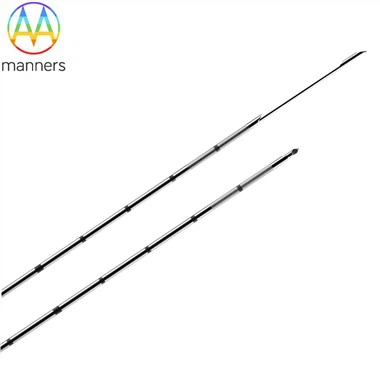
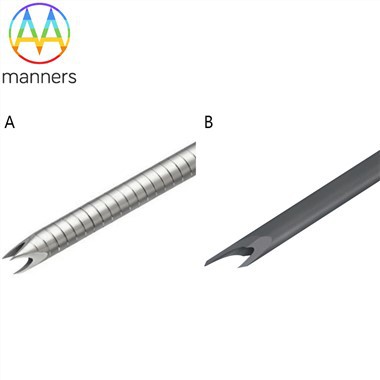
The excellent anti-clogging performance of tapered nozzles metal dispensing needles comes from gradient flow channel structure and multi-casing detachable design. The conical gradual shrinkage flow channel has no narrow dead-angle area of straight tubes, and the gradient flow guiding structure makes the fluid form a continuous and smooth flowing state, avoiding particle deposition and fluid residual accumulation. The flow channel pressure gradually decreases from inlet to outlet, which can effectively flush tiny residual impurities with fluid pressure, realizing self-cleaning of the flow channel during dispensing operation. The two and three casing combined structures are detachable layer by layer, which can completely disassemble the nested flow channel for thorough cleaning, solving the problem that dead corners of integrated straight tubes are difficult to clean. The high-precision polished stainless steel inner wall has ultra-low fluid adhesion, which is not easy to hang glue and deposit particles, fundamentally reducing the probability of residual solidification and blockage.
3. Anti-Clogging Product Classification & Application Scenarios
According to anti-clogging performance and fluid adaptation characteristics, tapered nozzles are divided into three graded anti-clogging types. First, universal anti-clogging type (double-casing structure), suitable for conventional adhesive and low-particle fluid dispensing, with basic self-cleaning anti-clogging performance, meeting daily continuous production demands. Second, enhanced anti-clogging type (three-casing detachable structure), with multi-layer split flow channel design, easy to disassemble and clean, suitable for medium-viscosity fluids and low-particle slurries, reducing blockage frequency by more than 60%. Third, heavy-duty anti-clogging customized type (large-gradient tapered structure), with enlarged smooth flow channel and enhanced polishing process, specially used for high-viscosity high-particle fluids such as solder paste and conductive paste, realizing long-term uninterrupted anti-clogging operation.
4. Anti-Clogging Operation & Maintenance Guidelines
Scientific operation and layered maintenance are the key to maintain the long-term anti-clogging performance of tapered nozzles. Firstly, targeted model selection: select enhanced or heavy-duty anti-clogging tapered nozzles for particle-containing and high-viscosity fluids to avoid blockage caused by mismatched structures. Secondly, real-time self-cleaning operation: keep low-pressure idling flushing for 2–3 seconds after each batch of dispensing, use fluid pressure to flush residual impurities in the gradient flow channel. Thirdly, layered disassembly and cleaning: disassemble the multi-casing structure layer by layer after daily production, wipe the inner wall of each casing with professional cleaning solvent, and eliminate hidden residual dead corners. Fourthly, regular deep maintenance: conduct full disassembly and deep cleaning of the nozzle structure every week, check the flow channel smoothness, and replace aging and deformed casings in time. Fifthly, classified storage: store cleaned nozzles in a dust-free and dry environment, avoid dust falling into the flow channel causing secondary blockage.
5. On-Site Anti-Clogging Practical Experience
In long-term continuous industrial production, tapered anti-clogging nozzles have achieved remarkable optimization effects. In solder paste continuous dispensing production lines, the gradient self-cleaning structure and detachable multi-casing design reduce blockage faults from 8–10 times per day to less than 1 time per week, and the equipment continuous operation rate is increased by 50%. Compared with traditional straight-tube needles, the service life of tapered nozzles is increased by more than 2 times, and the annual accessory replacement cost of enterprises is reduced by 40%. In multi-fluid alternating production scenarios, the layered disassembly and thorough cleaning function completely solves the problem of mixed fluid precipitation blockage, realizing stable switching of different fluid production. The ultra-smooth polished inner wall maintains long-term anti-adhesion performance, ensuring no residual solidification blockage in high-frequency intermittent dispensing.
6. Anti-Clogging Performance Summary
Tapered nozzles metal dispensing needles solve the stubborn blockage problem of traditional straight-tube dispensing accessories through gradient dead-angle-free flow channel design and detachable multi-casing structure. The unique self-cleaning flow guiding mechanism and convenient layered maintenance mode greatly reduce production fault frequency and maintenance cost. Graded anti-clogging product design realizes targeted adaptation of different complex fluids, with strong practicality and stability, providing reliable guarantee for long-term high-efficiency continuous industrial dispensing production.
7. Anti-Clogging Technology Development Prospects
In the future, industrial continuous production will put forward higher requirements for the anti-clogging durability of dispensing accessories. It is suggested that manufacturers optimize the nano-polishing process of tapered flow channels, further reduce fluid adhesion, and develop fully detachable ultra-clean multi-casing structures. Production enterprises should establish standardized layered maintenance systems for tapered nozzles, standardize daily cleaning and maintenance processes, and maximize the service life and anti-clogging stability of products. Intelligent self-cleaning tapered nozzles will become the mainstream development direction of the industry.