Evolution And Future Trends Of Veress Needles: From Spring-Loaded Classics To Smart Insufflation
Jul 11, 2026
https://en.wikipedia.org/wiki/Veress_needle
Since Dr. János Veress invented the needle in 1938, its core principle has remained unchanged, yet continuous refinements in materials, design, and functionality have evolved. Advancing minimally invasive surgery demands ever-greater safety, ease-of-use, and intelligence in pneumoperitoneum establishment, driving ongoing innovation. This article traces this evolution and forecasts future trajectories.
Historical Enhancements (Safety Focus):
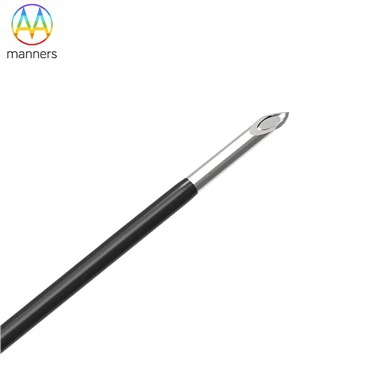
Early iterations were simpler, with less robust safety mechanisms. Subsequent improvements included: optimizing spring tension for reliable obturator deployment; refining tip geometry (sharper bevels/conical profiles) to reduce insertion force; adding side-ports to improve gas diffusion and minimize localized pressure; and introducing transparent hubs to facilitate aspiration tests (detecting blood/bowel content). These collectively lowered complication rates.
Material & Process Advancements:
Transitioning from carbon steel to medical 304/316L stainless steel improved biocompatibility and corrosion resistance. Manufacturing progressed from manual grinding to CNC precision machining and laser cutting, ensuring geometric accuracy and batch consistency. Surface technologies like electropolishing and passivation further enhanced luminal smoothness and corrosion protection.
Recent Innovations (Function Integration & Visualization):
High-end devices now integrate advanced features:
- Pressure Sensing: Miniature sensors within the hub monitor intraluminal pressure changes in real-time, aiding accurate determination of peritoneal entry (typically lower pressure than tissue).
- Visualization: Prototypes integrating micro-cameras or fiber optics aim for direct visualization of the puncture path. While challenged by current diameter constraints, image quality limitations, and cost, this remains a key developmental direction.
- Enhanced Blunt Tips: Exploring multi-flanged or flexible blunt tips for superior organ protection.
- Anti-Clogging Designs: Optimizing side-port geometry and surface treatments to resist tissue or clot occlusion.
Future Trends:
- Smart & Digital: Deep integration with intelligent insufflators for automated monitoring and feedback-e.g., auto-detecting position, auto-adjusting flow/pressure.
- Personalized & Precise: Developing specialized needles for specific patient populations (obese, pediatric) based on anatomical data.
- Advanced Materials: Exploring lighter, stronger, more corrosion-resistant alloys (e.g., nitinol for shape-memory tips) or ceramics.
- Sustainability: As single-use mandates strengthen, eco-friendly materials and packaging will gain prominence.
- Robotic Surgery Compatibility: Designing needles with haptic feedback or specialized ergonomics tailored for robotic-assisted laparoscopic systems.
- Despite its maturity, Veress needle innovation persists. Future iterations promise heightened safety, intelligence, and usability, bolstering minimally invasive surgery. For manufacturers, sustained R&D investment aligned with clinical needs is key to competitiveness.