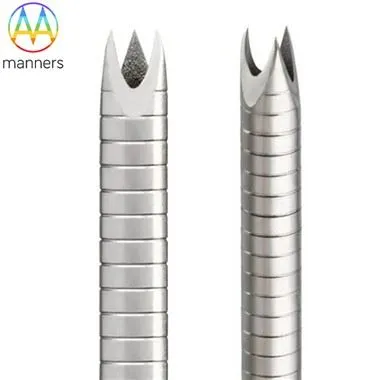
EMS Thread Is The Real Lock
Oct 16, 2026
The Pain: "It Screws In, So It Must Work"
The single most common mistake in dental procurement is assuming that if an ultrasonic scaler tip screws into an EMS Piezon handpiece, it is an EMS tip. It is not. A tip that physically threads on can still be acoustically wrong, mass-imbalanced, thread-tolerance-poor, and resonance-incompatible. Clinics discover this only after handpieces overheat, patients complain of "buzzing pain," tips loosen mid-procedure, and the piezoelectric stack suffers micro-fatigue that no warranty covers.
EMS uses a proprietary EMS-thread / BEM-type connection. Woodpecker UDS-series also uses EMS-thread; DTE/NSK/Satelec use a different thread. A "compatible" label on Alibaba or Made-in-China does not mean the tip was tuned in a laser-Doppler vibrometry lab the way original EMS instruments are. The pain is invisible at purchase and expensive at repair.
In multi-chair groups, this problem multiplies. One hygienist borrows a "generic EMS tip" from another room. The handpiece vibrates differently. She presses harder. The patient bleeds. The dentist blames the operator. The operator blames the machine. The supplier blames "incorrect technique." Nobody blames the tip's resonance curve-because nobody measured it.
The Principle: Piezo Is a Tuned Instrument, Not a Screw-On Bit
EMS Piezon systems use piezoelectric ceramics to create linear oscillation at about 32,000 movements per second. The handpiece, electronic module, and tip must vibrate as one system. The tip is not a chisel; it is the terminal resonator of a precision instrument.
Linear motion matters. Magnetostrictive scalers move elliptically; sonic scalers move awkwardly; EMS piezo moves like a windscreen wiper aligned to the tooth. When the tip is original and correctly seated, the lateral displacement stays low, enamel and cementum are respected, biofilm and calculus fracture cleanly, and acoustic streaming carries debris away with water irrigation.
When the tip is a cheap copy, the resonance breaks. The handpiece compensates, heat rises, the sonotrode wears, and the clinician feels "less power" even at high settings. The natural reaction-press harder-destroys the very advantage piezo scaling promised: minimally invasive, nearly painless debridement.
Equipment Classification
For EMS and EMS-thread ecosystems:
- G-series (G1–G6): supragingival prophylaxis, stain, buccal shelf calculus, heavy facial deposits.
- P-series (P1, P3, P4, P2L, P2R): periodontal slim tips for pockets, furcations, interproximal root surfaces.
- PS Instrument: slim probe-shaped tip for supragingival + subgingival up to 10 mm; EMS markets it for ~95% of cases.
- PSL / PSR: curved/interproximal heavy-calculus tips, adult initial therapy, up to 8 mm.
- P Instrument: stubborn hard calculus, supragingival/subgingival up to 4 mm.
- PI / PI Max: PEEK + carbon-fiber implant/restoration tip; safe around implants, veneers, crowns, brackets.
- E-series (E1–E15): endodontic irrigation, file activation, broken-file removal, retreatment.
- A / H / SB / cavity tips: special restorative, caries, bone, or surgical piezo tasks.
Practical Guide
Identify the handpiece exactly: EMS Piezon Master, Mini Piezon, Woodpecker UDS-E, generic EMS-thread piezo.
Request thread type, shank length, tip mass, material certificate, and resonance validation-not just "fits EMS."
Trial 5–10 tips before bulk purchase. Run 2 minutes at mid-power on a typodont; check heat, spray, rattle, tip lock.
Use the manufacturer torque wrench. Pliers strip threads. Over-tightening cracks the sonotrode.
Keep one original EMS tip as a reference gauge. Compare vibration feel side-by-side.
Ban mixed drawers. Color-code EMS-thread, Satelec-thread, DTE-thread cassettes.
Document handpiece model + tip batch in the sterilization log.
Real-World Experience
A 7-chair DSO in Southeast Asia switched from random marketplace tips to a verified EMS-thread OEM with ISO13485/ISO9001 documentation and laser-vibrometry reports. Over 6 months:
handpiece repair calls dropped from 9 to 2,
average prophy time fell by 6 minutes,
hypersensitivity complaints fell noticeably,
hygienists stopped "borrowing tips" because every room had the same validated set.
Another clinic bought USD 1.50 generic G-tips. Three months later the Piezon handpiece made a high-pitch whine and the sonotrode cracked. Repair bill: more than 400 original tips.
Summary
EMS Dental Scaler Tips are not commodities. The thread is the door; resonance is the engine. A tip that fits but does not tune will quietly bankrupt your handpiece program.
Outlook & Suggestions
Expect QR-coded tips, batch-level vibration reports, and RFID handpiece locking. Buyers should demand:
ISO13485 + ISO9001,
material cert (SS304/SS420/medical steel/PEEK),
autoclave validation at 134–135°C,
resonance tolerance data,
clear "genuine EMS" vs "EMS-thread compatible" language.
Standardize one EMS-thread ecosystem per handpiece family. Compatibility is a clinical claim, not a thread claim.