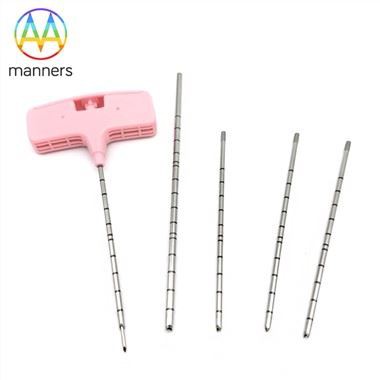
Echogenic Needles In Ultrasound-Guided Nerve Block And Vascular Access
Jul 05, 2026
Using the "Visible Tip" to Reduce Complications and Improve First-Pass Success
https://www.nature.com/articles/s41598-024-72620-8
In the two high-frequency scenarios of Regional Anesthesia (RA) and Vascular Access Establishment, echogenic needles have become pivotal tools for improving outcomes. Traditional regional nerve blocks (brachial plexus, femoral nerve, fascia iliaca, paravertebral, erector spinae plane, etc.) relied on surface anatomical landmarks or nerve stimulators, carrying risks of accidental vessel puncture, neural sheath penetration, or pneumothorax. With ultrasound guidance, clearly seeing the needle tip relative to the nerve bundle allows precise perineural injection while avoiding accompanying arteries. However, ordinary needles are extremely hard to track in out-of-plane insertion-often leading to "thinking it's there when it's still 1 cm short" or "overshooting into the pleura." Echogenic needles with specially reinforced tip etching/coating display a distinct hyperechoic dot in out-of-plane view; physicians can advance incrementally-pausing every 2–3 mm to correlate the tip dot with the hypoechoic nerve structure and correct trajectory in real time.
For Central Venous Catheterization (CVC) / Arterial Puncture / Ultrasound-Guided Peripheral IV: in obese, dehydrated, shocked, or post-chemotherapy patients with collapsed or deep veins, ordinary needles are frequently lost during angled insertion, prompting multiple blind attempts. Using an echogenic introducer needle (typically 18G–20G, 5–7 cm with depth markings and proximal echo enhancement) allows full in-plane tracking of the tip approaching the posterior venous wall, confirming "entry seen" before flashback-significantly reducing accidental carotid puncture or posterior-wall hematoma. Difficult IV access (DIVA) in pediatrics and ICU also benefits from high-frequency linear probes + fine echogenic localization needles (22G with local coating).
Evidence-Based Highlights:
Multiple controlled studies report echogenic needles reduce mean number of passes from 2.3 to 1.2, and raise first-attempt success from ~72% to >90%.
Reduced accidental arterial puncture rates-particularly in subclavian/internal jugular CVC, decreasing need for compressive hemostasis.
Shortened learning curve for novices-studies show medical students achieve target nerve block proficiency faster with echogenic vs. plain needles in simulators, boosting training confidence.
Selection Advice: Nerve blocks-prefer 50–100 mm length, 22G–21G with full-shaft micro-etching + tip reinforcement; short bevel recommended for better ultrasound identification. Vascular access-prefer 18G–20G with strong proximal (terminal 20 mm) echo coating or etched markers; length 4–7 cm per patient BMI. Note: insulated block needles (for nerve stimulators) must maintain electrical continuity-select micro-etched types compatible with electrophysiology rather than thick insulating coatings.
Limitation Reminder: Echogenic needles cannot replace proper scanning and anatomical knowledge-incorrect probe alignment will still cause tip loss; overly strong coatings may produce comet-tail artifacts behind bone or deep structures requiring discernment. Overall, investing in echogenic needles for nerve block and vascular access yields quantifiable safety improvements and efficiency gains-a recommended component of standard ultrasound-guided procedural kits.