Duel At The Needle Tip: Positioning And Competitive Strategy Of The Menghini Needle In The New-Generation EUS-FNB Needle Lineu
Apr 30, 2026
Duel at the Needle Tip: Positioning and Competitive Strategy of the Menghini Needle in the New-Generation EUS-FNB Needle Lineup
The field of Endoscopic Ultrasound-Guided Fine-Needle Biopsy (EUS-FNB) is experiencing an unprecedented "arms race". A new generation of biopsy needles, represented by the Franseen, Fork, anterograde-bevel, and Menghini needles, are vying for the title of "King of Pancreatic Tissue Acquisition" with their unique tip designs. This duel is not only an engineering contest but also a direct clash of clinical mindsets. Amidst this field of formidable competitors, what are the market positioning, core advantages, and challenges of the Menghini needle-rooted in the classic liver biopsy needle design philosophy? How can it carve out an irreplaceable ecological niche when pitted against other "star needle types"?
I. Competitor Profile: Design Philosophy and Clinical Portrait of Four New-Generation Needles
Before delving into the Menghini needle, it is essential to clarify the "tactical approaches" of its rivals:
1. Franseen Needle: The Precision "Tissue Harvester"
Design: A triangular crown-shaped tip with three symmetric sharp cutting edges.
Philosophy: Multi-plane rotational cutting. Through a "penetrate-rotate" motion, the three cutting edges perform controlled "mincing" from multiple angles, aiming to maximize tissue yield and core strip production rate.
Clinical Portrait: High-quality studies (e.g., Krishnan et al., GIE 2019) confirm its exceptional diagnostic sensitivity, specificity, and histological specimen adequacy in solid pancreatic lesions, often regarded as one of the current "gold standards" or benchmarks for FNB needles. It excels in efficiency and stability, especially in cases requiring large tissue volumes for genetic testing.
2. Fork Needle: The Agile "Tissue Grasper"
Design: A bifurcated, bird-beak-like tip with two asymmetric sharp prongs.
Philosophy: Penetration anchoring and hooking. The bifurcated tip "catches" and secures tissue during puncture, then shears it off during withdrawal. The design aims to reduce tissue slippage and improve single-pass success rates.
Clinical Portrait: Multiple randomized controlled trials demonstrate diagnostic efficacy comparable to the Franseen needle, with strong performance in core tissue strip retrieval and reducing the number of punctures. Its design may offer unique advantages in certain firm-textured tumors.
3. Anterograde-Bevel Needle: The Modified "Lateral Cutter"
Design: Retains the traditional side-port opening but with an anterograde bevel direction (distinct from the Menghini's classic inner bevel).
Philosophy: An incremental improvement on the traditional side-port needle, aiming to enhance cutting efficiency. It represents a progressive refinement of the conventional reverse-bevel needle.
Clinical Portrait: Studies show superior efficacy to standard FNA needles, but direct and indirect comparisons with Franseen and Fork needles indicate it may be slightly inferior. Its advantage lies in an operational workflow consistent with older needle types, resulting in a low learning curve.
4. Menghini Needle: The Classic "Negative-Pressure Corer"
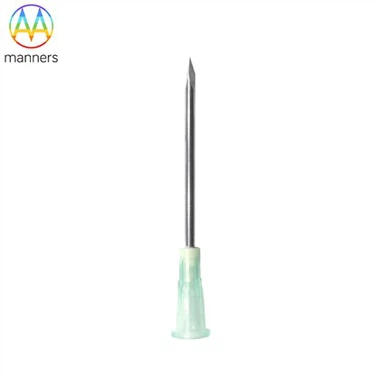
Design: The signature inner-bevel tip, paired with a side port for syringe connection to generate negative pressure.
Philosophy: Low-resistance puncture and negative-pressure coring. The sharp recessed tip enables easy penetration, while simultaneous negative pressure "sucks" tissue into the needle groove for intact shearing. The core goal is to harvest cylindrical tissue cores with preserved architecture and minimal crush artifact.
II. Head-to-Head Competition: Analyzing the Menghini Needle's "Combat Effectiveness"
Based on current evidence-based medicine, a competitive landscape for the Menghini needle can be mapped:
vs. Standard FNA Needles: Comprehensive superiority. It demonstrates significant advantages in diagnostic accuracy, specimen adequacy, and histological yield-securing its legitimate status as a "new-generation FNB needle".
vs. Anterograde-Bevel Needles: Competitive edge. Network meta-analysis rankings show the Menghini needle outperforms anterograde-bevel needles in composite scores, validating the value of its innovative design over incremental modifications.
vs. Franseen/Fork Needles: Differentiated strengths, currently a follower. This is the core competitive arena. Multiple head-to-head trials and meta-analyses note that Franseen and Fork needles often show statistically significant advantages or trends in key metrics like core tissue retrieval rate and diagnostic sensitivity. The Menghini needle has yet to surpass top-tier competitors in the most intuitive metric of "tissue yield".
However, competition extends far beyond this single dimension. The Menghini needle's core competitive strategy lies in leveraging differentiated advantages:
1. Advantage 1: Exceptional "Tissue Quality" and Pathologist-Friendliness
This is the Menghini needle's greatest potential trump card. Compared to "multi-plane rotational cutting" or "hooking", its "inner-bevel coring" theoretically exerts less mechanical compression and shearing on tissue cellular structures. This provides pathologists with specimens featuring natural cell morphology and clear tissue architecture-an invaluable asset for diagnosing lesions reliant on refined cytological features (e.g., neuroendocrine tumor grading) or complex tissue structures (e.g., storiform fibrosis in autoimmune pancreatitis). In the era of molecular pathology, intact DNA/RNA also facilitates downstream testing.
2. Advantage 2: Gentler Learning Curve and Operational Controllability
For physicians already proficient in EUS-FNA (which relies on negative-pressure aspiration), transitioning to the Menghini needle is nearly "seamless". Its workflow (penetration → simultaneous negative pressure → withdrawal) is intuitive and controllable, with low psychological barriers and minimal technical adaptation costs. This has significant practical implications for disseminating high-quality FNB techniques in community hospitals or non-top-tier endoscopy centers.
3. Advantage 3: Specialized Expertise in Dense/Fibrotic Tumors
In extremely firm or densely fibrotic pancreatic lesions, overly aggressive cutting may deform the needle tip or pulverize tissue excessively. The Menghini needle's low-resistance penetration and "coring" dissection may deliver superior reliability and tissue retrieval success rates in these "tough cases"-warranting further research in specific patient subgroups.
III. Market Positioning and Future Strategy
Based on the above analysis, the Menghini needle's prudent positioning is not to "challenge the leader across all fronts", but to become a premium quality choice for high-end markets and an efficiency pioneer for mass markets.
At Top-Tier Medical Centers: It should be promoted as a critical complement to Franseen and Fork needles. When lesions are suspected to require exceptional tissue integrity, or when initial specimens from other needles are suboptimal, the Menghini needle can serve as a "second-line weapon"-delivering the decisive blow for definitive diagnosis via its tissue quality advantage.
In General Healthcare Facilities: It should be positioned as a primary alternative to standard FNA for upgrading to FNB technology. Its high performance (vs. FNA) and ease of use enable more centers to significantly improve pancreatic tumor diagnosis without relying on Rapid On-Site Evaluation (ROSE).
Conclusion: A Steady Force in a Diverse Ecosystem
There is no sole winner in the duel of EUS-FNB needle tips-only the optimal choice for each clinical scenario. The Franseen and Fork needles set high-performance benchmarks with their robust tissue acquisition capabilities. The Menghini needle, a contender returning with timeless wisdom, has secured a firm foothold in the fierce competition through its commitment to tissue quality, operational stability, and potential adaptability to specific clinical challenges. It represents a distinct value proposition: not merely pursuing "more", but striving for "better" while ensuring "sufficient". In an era advancing toward precision and personalized medicine, this pursuit of specimen "quality" is as vital as the quest for "quantity". Thus, the Menghini needle is not just a competitor in the race, but an indispensable, steady force collectively driving the advancement of EUS-FNB technology as a whole.