Disposable And Reusable Veress Needles: Scenario-Based Application Analysis
Aug 16, 2026
https://en.wikipedia.org/wiki/Veress_needle
Industry Pain Points
Unreasonable selection of Veress needle usage types is a common clinical pain point, which easily leads to safety risks or resource waste. In high-infection-risk surgical scenarios, the reuse of ordinary instruments is prone to incomplete sterilization, resulting in cross-infection and postoperative patient infection complications. In conventional high-frequency routine surgery, the full use of disposable instruments will greatly increase the operational cost of medical institutions and cause waste of medical resources. At present, many medical institutions lack clear scenario-based selection standards, cannot distinguish the applicable scenarios of disposable and reusable Veress needles, resulting in mismatched instrument selection. Blind reuse increases safety hazards, and blind use of disposable products increases cost pressure, which affects the refined management and safe development of clinical surgical work.
Unified Working Principle of Two Types of Products
Disposable and reusable Veress needles have consistent core working principles, both adopting classic mechanical safety protection and integrated gas delivery design. Both types of instruments rely on abdominal wall tissue resistance to realize automatic retraction and reset of the blunt needle core, complete safe low-trauma puncture, and use the inner hollow lumen to build a stable pneumoperitoneum channel. The difference in usage types does not affect the core safety and functional principles of the product. The essential difference lies in material durability, process thickness and performance stability: disposable Veress needles focus on one-time sterile safety, with lightweight design and low cost; reusable Veress needles focus on long-term cyclic use, with thickened medical stainless steel structure and enhanced fatigue resistance, adapting to repeated sterilization and multiple operations.
Classification and Scenario Positioning
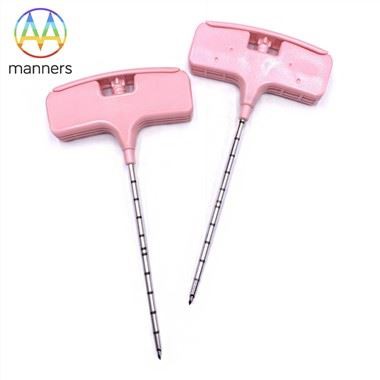
Veress needles are scientifically divided into disposable sterile type and reusable durable type, with clear scenario positioning and differentiated advantages. Disposable Veress needles are made of high-quality 304 medical stainless steel, with standardized size specifications, independent sterile packaging, no need for manual cleaning and sterilization after use. They are suitable for emergency surgery, infectious disease patient surgery, pediatric surgery and other high-safety and high-infection-risk scenarios, completely avoiding cross-infection hidden dangers. Reusable Veress needles are made of high-grade 316 medical stainless steel, with thickened needle body and enhanced structural stability, which can withstand hundreds of high-temperature sterilization cycles. They are suitable for conventional general surgery, routine gynecological minimally invasive surgery and other high-frequency and low-infection-risk scenarios, with high cost performance in long-term use. Both types of products pass ISO dual certification and support customized processing and packaging services.
Dual-Type Standard Operation Guidelines
Clinical operations formulate targeted standardized processes according to different types of Veress needles to ensure safety and efficiency. Disposable Veress needle operation: check packaging integrity and sterile validity period before use; take out the instrument in a sterile environment, confirm functional integrity; complete standard puncture and pneumoperitoneum operation; destroy the instrument uniformly after use, and strictly prohibit secondary use. Reusable Veress needle operation: complete preoperative functional inspection and sterile disinfection; implement standardized puncture operation to avoid violent damage; after operation, thoroughly clean lumen residues and surface stains, conduct professional high-temperature sterilization and sealed storage; regularly detect spring sensitivity and structural stability, and eliminate aging and failed products in time. Both types of operations must complete double safety verification of aspiration and pressure test to ensure puncture safety.
Practical Experience of Differentiated Application
Long-term clinical practical experience summarizes a complete set of differentiated selection and application experience of Veress needles. For special high-risk scenarios such as infectious diseases, immune deficiency patients and emergency trauma surgery, disposable Veress needles must be selected to achieve zero cross-infection risk and ensure absolute surgical safety. For daily elective routine surgery, reusable 316 stainless steel Veress needles are preferred, which can ensure stable surgical performance and greatly reduce the annual consumable cost of medical institutions. Disposable products are lightweight and flexible, suitable for short-time fine surgery; reusable products have stable structure and strong rigidity, suitable for long-time complex laparoscopic surgery. Scientific classification selection can balance clinical safety and cost control, realize optimal allocation of medical resources, and avoid safety risks and resource waste.
Summary and Sublimation
The dual-product system of disposable and reusable Veress needles solves the industry's dual dilemma of clinical safety and medical cost control, forming a perfect scenario-based matching system. Disposable products guarantee the ultimate safety of high-risk surgery, while reusable products realize cost optimization of conventional surgery. The two types of products have complementary advantages and consistent core functional principles, covering all clinical laparoscopic surgery scenarios. Scientific classified application breaks the one-sided use mode of traditional instruments, realizes refined and standardized instrument management, and effectively improves the safety, economy and standardization of clinical minimally invasive surgery, which is an important progress in the development of modern surgical instrument management.
Industry Prospects and Suggestions
In the future, the dual-type product system of Veress needles will be further optimized and upgraded. It is suggested that manufacturers continue to optimize the lightweight design of disposable products, reduce material consumption on the premise of ensuring safety, and improve cost performance; upgrade the material and process of reusable products, improve sterilization resistance and service life, and reduce long-term use cost. Medical institutions should formulate clear scenario-based selection specifications, realize precise matching of instrument types and surgical scenarios, and establish standardized use, maintenance and elimination mechanisms. The industry should further standardize the production standards of dual-type products, strengthen quality supervision, and promote the differentiated, standardized and refined development of Veress needle industry products.