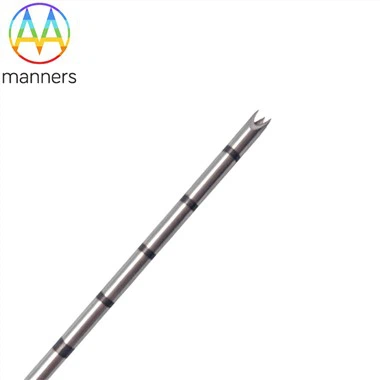
Certification Standards And Quality Stability Of Veress Needles
Aug 16, 2026
https://en.wikipedia.org/wiki/Veress_needle
Industry Pain Points
The lack of unified quality certification standards is a prominent pain point in the Veress needle industry. A large number of unqualified products on the market lack professional medical quality certification, with irregular production processes and unstable product performance. Uncertified Veress needles have problems such as unqualified material biocompatibility, unstable mechanical structure and unsmooth lumen, which are prone to puncture failure, gas delivery disorder and intraoperative instrument failure in clinical use. The uneven product quality leads to inconsistent clinical application effect, increases surgical safety risks, and makes it difficult for medical institutions to screen high-quality instruments. At the same time, the lack of standardized quality supervision leads to disordered market competition, which restricts the standardized and high-quality development of the entire Veress needle industry and affects the popularization of high-standard minimally invasive surgery.
Quality Control and Certification Principle
The quality stability of Veress needles relies on standardized production systems and professional international certification standards, and ISO9001:2015 quality management system and ISO13485 medical device professional certification are the core guarantee of product quality. ISO9001 certification standardizes the whole-process production management of products from raw material procurement, processing and production to finished product inspection, ensuring the consistency of product batch quality. ISO13485 is a special certification for medical devices, focusing on the safety, biocompatibility and clinical applicability of medical instruments, strictly restricting material quality, structural performance, sterilization performance and dimensional precision of Veress needles. Certified Veress needles must pass strict mechanical performance test, biocompatibility test and high-temperature sterilization durability test, ensuring that the safety protection principle and gas delivery function of the instrument can operate stably and reliably in clinical environment.
Certified Product Classification and Advantages
All standardized Veress needles pass dual certification of ISO9001:2015 and ISO13485, and form a hierarchical and classified high-quality product system. According to usage attributes, certified products are divided into disposable sterile type and reusable durable type. Disposable certified Veress needles adopt full sterile packaging, with strict production and disinfection standards, zero cross-infection risk, stable one-time use performance, suitable for emergency surgery and high-infection-risk scenarios. Reusable certified products are made of high-standard 304/316 stainless steel, with stable structural performance, strong sterilization resistance, long service life, and all performance indicators meet international medical standards. All certified products support standard carton packaging and personalized customized packaging, with complete quality inspection reports and traceable quality sources, which are far superior to uncertified inferior products in terms of safety and stability.
Standardized Quality Operation Guidelines
In order to maintain the quality stability of certified Veress needles in clinical application, the industry has formulated standardized operation and management guidelines. First, preoperative quality verification: confirm that the product has complete ISO certification qualification, check the production batch, sterile validity period and packaging integrity, and reject uncertified and expired products. Second, standardized use according to product attributes: disposable certified products are used once and discarded, strictly prohibiting secondary use; reusable certified products are used in accordance with standardized operation specifications to avoid man-made structural damage. Third, postoperative quality maintenance: clean, disinfect and store reusable products in a standardized manner after use, regularly test mechanical performance and lumen patency, and eliminate products with performance attenuation in time. Fourth, establish quality file management, record product use times and maintenance status, and realize full-process quality traceability.
Practical Experience of Certified Products
Clinical practical experience fully proves that dual-certified Veress needles have extremely high quality stability and clinical safety. Certified products have uniform dimensional precision, stable mechanical structure, sensitive safety protection mechanism and smooth gas delivery lumen, with almost zero failure rate in clinical use. Compared with uncertified products, certified Veress needles have better biocompatibility, no postoperative adverse tissue reactions, and more thorough sterilization effect, which can effectively reduce clinical infection risks and surgical complications. In long-term repeated use, certified reusable products maintain stable performance, no deformation, no rust and no functional attenuation, effectively reducing the instrument replacement cost of medical institutions and improving the stability and continuity of clinical surgical work.
Summary and Sublimation
ISO dual certification is the quality threshold for standardized production of Veress needles and the core benchmark to distinguish high-quality products from inferior products. Standardized certification systems standardize the production process, material selection and performance indicators of Veress needles, fundamentally solve the quality chaos and safety hazards of the industry. Certified Veress needles take clinical safety as the core, realize high stability, high safety and high compatibility of instruments, and provide reliable quality guarantee for laparoscopic minimally invasive surgery. The popularization of certified products standardizes the industry development order, improves the overall quality level of Veress needle products, and promotes the standardized and rigorous development of the medical device industry.
Industry Prospects and Suggestions
In the future, full certification and full standardization will become the inevitable development trend of the Veress needle industry. It is suggested that all industry manufacturers fully implement ISO9001 and ISO13485 certification standards, realize full coverage of product certification, and completely eliminate uncertified inferior products. Strengthen whole-process quality supervision in production, improve product precision and performance consistency, and build a standardized quality system. Medical institutions should take international certification as the core procurement standard, fully popularize certified high-quality Veress needles, and establish standardized instrument use and maintenance management mechanisms. Industry associations should strengthen standard promotion and market rectification, guide the industry to develop in a standardized and high-quality direction, and better serve clinical minimally invasive surgical needs.