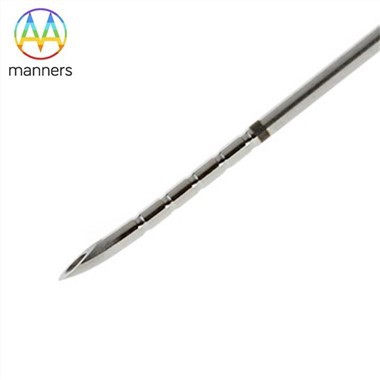
Diamond Tip Bone Marrow Biopsy Needle: Single-Use Design
Nov 21, 2026
Meta description: Why diamond tip bone marrow biopsy needles are single-use: infection control, edge retention, sterilisation validation and disposal.
A diamond tip is a precision cutting edge, and precision does not survive reprocessing well. The case for single-use marrow needles rests on three arguments that reinforce each other: infection control, edge integrity and accountability. Understanding them explains why disposable design is now the default rather than a premium option.
The Risks of Reprocessing
Marrow needles have long, narrow lumens and side holes. Cleaning depends on fluid reaching every surface, and verification is difficult. Residual protein can survive a sterilisation cycle, and prion diseases are not reliably inactivated by conventional methods. For a device that enters bone and contacts marrow, that residual risk is difficult to justify.
Edge degradation is the second problem. Grinding leaves a carefully controlled radius, and repeated cleaning, handling and sterilisation alter it. A reprocessed needle may look clean and sharp while requiring noticeably more force. The operator compensates, and the specimen pays the price through compression and fragmentation.
Regulatory scrutiny adds a third pressure. Reprocessing a single-use device shifts validation responsibility onto the reprocessor, who must demonstrate cleaning, sterility and functional performance. Many departments lack the metrology to verify tip geometry, so the claim rests on visual inspection and documentation rather than measurement. That gap is difficult to defend when an adverse event is investigated.
How Disposable Design Protects Performance
A single-use needle is validated once, at the factory, and then used once. The tip geometry, stylet fit, side-hole patency and Luer connection are all in the condition that was inspected at release. Sterilisation is performed under controlled conditions with validated aeration, and the sterile barrier is maintained until the pack is opened.
Material selection supports the same goal. Stainless steel cannulas are paired with polymer handles and caps chosen for compatibility with ethylene oxide or another validated method. The assembly is designed so that it cannot be easily opened and reassembled, which discourages informal reuse and makes tampering visible.
Accountability is the third benefit. A lot code links the device to manufacturing records, so a complaint about force, blockage or breakage can be investigated. In a reusable model, that link is broken at the first reprocessing cycle, and the history of the instrument is unknown.
Design also has to discourage casual reuse. A device that can be opened, cleaned and reassembled with ordinary tools invites informal reprocessing even when policy prohibits it. Tamper-evident packaging, single-piece assemblies and clear single-use labelling raise the effort required to deviate, which is a more reliable control than relying on intent.
Classifying Disposable Configurations
Disposable marrow devices range from a bare sterile needle to a complete procedure kit. The kit typically includes the needle, stylet, extraction cord or guide, Luer cap, safety cap and a collection container. The more complete the kit, the fewer separate items must be sourced and the lower the risk of a missing component.
Gauge and length create a second classification, from 8G large-core instruments to 18G fine needles. A third distinction is the safety feature: a simple tip cap, a hinged shield or a fully integrated safety helmet. Each adds cost and training burden, and each removes a specific exposure pathway.
Sterile presentation also varies. Peel pouches suit single items, while rigid trays suit kits with multiple components and fragile tips. The choice affects transport protection, opening technique and waste volume, all of which matter in a busy procedure room.
Shelf life and storage form another distinction. A product validated for three years at controlled humidity may fail prematurely in a warm, humid stockroom, especially if the sterile barrier includes paper that absorbs moisture. Distribution conditions should be part of the specification, because sterility assurance depends on the pack arriving intact, not only on the sterilisation cycle.
Practical Guide to Single-Use Practice
Inspect the pack before opening. A damaged sterile barrier is a reason to discard, not to use with extra care. Open onto a clean field and keep the components in order so that the sequence is obvious. Confirm the gauge and length against the request before puncture, because errors are costly once the needle is in bone.
Use the device for one patient and one procedure only. If a second pass is needed, use a new needle; the edge that struggled once will struggle more on the second attempt. After the procedure, dispose of the entire assembly in a sharps container without disassembly unless the design specifies separation.
Record the lot code in the procedure note where policy requires it. That record is the only practical route back to manufacturing data if a problem appears later, and it takes seconds to write.
Field Experience
Units that moved from reprocessed needles to single-use kits describe a gradual change rather than a dramatic one: fewer difficult passes, fewer unexplained poor cores and less time spent on cleaning and inspection. The improvement is easy to attribute once core length and pass count are tracked.
Cost comparisons often ignore labour. Reprocessing requires collection, cleaning, inspection, packaging and sterilisation, each with documentation. When those hours are counted, single use is frequently cheaper for low-volume specialties, and it removes a validation burden that many departments are not equipped to carry.
Waste management is the counterargument. Kits with multiple polymer components increase volume, and some units lack capacity for sharps containers. Compact designs and separable components can reduce the burden, but the infection-control case still favours disposal.
Training should include what not to do. Staff sometimes reuse a needle within the same patient after a failed pass, believing that sterility is preserved because the device has not left the field. The needle has already contacted bone, and its edge has been loaded; a second pass with the same tip is both a quality and a safety compromise. A clear rule, reinforced by kit design, is more effective than discretion.
Summary
Single-use design protects three things that reprocessing erodes: sterility assurance, edge geometry and traceability. A sealed, validated needle arrives in the condition that was tested, and a lot code keeps that history available. The disposable model is therefore a quality system, not merely a purchasing category, and it should be specified and audited like one.
Outlook
Material innovation may reduce waste without compromising safety. Thinner-walled cannulas, lighter handles and recyclable polymers can shrink the disposal footprint while preserving performance. Regulation will continue to push toward validated single-use claims and clearer instructions.
Sterilisation capacity is a practical constraint that manufacturers rarely discuss. Ethylene oxide cycles are long, and aeration adds time, so a supplier's ability to deliver consistent volume depends on validated chamber capacity. Buyers planning conversions from reusable to single-use should ask about lead times under peak demand, not only about unit price.
Single-use also changes the training burden. Staff no longer need to inspect, clean and package instruments, but they do need to understand pack integrity, correct opening and disposal. That training is shorter and more consistent than reprocessing training, which varies with water quality, detergent and dryer performance in ways that are hard to standardise across sites.
Storage is the last practical consideration. Kits must be kept dry, within temperature limits and protected from compression, because a crushed tray can compromise the sterile barrier without visible damage to the outer carton. Stock rotation by expiry date and a simple receiving inspection prevent the avoidable failure of opening a pack that was damaged months earlier.
None of this makes the device inherently safer; it makes the safety dependent on a supply chain that behaves predictably. That is why single-use adoption usually follows a review of storage, training and waste handling, not just a decision to stop reprocessing. The device is only one part of the system that keeps a procedure clean, and the other parts deserve the same attention.
Digital traceability is likely to extend from lot codes to unit-level scanning, making recalls faster and complaint investigations more precise. That capability will favour suppliers who already treat the needle as a controlled medical product rather than a machined item.