Decoding The Micron-Level Precision Logic Of The V3 Infusion Needle
Jul 10, 2026
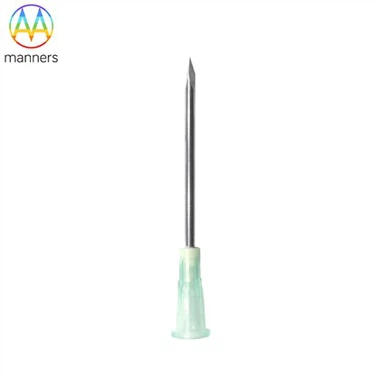
Amid the rapid adoption of automated fluid delivery systems, dimensional deviations in industrial dispensing needles directly cause inconsistent dosing of essential oils and botanical extracts. Many manufacturers remain trapped by the industry-wide challenge of inconsistent batch production accuracy. The V3 Infusion Needle breaks this bottleneck by utilizing the Japanese Citizen Cincom L12-1M7 Swiss-type lathe, establishing itself as a preferred component in food processing and tobacco manufacturing.
Raw material selection presents inherent machining challenges. SS304 stainless steel exhibits significant work-hardening characteristics, concentrates cutting heat, and is prone to deformation in thin-walled structures. Conventional domestic lathes typically hold tolerances at ±0.05 mm-insufficient for robotic automation interfaces. By employing the Citizen sliding headstock lathe to machine the hex base, the manufacturer locks dimensional tolerances at ±0.01 mm, angular tolerances at ±0.1°, and surface roughness at Ra < 0.4 μm. The fully threaded structure is machined strictly to ASME B1.21M standards, ensuring uniform load distribution. This completely eliminates issues of needle loosening and leakage during high-speed operation, guaranteeing long-term mechanical stability.
The needle tip abandons traditional turning in favor of two-die rotary swaging for cold-forming. This process aligns stainless steel grains axially, maintaining a consistent hardness of HRC 22–25 without compromising material integrity. This ensures the dual orifices remain geometrically precise while enhancing fatigue resistance-a stark contrast to turned needles prone to micro-burrs. Subsequent laser welding and "V3" laser marking introduce minimal heat-affected zones (HAZ), preventing tip deformation.
Post-machining, products undergo electropolishing per ASTM B912 to eliminate micro-burrs and micro-cracks. Citric acid passivation generates a dense oxide layer on the steel surface, significantly boosting corrosion resistance, followed by 40 kHz high-frequency ultrasonic cleaning to remove metallic debris and prevent food-grade media contamination. The entire workflow operates under dual ISO 9001:2015 and ISO 13485 frameworks, applying medical device-level controls to industrial components.
Looking ahead, automated fluid systems will evolve toward micro-precision dosing, where the ±0.01 mm threshold becomes the dividing line between premium and inferior products. Leveraging high-end imported equipment and standardized processes, the V3 Infusion Needle manufacturer provides a blueprint for domestic peers, proving that Chinese manufacturers can meet international standards, escape low-end homogeneity, and solidify the foundation for domestic substitution in automation components.