Customization Service Of Blunt Tip Filled Needles For Special Compounding Scenarios
Nov 03, 2026
Pain Points
Standard off-the-shelf blunt tip filled needles cannot satisfy all specialized compounding and automated production requirements. Fixed cannula lengths may be too short to reach liquid at the bottom of tall vials, or too long for isolator glove boxes and automated compounding stations. Some customers need unique gauge-length combinations for proprietary compounding workflows. Standard packaging formats fail to meet cleanroom traceability, laser marking and customer-specific labeling demands. Many suppliers only offer fixed SKUs and lack drawing-to-product development capacity. When customers provide physical sample needles, suppliers cannot replicate tip geometry, filter position and hub structure accurately. This forces compounding centers to modify standard needles manually, which damages sterility, ruins the 45° bevel profile and compromises 5 micron filtration integrity. Manual modification introduces uncontrollable particulate risks and non-compliance with medical device quality systems.
Working Principle
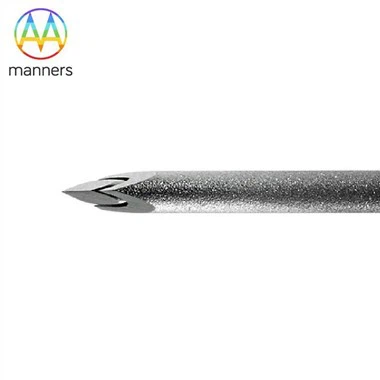
Blunt tip filled needles support customization based on customer 2D drawings, 3D models or physical samples, while retaining the core functional configuration: stainless steel cannula, 45° anti-coring bevel, built-in 5 micron filter membrane and standard luer hub. Customization mainly adjusts cannula working length under unchanged gauge, bevel angle and filter specification. The 45° bevel geometry stays consistent to preserve anti-coring performance. The 5μm filter maintains identical particle interception efficiency. The standard luer taper ensures continued syringe compatibility. Engineers convert customer drawings into CNC machining parameters for stainless steel tube cutting, bevel grinding, hub assembly and filter encapsulation. Custom packaging can modify carton layout, sterile pouch design, printing content and batch coding scheme according to client requirements. All customized products follow the same sterile single-use rules and are still limited to medication withdrawal, reconstitution and IV bag access, not direct patient injection.
Device Classification
Customized blunt tip filled needles are grouped by customization scope. Length-customized variants: same gauge, same bevel and filter, only cannula length adjusted for isolators, automatic compounders, tall vials or shallow IV bag ports. Drawing-based full-spec customization: customers submit 2D or 3D files to define length, marking position and packaging. Sample-replication customization: suppliers reverse-engineer qualified customer samples to match geometry, filter position and assembly structure. Packaging customization: retain standard needle performance while changing outer carton, inner sterile pouch, label text and traceability code format. All customized products are available across the full gauge range from14G to27G.
Step-by-Step Operation Guide
For procurement and application of customized blunt tip filled needles: first, define clear functional requirements: target gauge, required cannula length, working scenario (isolator / auto-compounder / manual pharmacy), packaging and marking needs. Provide 2D drawings, 3D files or reference samples to the manufacturer. Second, confirm that the supplier keeps the fixed core parameters: 45° anti-coring bevel and 5 micron filter membrane. Review the first article sample for dimension, tip quality, filter sealing and luer compatibility. Third, after formal batch delivery, train operators on the special length characteristics. Longer cannulas need careful depth control to avoid touching vial bottom sediment; shorter custom models must guarantee enough liquid immersion depth. Fourth, follow the same aseptic operation flow as standard products: disinfection, slow aspiration, no back-flushing, needle replacement before patient administration and sharps disposal. Fifth, store customized batches separately and use dedicated traceability logs.
Practical Clinical & Compounding Experience
Central compounding centers and medical device OEMs are the main users of custom blunt tip filled needles. The most frequent custom demand is extended cannula length for closed isolator systems. Users warn that customization should not change core safety features. Some buyers mistakenly ask to remove the 5μm filter or alter the 45° bevel angle for faster flow, which destroys the original particulate and anti-coring protection. First article validation is critical; customers should test filtration efficiency, anti-coring effect and luer leakage before mass order release. Custom packaging with laser-etched batch codes greatly simplifies cleanroom digital traceability.
Summary & Value Elevation
Customization of blunt tip filled needles is not arbitrary structural alteration. It is dimension adaptation on the stable safety foundation of 45° bevel, 5μm filter and standard luer hub. It bridges the gap between standardized medical consumables and unique workflow constraints of automated compounding, isolation pharmacy and special container systems. It avoids unsafe manual modification by end users and keeps the whole safety performance validated and controlled. Customization capability reflects a manufacturer's understanding of clinical workflow rather than merely machining flexibility.
Industry Outlook & Suggestions
As automated pharmacy compounding equipment penetrates deeper, customized blunt tip filled needle demand will grow steadily. Suppliers should build standardized first-article validation workflows for drawing and sample-based orders. Customers should separate variable dimensional parameters from non-negotiable safety core parameters in technical specifications. Quality agreements must explicitly lock 45° bevel and 5 micron filter performance for all custom batches. The future trend is modular needle design: fixed filter and hub module with interchangeable cannula length options to shorten custom development cycles and lower verification cost.