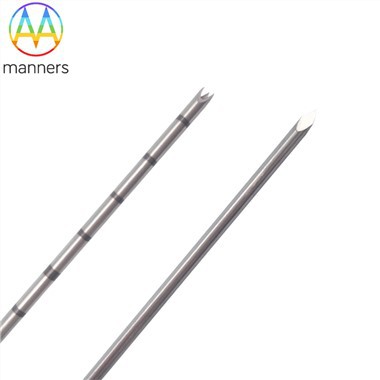
Anti-Coring Performance Of 45° Bevel On Blunt Tip Filled Needles
Nov 03, 2026
Pain Points
Rubber stopper coring is a pervasive and underrated defect in parenteral drug preparation. Traditional sharp needles cut circular rubber plugs out from vial stoppers. These rubber fragments fall into medicinal liquid and become foreign particulate contaminants. Even with downstream filters, oversized rubber chunks may overload the filter membrane instantly and cause blockage or breakthrough. Repeated punctures with sharp needles expand stopper cracks, leading to liquid leakage, microbial ingress and drug degradation. In busy infusion wards, nurses cannot afford slow, careful puncture techniques every time. Operators often increase piercing force, which worsens coring. Many blunt products on the market adopt flat tips without optimized bevel angles; they need excessive force to penetrate stoppers and may bend or deform the cannula. Without a balanced 45° bevel design, blunt needles sacrifice either penetration smoothness or anti-coring ability, creating a trade-off dilemma for clinical users.
Working Principle
The 45° angled blunt bevel is the geometric core for anti-coring of blunt tip filled needles. Unlike sharp cutting edges, this bevel surface spreads contact pressure evenly on rubber stopper material. When pressed vertically, it stretches and displaces the elastic rubber instead of shearing and cutting discrete rubber cores. The stainless steel cannula provides enough rigidity to avoid tip folding during penetration. Combined with the built-in 5 micron filter membrane, the system forms two-layer protection: the 45° bevel minimizes new rubber particle generation, and the filter captures residual tiny debris that still enters liquid. The standard luer hub ensures stable connection with luer lock or slip syringes, so operators can control insertion speed and force precisely. All gauge variants from 14G to27G inherit the same 45° bevel geometry. Custom-length cannulas keep this angle unchanged, only adjusting the working insertion depth according to vial height or equipment requirements.
Device Classification
Blunt tip filled needles with 45° anti-coring bevel are categorized by gauge and functional orientation. Large-bore 14G–18G: thicker stainless steel tube, robust 45° bevel, suitable for thick rubber stoppers on large-volume IV bags and bulk vials, resisting deformation under heavy force. Medium-bore 19G–23G: the most widely used grade, balanced stiffness and anti-coring performance for standard drug vials and glass ampoules. Fine-bore 24G–27G: thin cannula with precision 45° micro-bevel, for small rubber stoppers of pediatric and specialty drug vials; operators must apply gentle pressure to avoid bending. Products can also be sorted by customization: standard fixed-length stock items and custom-length versions produced from 2D/3D drawings or samples. Packaging includes standard export cartons and customer-specified sterile packaging schemes.
Step-by-Step Operation Guide
First, select suitable gauge according to stopper thickness and vial size. Inspect cannula tip: confirm the complete 45° bevel without burr or deformation. Assemble the needle onto syringe and disinfect stopper surface properly. Second, aim the cannula perpendicular to the stopper surface. Apply steady, moderate axial pressure rather than lateral twisting or sliding cutting motion. The 45° bevel will push rubber aside and form a clean entry hole without coring. Third, once the tip enters the liquid space, keep it submerged and withdraw medication slowly. The 5μm filter will capture occasional tiny rubber dust that escapes the anti-coring geometry. Fourth, after aspiration, replace this blunt tip filled needle with an administration needle before injection. Discard the used needle into sharps container directly. Do not reuse the cannula for multiple vial punctures, because repeated penetration may wear the bevel profile and weaken anti-coring capacity.
Practical Clinical & Compounding Experience
In controlled ward trials, 45° bevel blunt tip filled needles cut stopper coring incidents drastically compared with conventional sharp needles. Operators should avoid rocking the needle side to side during penetration; side force is the top trigger of rubber chunk formation. Staff report that 20G–22G delivers the best hand-feel balance: easy penetration and low coring probability. Thin fine-gauge cannulas require extra care. If resistance suddenly spikes during insertion, stop and check whether the tip is bent. Quality managers remind procurement teams to audit tip machining consistency; poor bevel finishing with micro burrs will destroy anti-coring effects even with nominal 45° design.
Summary & Value Elevation
The 45° bevel design solves the root cause of rubber particulate pollution: mechanical cutting of stoppers. It shifts the puncture behavior from cutting displacement to elastic material displacement. Paired with the 5 micron filter, blunt tip filled needles achieve source reduction plus end filtration. This geometric innovation reduces filter load, extends effective filtration time and lowers the risk of filter failure. It relieves the operational burden on nurses and pharmacists, making anti-coring protection reproducible under high-intensity clinical work instead of relying on individual operator skill.
Industry Outlook & Suggestions
Anti-coring design will become a mandatory performance indicator for medication preparation needles. Manufacturers should control bevel angle tolerance and surface polishing precision in CNC machining. End-user hospitals can add visual comparison training: show coring samples from sharp needles versus clean puncture marks of 45° blunt bevel. Future development can combine the proven 45° profile with lubricant coating to further reduce penetration force, while avoiding introducing extra extractable contaminants that affect parenteral drug safety.