Competition Among Precision Instruments: Market Pattern, Mainstream Products And Technical Frontiers Of OPU Needles
Apr 29, 2026
Competition Among Precision Instruments: Market Pattern, Mainstream Products and Technical Frontiers of OPU Needles
Amid the global commercial expansion of OPU IVP technology, OPU needles, as critical specialized consumables, have formed a highly segmented, professional and competitive market. Leading brands differentiate themselves in material formulation, structural design, precision processing and supporting system adaptation, jointly driving technical iteration and industry application expansion. This article summarizes the current market landscape, analyzes the technical characteristics of mainstream OPU needle products, and prospects cutting-edge R&D trends.
I. Market Pattern and Core Participants
The global OPU needle market is dominated by international enterprises with profound expertise in veterinary reproductive medical devices and assisted breeding, alongside regional manufacturers and emerging suppliers.
Global Leading Brands
- Minitube (Germany): A global leader in animal reproduction solutions, featuring refined German precision manufacturing. Its OPU needles excel in systematic compatibility with self-developed ultrasound devices and negative pressure pump platforms.
- IMV Technologies (France): A multinational giant covering full reproductive product lines, with humanized operational design, diversified specifications and outstanding clinical adaptability.
- AB Technology / Agtech (USA): Major players in the North American market, with strong compatibility with mainstream veterinary B-ultrasound equipment.
- Fujihira (Japan): Renowned for ultra-precision medical processing, delivering exceptional tip sharpness and lumen surface finish.
Regional Brands & OEM/ODM Manufacturers
Major livestock breeding countries including Brazil and China host local manufacturers and foundries for international brands. Regional players leverage cost advantages and localized after-sales services, with product performance steadily catching up with imported standards.
Core Market Characteristics
The sector is highly specialized, with key customers including large-scale breeding companies, embryo transfer enterprises, research institutions and high-end pastures. Procurement decisions focus on recovery performance, equipment compatibility, technical support and brand reputation. Single-use sterile OPU needles have become the mainstream standard to ensure procedural standardization and cross-infection prevention.
II. Technical Characteristics of Mainstream OPU Needle Products
High-end OPU needles from all brands pursue balanced optimization of multiple core performance indicators.
Needle Tubing Materials and Processing Technology
- Materials: Medical-grade 304 or 316L stainless steel with excellent rigidity, toughness and corrosion resistance; customized high-performance alloys adopted in premium models.
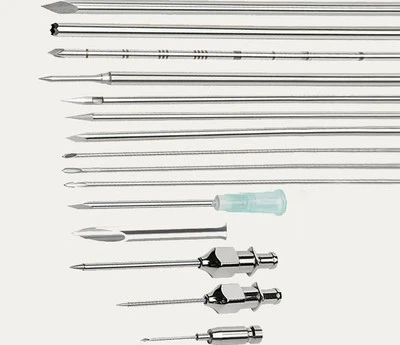
- Processing: High-precision seamless tube drawing ensures uniform inner diameter. Electrolytic polishing and special surface coating achieve mirror-grade smoothness, minimizing cell adhesion and friction damage. Needle tips are laser-cut or mechanically precision ground for consistent bevel angle and sharpness.
Tip Design
- Bevel Angle: Ranging from 12° to 30°. Small-angle tips reduce penetration resistance; large-angle designs enhance structural strength for complex tissue conditions.
- Echogenic Tip Technology: A landmark configuration for high-end products. Laser micro-etching, microbubble polymer coating or gold-plated treatment enhance ultrasonic reflection, significantly improving real-time visualization and puncture accuracy.
- Dual-Lumen Structure: A high-value optional design for simultaneous aspiration and in-situ flushing, effectively boosting COC recovery with higher processing difficulty and manufacturing costs.
Specifications and Compatibility
- Length: Common specifications range from 35 cm to 55 cm, adapting to the anatomical characteristics of cattle at different growth stages.
- Gauge: 20G (outer diameter approx. 0.9 mm) dominates the market, balancing rigidity, minimal invasion and stable flow rate. Fine 21G/22G models are applied for delicate scenarios and experimental animals.
- Interface: Standard Luer Lock connectors ensure tight connection with handles and negative pressure pipelines, with brand-specific reserved dimensional differences requiring compatibility verification.
Supporting System Matching
Top-tier OPU needle brands form integrated solutions with dedicated puncture handles, programmable negative pressure pumps and constant-temperature collection devices. Presettable personalized pressure parameters, instant foot-switch control and full-process constant temperature control jointly realize systematic efficiency improvement.
III. Cutting-Edge Technologies and Future Trends
- Intelligent Sensing Integration: Next-generation OPU needles are expected to embed miniature pressure and optical sensors to monitor puncture pressure, fluid blockage and preliminary tissue identification in real time.
- Advanced New Materials: Nitinol shape-memory alloys and ultra-low-friction DLC coatings are being developed to realize flexible adaptive puncture and further reduce cell mechanical stress.
- Cost Control and Popularization: Optimized structural design and large-scale production lower the cost of disposable high-performance needles, promoting technology penetration in medium and small-scale pastures.
- Automatic Puncture Exploration: Combining robotic arms and AI image recognition to realize intelligent follicle positioning and automatic puncture, representing the ultimate direction for standardized, high-efficiency and operator-independent OPU operations.
Conclusion
The OPU needle market represents the intersection of precision machinery manufacturing and animal biotechnology. Intense market competition drives manufacturers to pursue extreme refinement in every microscopic detail of needle tip design and lumen processing. Breakthroughs in material science, microfabrication, ultrasonic visualization and fluid control jointly provide embryologists with stable, reliable operational tools to maximize high-quality oocyte acquisition from elite donor cattle. For end users, fully understanding product technical attributes and selecting matched products based on operational habits, equipment conditions and budget is critical to standardized OPU practice. Continuous technological innovation will further lower the application threshold of high-end reproductive technology, empowering long-term genetic upgrading of global animal husbandry.