Clinical Application Scenarios And Selection Criteria For Breast Biopsy Needles Of Different Sizes
Jul 19, 2026
https://www.mayoclinic.org/tests-procedures/breast-biopsy/about/pac-20384812
No single breast biopsy needle gauge holds absolute superiority; suitability varies across clinical scenarios. Scientific gauge selection is the core to balancing puncture trauma, sampling accuracy, procedural efficiency and patient safety. During clinical diagnosis, medical practitioners must match different biopsy needle gauges according to lesion size, location, pathological nature, mammary gland thickness and patient physical conditions. Leveraging Manners' full gradient size portfolio enables precise, personalized puncture diagnosis. Standardized gauge selection criteria effectively reduce misdiagnosis and missed diagnosis rates, eliminate repeated punctures and mitigate postoperative complications, forming a critical component of standardized minimally invasive breast biopsy protocols.
Large-bore gauges (8G, 11G, 13G) target large-volume, complex and high-risk breast lesions. Their oversized lumens deliver abundant intact tissue specimens capturing complete lesion morphology, suitable for masses over 20mm in diameter, deep lesions with high malignant suspicion, extensive sampling of fibroadenomas and vacuum-assisted breast biopsy procedures. For patients with diffuse multi-focal lesions, thick-gauge needles harvest adequate tissue in one puncture pass to avoid cumulative trauma from repeated penetration and lower risks of pathological diagnostic bias caused by insufficient sampling. Clinically, thick gauges are prioritized for obese patients with thick mammary tissue and deeply buried lesions to guarantee penetration power and valid sampling for complex clinical cases.
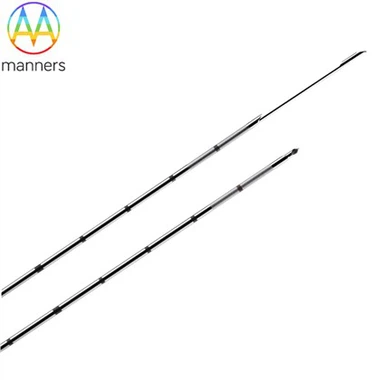
Medium mainstream gauges (14G, 15G, 16G) serve as universal all-round specifications applicable to over 90% of routine breast biopsy procedures, designated as the standard recommended gauge range by clinical expert consensus on breast puncture diagnosis. For routine solid breast nodules measuring 10–20mm with benign or suspected malignant features, 14G–16G needles are the primary selection. This gauge gradient achieves an ideal balance between sampling precision and minimal invasiveness, featuring rigid needle bodies for stable penetration without deviation. The forward-throw-free precision structure accurately controls puncture depth to avoid injury to chest wall, blood vessels and pleura. Paired with echogenic markers for ultrasound-guided pinpoint positioning of the sampling notch, harvested specimens are intact with minimal impurities, fully meeting all requirements of routine pathological examination, subtype diagnosis and immunohistochemical screening. Characterized by mild postoperative trauma, rapid recovery and extremely low complication rates, these gauges are universally applicable to outpatient screening, preoperative inpatient diagnosis and follow-up sampling, delivering outstanding versatility and practicality.
Minimally invasive thin gauges (18G, 20G) focus on refined low-trauma diagnosis for micro lesions and sensitive patient groups. For micro breast nodules under 10mm, superficial gland lesions and targeted sampling of mammary calcifications, 18G and 20G thin needles accurately lock onto tiny abnormal areas and prevent extensive damage to healthy mammary tissue caused by thick-gauge instruments, maximally preserving normal breast anatomical structure. Tailored for special patient cohorts including menstruating women, individuals with coagulation disorders, the elderly, immunocompromised patients and keloid-prone populations, these thin gauges create micro puncture wounds that drastically reduce risks of postoperative bleeding, infection and scar hyperplasia, accompanied by minimal postoperative discomfort and shortened recovery cycles. Thin-needle puncture delivers preliminary screening for lesions with ambiguous pathological features, avoiding physical and mental burdens from excessive medical intervention.
Three core principles govern clinical gauge selection: lesion matching, minimal trauma and precise adaptation. First, match gauge size to lesion volume: thick gauges for large lesions and thin gauges for micro lesions to guarantee sufficient tissue yield. Second, adjust gauge based on lesion depth: rigid medium-to-thick gauges for deep lesions and thin gauges for superficial lesions. Third, optimize selection according to patient physical status: prioritize minimally invasive thin gauges for sensitive high-risk populations and large-bore thick gauges for complex lesions. Supported by custom sizing capabilities, exclusive gauge specifications can be manufactured for intractable complex lesions to break limitations of standard sizes. Integrated with high-precision product craftsmanship, the standardized gauge selection system comprehensively elevates puncture diagnostic accuracy and safety, aligning with the refined development demands of modern minimally invasive breast medicine.