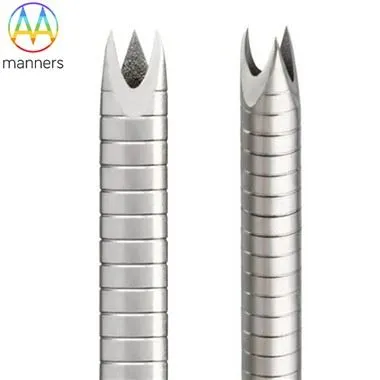
Biocompatibility And Stainless Steel Selection: The Scientific Basis For Infusion Needles
Jul 31, 2026
Introduction: Material Safety as the Non-Negotiable Foundation
For an Infusion Needle-a Class III invasive device contacting bone marrow, hematopoietic cells, nerves, and blood-material biocompatibility transcends regulatory checkboxes. It is the bedrock of patient safety and diagnostic validity. Specifying Stainless Steel reflects decades of scientific scrutiny, clinical validation, and metallurgical advancement. For a responsible Infusion Needle manufacturer, selecting the optimal alloy and processing it correctly is the first, most critical layer in the quality assurance hierarchy. This article examines why stainless steel prevails, compares common grades, outlines biocompatibility evaluations per ISO 10993, and discusses how surface treatments mitigate risks like nickel ion release.
Why Stainless Steel Dominates Infusion Needle Manufacturing
Stainless steel offers a unique confluence of properties essential for marrow access:
- Mechanical Performance: High yield strength and hardness allow the needle to withstand axial compressive forces (up to 100N+) and torsional stresses during cortical penetration without plastic deformation or fracture. Adequate ductility prevents catastrophic brittle failure, unlike ceramics or glass.
- Corrosion Resistance: The human body presents a corrosive milieu (chlorides, proteins, enzymes). Stainless steel spontaneously forms a nanoscale passive film (primarily Cr₂O₃). This self-repairing layer insulates the base metal. Grade 316L, with added Molybdenum, exhibits superior resistance to pitting and crevice corrosion in chloride-rich blood plasma compared to 304.
- Manufacturability: Excellent machinability facilitates complex geometries-micrometer-precise tips, smooth lumens, robust hubs-via grinding, swaging, laser cutting, and electropolishing.
- Cost-Effectiveness: Compared to titanium, cobalt-chrome, or noble metals, stainless steel offers significant economic advantages, crucial for widely used diagnostic disposables.
- Baseline Biocompatibility: Properly processed medical stainless steel meets core ISO 10993 requirements for cytotoxicity, sensitization, and hemolysis.
Grade Selection: 304 vs. 316L – A Critical Distinction
- 304 Stainless Steel (18-8): Contains ~18% Chromium, ~8% Nickel. Offers good general corrosion resistance and weldability at moderate cost. Suitable for lower-risk, short-term contact devices or cost-sensitive markets.
- 316L Stainless Steel (Medical Grade Preferred): Augmented with 2–3% Molybdenum and restricted to <0.03% Carbon. Molybdenum drastically boosts resistance to chloride-induced pitting and crevice corrosion. Low carbon prevents "sensitization"-chromium carbide precipitation at grain boundaries during thermal processing-which causes intergranular corrosion. For Infusion Needles potentially exposed to prolonged blood contact or aggressive disinfectants, 316L is the unequivocally superior choice, often highlighted as a key quality marker by premium manufacturers.
Biocompatibility Evaluation: Navigating ISO 10993
Comprehensive biological safety assessment is mandatory:
- Cytotoxicity (ISO 10993-5): Extracts tested on cell cultures (e.g., L929 fibroblasts). Reactivity must be ≤ Grade 1 (mild).
- Sensitization (ISO 10993-10): Guinea Pig Maximization Test (GPMT) or Murine Local Lymph Node Assay (LLNA) assess allergic potential.
- Irritation (ISO 10993-10): Intracutaneous reactivity tests (e.g., rabbit model) evaluate tissue irritation.
- Hemolysis (ASTM F756 / ISO 10993-4): Measures hemoglobin release after blood contact. Hemolysis must be <5%.
- Genotoxicity (ISO 10993-3): Ames test (mutagenicity) and chromosomal aberration assays rule out genetic damage potential.
- Implantation (ISO 10993-6): Histological assessment of local tissue reactions (inflammation, fibrosis, necrosis) post-implantation in animal models.
- Manufacturers must contract accredited laboratories (CNAS/CMA certified) and compile full reports for regulatory submissions (FDA 510(k), CE MDR Technical Files).
Surface Treatment: Electropolishing as a Biocompatibility Multiplier
Electropolishing is not merely cosmetic; it's a critical surface engineering step:
- Defect Removal: Eliminates micro-burrs, heat-affected layers, and embedded contaminants from machining that foster corrosion initiation or thrombogenicity.
- Passive Layer Enhancement: Enriches chromium at the surface, creating a thicker, more uniform, and stable passive film, boosting corrosion resistance.
- Thrombosis Mitigation: A mirror-smooth surface (Ra ≤ 0.2µm) drastically reduces protein adsorption, platelet adhesion, and thrombus formation-vital for maintaining lumen patency and sample integrity.
- Cleanability: Smooth surfaces facilitate the removal of contaminants during cleaning and sterilization processes.
Addressing Nickel Ion Release Concerns
Nickel (Ni) is a known contact sensitizer. While the passive film blocks direct Ni exposure, trace ionic release can occur, especially in acidic environments. Strategies include:
- High Nitrogen Nickel-Free Steels: Eliminate Ni entirely but are costly and difficult to process; currently limited to high-end implants.
- Barrier Coatings: Diamond-Like Carbon (DLC), Titanium Nitride (TiN), or noble metal (Au, Pt) coatings physically isolate the substrate. Effective but expensive; mainly used in cardiovascular stents/joints.
- Stringent Process Control: For short-term use devices like Infusion Needles, industry consensus holds that high-quality 316L steel with proper Electropolishing results in negligible Ni release (ppb levels), posing minimal clinical risk. Manufacturers should nonetheless include precautionary statements in Instructions for Use (IFU) and pursue ongoing research into safer alternatives.
Conclusion
Stainless Steel, particularly 316L, remains the optimal material for Infusion Needles due to its balanced property profile. However, material safety is holistically determined by alloy selection, processing precision, surface treatment efficacy, and rigorous biological validation. A manufacturer's expertise in metallurgy, tribology (friction/wear science), and electrochemistry directly translates to clinical safety. Ultimately, in the medical device arena, material integrity equates to patient safety, demanding the utmost diligence from concept to sterilized product. Manufacturers must view themselves not just as fabricators, but as guardians of biological compatibility.