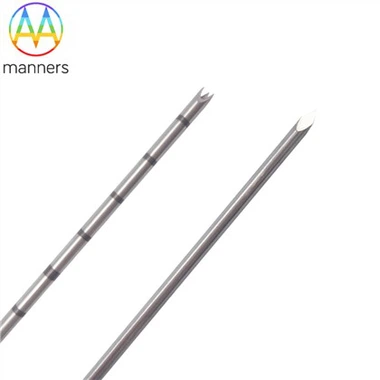
Atraumatic Pencil Point Spinal Needle VS Quincke Point Needle & Manufacturer Technical Iteration Strength
Aug 05, 2026
In the field of clinical spinal puncture and spinal anesthesia, atraumatic pencil point spinal needles and traditional Quincke point spinal needles are two mainstream types of puncture instruments, with huge differences in structural design, operational performance and clinical complication rate. Professional atraumatic pencil point spinal needle manufacturers rely on years of medical device R&D and production experience, continuously iterating product technology, upgrading blunt-tip manufacturing processes, and gradually replacing traditional sharp-tip needles to become the mainstream choice of modern high-standard clinical medical institutions.
The essential difference between the two products lies in the tip structure and puncture mechanism. The Quincke point needle adopts a sharp cutting tip, which is designed for rapid puncture. However, the sharp tip will cut the dural fibers and subcutaneous tissue transversely during penetration, forming irregular, non-retractable wounds. The torn dural tissue cannot heal quickly after the operation, resulting in persistent cerebrospinal fluid leakage, which is the fundamental reason for the high incidence of postoperative headache and inflammatory reactions of traditional needles. In contrast, the atraumatic pencil point spinal needle developed by professional manufacturers abandons the cutting design and adopts a rounded blunt pencil tip. During the puncture process, it pushes and separates tissue fibers along the fiber gap without cutting damage, and the puncture wound can self-close rapidly after needle withdrawal.
In terms of operational experience and clinical adaptability, the manufacturer's upgraded pencil point spinal needle also has obvious advantages. Although the Quincke sharp-point needle has fast puncture speed, it has poor controllability and is easy to cause excessive tissue damage. It is not suitable for delicate patients such as the elderly, children, and pregnant women. The atraumatic pencil point spinal needle has moderate puncture resistance, which can help doctors feel the layered penetration of skin, subcutaneous tissue and dura mater clearly, improve the accuracy of puncture positioning, and avoid excessive puncture depth that damages spinal cord and nerve tissues. This humanized performance design makes the product suitable for all age groups and various complex clinical scenarios.
Professional manufacturers continue to carry out technical iterations on the basis of traditional pencil point products to optimize product performance comprehensively. In terms of material technology, high-purity medical stainless steel is adopted to improve the flexibility and fracture resistance of the needle body, avoiding needle breakage during complex puncture operations. In terms of tip processing, ultra-precise CNC grinding technology is used to unify the blunt tip radian of each product, solving the problem of uneven tip quality of low-cost products on the market. In terms of channel design, the optimized lateral fluid guide hole ensures smooth and rapid outflow of cerebrospinal fluid and uniform injection of anesthetic drugs, improving clinical diagnosis and treatment efficiency.
From the perspective of clinical economic benefits, the manufacturer's high-quality atraumatic pencil point spinal needle can effectively reduce the incidence of postoperative complications, shorten patient hospitalization and recovery time, and reduce the additional medical costs caused by sequelae treatment. Although the production process of pencil point needles is more complex than that of Quincke point needles, its comprehensive clinical value is far higher. With the continuous improvement of global clinical minimally invasive medical standards, professional manufacturers' technically iterated atraumatic pencil point spinal needles have become the mainstream trend of spinal puncture instrument upgrading.
https://www.bmj.com/content/361/bmj.k1920