An Industrial Economics Perspective: The OPU Needle—Key Consumable Driving Economies Of Scale in Elite Breeding
Apr 13, 2026
An Industrial Economics Perspective: The OPU Needle-Key Consumable Driving the "Economies of Scale" in Elite Breeding
In the modern livestock industry, where the pursuit of peak genetic progress is paramount, OPU-IVP technology has become the "super engine" for rapidly and scalably disseminating top-tier genetics from the "pinnacle" to commercial herds. However, the power output of any engine relies on the reliability and efficiency of its fundamental components. Within the industrialized OPU-IVP pipeline, the OPU needle has evolved from a mere technical detail into a strategic core consumable that influences the profitability, expansion speed, and operational stability of the entire business model. Its standardization, performance, and cost directly define the "unit economics" of rapid elite breeding.
I. The Core Paradox: Scalability Demands vs. The "Bucket Effect" of Operations
The essence of industrialization lies in standardization, repeatability, and scalability. Yet, in the OPU process, variations in operator experience and fluctuations in consumable performance can easily become the "shortest plank" in the production barrel.
Scalability Demand: Large breeding companies or embryo production centers require regular OPU operations on dozens or even hundreds of core donor cows weekly, demanding highly standardized processes and predictable outcomes.
Practical Bottleneck: If OPU needle performance is unstable (e.g., high variability in recovery rates, high trauma rates), it directly leads to:
Unpredictable yields of oocytes from valuable donors, disrupting production planning.
Premature retirement of donor cows due to ovarian health issues, inflating the depreciation cost of these "seed" assets.
Lengthy operator training cycles and soaring labor costs.
II. The Economic Lever: How the OPU Needle Pries Open "Unit Embryo Cost"
The total cost of a transferable in vitroembryo comprises direct materials, equipment depreciation, labor, and donor maintenance. As a high-frequency consumable, the OPU needle profoundly impacts the final cost structure through multiple dimensions:
Increasing "Raw Material" Acquisition Efficiency to Amortize Fixed Costs: A high-yield, stable OPU needle means obtaining more usable oocytes per session from the same high-value donor cow. This directly amortizes fixed costs-such as feeding management and hormonal synchronization-per oocyte, fundamentally reducing the "raw material" unit price.
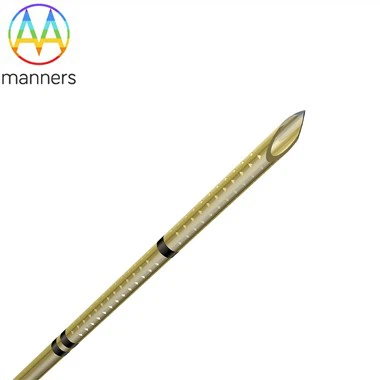
Safeguarding Long-Term Value of Donor "Assets": Adopting low-trauma blunt-tip or multi-side-hole needles drastically reduces the risk of ovarian adhesions and inflammation. This allows a top-tier donor cow, worth hundreds of thousands or even millions, to safely serve through more OPU cycles (e.g., extending from 30 to over 50 cycles). This significantly extends the "service life" of core genetic assets and lowers their annual depreciation-a key factor in long-term economic viability.
Driving Operational Standardization to Reduce Labor Dependency: Standardized, reliable OPU needles, combined with uniform aspiration parameters, reduce excessive reliance on an operator's personal "intuition" or "touch." This facilitates easier technical training, minimizes output variance between operators, and benefits standardized production management and scale expansion. Transitioning from relying on "master artisans" to depending on "standardized processes" is the only path to industrialization.
Reducing Production Volatility and Ensuring Supply Chain Stability: In order-driven commercial embryo production, clients (ranches) require a stable quantity of embryos. Consumables with fluctuating performance lead to weekly output fluctuations, making contract fulfillment difficult. Reliable OPU needles are the foundation of stable supply, helping build commercial credibility and secure long-term orders.
III. Consumable Strategy: Shifting Cognition from "Cost Item" to "Investment Item"
Therefore, leading breeding enterprises should no longer view OPU needles as a "cost item" to be ruthlessly compressed, but rather as a "key investment item" that enhances the overall return on investment (ROI).
Shift in Selection Logic: Moving away from simply comparing "price per needle" towards a comprehensive assessment of the "cost per usable embryo attributable to the needle." This metric encompasses needle price, recovery rate, impact on donor health, and operational efficiency.
Supply Chain Management: Establishing strategic partnerships with consumable suppliers capable of providing stable performance and technical iteration support, ensuring supply security and synchronization with technological advancements, rather than taking risks with numerous cheap but unstable products.
Conclusion: Defining the Micro-Foundation of Industrial Competitiveness
In an era of global genetic material flow and intense breeding competition, the race for rapid elite breeding is not just about genetic technology; it is a competition of industrialization capabilities-transforming technology into stable, efficient, and profitable products. The OPU needle, as the first physical interface connecting top-tier genetics with industrial-scale amplification, has seen its reliability, consistency, and advancement become a microscopic benchmark for measuring the maturity and long-term competitiveness of a breeding enterprise or embryo factory. Investing in the most sophisticated "sampling probe" is an investment in more controllable production costs, more sustainable utilization of genetic resources, and stronger scalable expansion capabilities-this is the pragmatic wisdom for winning the race in the bio-economy era.