A Precision Engineering Perspective: The OPU Needle—The Core Sampling Probe Of The Living Oocyte Factory
Apr 13, 2026
A Precision Engineering Perspective: The OPU Needle-The "Core Sampling Probe" of the Living Oocyte Factory
In the precision engineering of modern livestock genetic improvement, OPU-IVP (Ovum Pick-Up & In Vitro Embryo Production) technology has become the core engine for the rapid propagation of elite breeds. However, the "spark" igniting this engine and the "quality of raw materials" depend entirely on its foremost execution unit: the OPU needle. The OPU needle has transcended the simple definition of a "hollow thin tube"; it is now a highly sensitive sampling system integrating biomedicine, precision fluid dynamics, and minimally invasive surgical concepts. Its performance directly dictates the efficiency and output ceiling of the entire subsequent IVP production line.
I. The Core Paradox: An Engineering Trade-off Between Sampling Efficiency and Cellular Vitality
The fundamental challenge of OPU technology lies in achieving the efficient, non-destructive collection of micron-scale oocytes within a living, dynamic ovarian environment. This is essentially a multi-objective optimization problem:
Efficiency Objective: To cover as many follicles as possible with minimal punctures in a single session, generating sufficient negative pressure flow fields to ensure the complete and rapid detachment of Cumulus-Oocyte Complexes (COCs) from the follicle wall and their aspiration.
Quality Objective: To minimize mechanical damage, osmotic shock, and temperature fluctuations inflicted upon the oocytes during collection. Any subtle sub-lethal damage is amplified during subsequent in vitroculture, significantly compromising the potential to develop into high-quality blastocysts.
The design of the OPU needle is a systems engineering effort aimed squarely at resolving this core contradiction.
II. System Decoupling: Collaborative Optimization of Tip Geometry, Fluid Control, and Material Science
1. Tip Geometry: The Precise "Minimally Invasive Orifice"
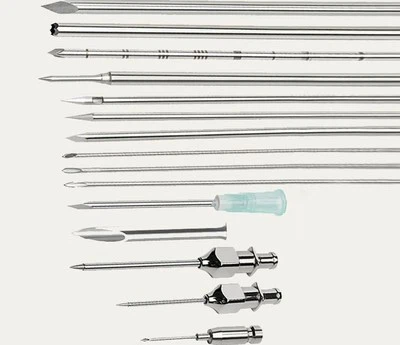
The needle tip is the interface directly interacting with biological tissue. While traditional beveled tips offer sharpness, they function more like a "scalpel," causing unnecessary tissue cutting and hemorrhage. Advanced OPU needles utilize multi-side-hole blunt-tip designs or pencil-point designs with protective sheaths. Blunt tips deflect blood vessels, reducing puncture-induced bleeding; meanwhile, meticulously designed side-hole layouts expand the single-point aspiration range, enabling "zonal" collection. This reduces repeated punctures of the ovarian cortex, significantly lowering tissue trauma while boosting efficiency.
2. Fluid Dynamics Control: From "Brute Force Aspiration" to "Gentle Capture"
The aspiration system acts as the "conveyor belt" for COCs. Simple constant high negative pressure can subject oocytes to violent shear forces or cause premature follicular collapse. Consequently, modern OPU systems integrate programmable pulsed negative pressure control. These systems simulate a more physiological "sucking" action, using gentle pulse pressures to loosen and aspirate COCs when follicular contents are viscous. Some systems feature real-time pressure sensors and visual flow paths, allowing operators to "see" and optimize fluid states for precise, controllable sampling.
3. Materials and Biocompatibility: Constructing a "Cell-Friendly" Transit Channel
The inner wall of the OPU needle is the first contact surface for COCs after leaving the maternal body. To reduce cell adhesion and activation of unnecessary stress responses, high-end needle tubing employs medical-grade stainless steel with ultra-smooth hydrophilic coatings. Such coatings drastically reduce protein and cell adsorption on the tube walls, ensuring the maximum number of recovered cells enter the collector while avoiding chemical toxicity risks to oocytes from material leachables.
III. Performance Validation: Holistic Evaluation from "Recovery Rate" to "Developmental Potential"
The value of a superior OPU needle must be validated by full-chain data:
Primary Metrics (Recovery Rate): The proportion of visible follicles retrieved and the percentage of morphologically intact COCs (uniform cytoplasm, compact cumulus cells) under standardized operating conditions.
Core Metric (Developmental Potential): Following in vitromaturation and fertilization, the blastocyst formation rate is the gold standard. High-performance needles should consistently yield a higher proportion of high-quality blastocysts with greater cell counts.
Animal Welfare Metrics: Post-operative ovarian status monitored via ultrasound to assess hemorrhagic spots and adhesions. An excellent needle design minimizes mechanical trauma, ensuring donor cows can be utilized repeatedly and safely to achieve sustainable production.
Conclusion: Defining the Quality Starting Point of Embryo Production
Within the grand blueprint of industrialized rapid propagation of elite breeds, the OPU needle plays a dual role as both "raw material quality inspector" and "first process station." It is not merely a tool for acquiring genetic material but serves as the sentinel and bottleneck for quality control across the entire OPU-IVP system. Every incremental optimization in needle tip fluid dynamics, material interfaces, and operational kinetics directly translates into more efficient genetic gain, more stable production batches, and more sustainable animal utilization.
Therefore, investing in a precision-engineered, optimized OPU needle is not a simple procurement of consumables; it is a strategic deployment regarding the "initial investment" and "long-term output" of the entire elite breeding production line. It ensures that from the very first step of in vivocollection, the highest quality foundation is laid for creating life's miracles.