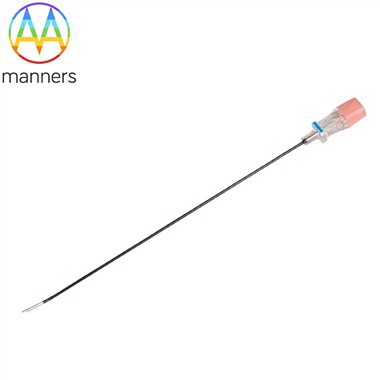
A Comprehensive Analysis Of The Production Process Of Manners RF Transseptal Puncture Needles
Jul 01, 2026
https://pmc.ncbi.nlm.nih.gov/articles/PMC4333976/
The clinical performance of medical devices fundamentally depends on their manufacturing processes. The Manners RF transseptal puncture needle has become a benchmark for quality in RF puncture precision instruments thanks to its comprehensive high-precision processing system. Focusing on minimally invasive cardiac interventions, every process-from raw material selection to finished product inspection-is benchmarked against the highest international medical standards. Relying on imported Japanese high-precision equipment and proprietary processes, micrometer-level accuracy is achieved, ensuring the safety and stability of clinical use.
Raw material selection forms the foundation of quality. Manners rejects ordinary industrial stainless steel, exclusively opting for medical-grade 304 and 305 stainless steel base materials. Through cold working processes, the material hardness is optimized and stably maintained within the optimal HRC 22-25 range. This hardness parameter perfectly balances puncture rigidity and kink resistance, preventing needle deformation or deviation during puncture while avoiding excessive tissue damage caused by overly hard materials. It meets the biocompatibility standards for implantable medical metal materials and suits the needs of repeated, fine puncture operations.
The core forming process utilizes a Japanese Citizen Cincom R04 sliding headstock lathe. As specialized equipment for micro-precision parts, this machine achieves a maximum speed of 80,000 rpm, enabling dimensional accuracy of 0.01 mm and angular tolerance control of 0.1°. To meet the stringent requirements for small specifications and smoothness, the equipment performs high-speed finishing via a guide bushing unit, controlling surface roughness to Ra < 0.4 μm. This eliminates defects such as burrs and micro-protrusions on the needle body, preventing intraoperative scratching of human tissue and residue contamination.
Following precision machining, the ASTM B912 standard electropolishing process is executed. Through electrochemical treatment, microscopic surface impurities are precisely stripped away, with a controlled stripping thickness error not exceeding ±0.0001 inches, ultimately achieving a mirror-like smooth finish with Ra 0.25 μm on the needle tip bevel. This process eliminates micro-cracks and burrs generated during machining and greatly enhances the needle's corrosion resistance, preventing material degradation caused by bodily fluid erosion.
After polishing, a high-frequency ultrasonic cleaning process is implemented. Impacting at 40,000 cycles per second, high-frequency sound waves strip away trace contaminants such as residual oil, metal shavings, and dust from the needle surface, offering a cleaning effect far superior to traditional manual or solvent cleaning methods. Finally, multi-dimensional rigorous quality inspections verify dimensional accuracy, structural integrity, and surface finish. The entire process follows ISO 9001:2015 and ISO 13485 certification systems, ensuring the finished product is ready for various sterile interventional surgical scenarios.