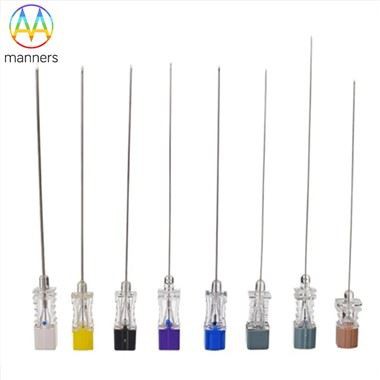
Medical-Grade Stainless Steel For High-Quality RF Puncture Needles
Jul 01, 2026
https://pmc.ncbi.nlm.nih.gov/articles/PMC4333976/
In the field of minimally invasive cardiac interventional devices, material performance directly determines product safety, durability, and clinical adaptability. The Manners RF transseptal puncture needle precisely selects dual base materials-medical-grade 304 and 305 stainless steel-and optimizes their characteristics through proprietary processes. Perfectly suited for the complex clinical environment of transseptal puncture, this constitutes the core advantage distinguishing it from ordinary puncture instruments.
304 and 305 stainless steels are internationally recognized high-end medical metal materials, boasting excellent biocompatibility, corrosion resistance, and structural stability. They exhibit no heavy metal leaching or human rejection reactions. Long-term contact with blood and myocardial tissue will not result in oxidation, rust, or degradation, fully meeting the safety standards for cardiac interventional implant devices. Compared to ordinary carbon steel or inferior stainless steel, these materials can withstand intraoperative RF energy impacts and bodily fluid acid-base erosion, significantly extending the instrument's service life and ensuring stable performance throughout the surgery.
Manners modifies the base material through a proprietary cold-working process, precisely adjusting the needle body hardness to the golden range of HRC 22-25. Insufficient hardness results in a soft needle body that easily bends and deviates when puncturing thickened or fibrotic septa, leading to inaccurate positioning. Conversely, excessive hardness increases brittleness, making the needle prone to breaking under stress, while an overly hard tip can easily cause tissue laceration. The precise hardness ratio of HRC 22-25 gives the puncture needle both rigidity and toughness, allowing for precise transmission of RF energy and adapting to various complex anatomical puncture requirements.
Based on the support of high-quality base materials, the product achieves extreme dimensional stability. With two diameter specifications of 0.6 mm and 0.7 mm, the overall tolerance is controlled within ±0.01 mm. The needle body features uniform thickness and precise concentricity, ensuring balanced force distribution during puncture without unilateral deviation issues. Simultaneously, the premium stainless steel base material is compatible with subsequent electropolishing and ultrasonic cleaning processes, achieving a mirror-like smooth surface, thoroughly eliminating processing residue defects and preventing the risk of embolism caused by micro-debris generation during surgery.
In terms of clinical adaptability, the 304 and 305 stainless steel materials are compatible with various RF energy output devices, offering stable electrical conductivity. This ensures focused output and lossless conduction of RF pulse energy, concentrating the puncture point energy for precise action. Empowered by high-quality materials and processes, the Manners RF transseptal puncture needle has passed dual international quality system certifications. The safety and performance stability of the materials have been verified in clinical practice, making it suitable for adult and pediatric cardiac interventional surgeries across all age groups.