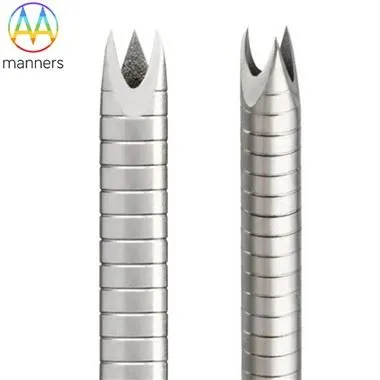
What exactly is an occlusive pin?
Nov 28, 2022
Is "nerve block" the same thing as "closure"
Nerve block: refers to the direct injection of drugs or physical stimulation in or near the nerve tissue of the nerve stem, plexus, brain nerve or spinal nerve root, sympathetic ganglion and so on to block the nerve conduction function, which is called nerve block. The purpose of relieving pain, improving blood circulation and treating painful diseases through nerve block is called nerve block therapy.
Block therapy: originated from the former Soviet Union and the United Kingdom, also known as procaine block therapy, is the injection of procaine into the local pain points of the human body, in order to block the abnormal stimulation of the lesion site to the brain conduction, thus changing the metabolism of the lesion site, accelerate the recovery of the disease.
The English name of Nerve blockade is "Neural blockade" or "Nerve block", this term has been applied all over the world for nearly a hundred years, it is still in use today, to indicate that the conduction of nerve impulse is blocked by means of drugs, should not be translated into "blockade" or "nerve blockade" in any case. However, many doctors still refer to "nerve block" or "injection therapy" as "blocking".
The word "closed" originated in China in the 1950s. At that time, due to the difficulty of academic information exchange with foreign countries, it was difficult to understand the correct terms in foreign countries, which was understandable. After a long time, they will be used to it. But for now, it is better to promote the use of correct international medical terms. Just like the "abdominal pain" called "stomach pain", although there is no big mistake, everyone can understand, but by the doctor's mouth said, make people feel irregular.
Many non-pain specialists, and even some nursing staff, are keen to inject multiple drugs at pain points, acupoints or nerve endings to relieve pain due to lack of systematic knowledge and training, which they call "block therapy". Some injection with a small amount of local anesthesia drugs, others do not add. Some doctors inject a wide variety of drugs locally, such as adding antibiotics, animal blood products, animal organ products, traditional Chinese medicine preparations, anti-immune preparations, and anti-tumor drugs into the injection. While such treatments can sometimes relieve pain in some patients, there have been many complications and medical disputes. There are also some idle people in the society, for the purpose of making money, "a needle goes everywhere", "closed" everywhere, so that the word "closed" adds a bad color. The term "block therapy" has become so popular that some medical staff and some patients misunderstand and even fear the formal "nerve block". In my opinion, regular doctors should not use the informal word "closed". Moreover, the source of the word "block" is nowhere to be found in the English, Russian and Japanese pain literature. In the treatment of pain, it is better to call it nerve block or injection therapy. These two terms are universal, scientific and normative.
It can be seen that the two are completely unrelated concepts and two completely different treatment methods. Nerve block therapy, as the most basic means of pain treatment, can play a greater role in relieving the immediate pain of the majority of pain patients.
As for the fact that quite a few ordinary people believe that hitting "closed" bones will make them brittle, is this really the case? It may be that some ignorant people think that drugs contain hormones, which will lead to osteoporosis. I once found such a sentence in a monograph on osteoporosis: "When given 25 mg of cortisone every other day, the bone volume of trabecular bone decreases by 3.5% after 1 year", it can be seen that the little hormone we use in pain treatment is not enough. Of course, this does not mean that we can use hormones freely in pain treatment. We should not be afraid to use hormones, but also fully understand the pharmacology and side effects of hormones. Patients who have this problem should be patient to explain, the patient should gradually realize the real difference between the two concepts and the two treatment methods. Especially with the continuous development of the cause of pain, more popular science publicity in this area, the "nerve block" is mistaken for "closure", even refuse to accept the wrong view will be clarified!