Decoding Materials And Structural Mechanics Of Endoscopic Biopsy Needles For Medical Device Engineers
May 16, 2026
Core Keywords
Super‑Elastic Nitinol | Micro‑Structural Mechanics | Precision Laser Machining
Application Scenarios
Research and development of ultra‑fine puncture needles for endobronchial ultrasound‑guided transbronchial needle aspiration; design of minimally invasive needles capable of biopsy through the accessory pancreatic duct of duodenoscopes; development of biliary sub‑scope biopsy tools balancing flexibility and support rigidity.
Selling Points
From an engineering perspective, this paper unveils the mysteries of material science and intricate micro‑structural mechanical design behind a biopsy needle that navigates metres‑long tortuous channels with inner diameters less than 1 mm while maintaining tip rigidity for puncture and cutting. It focuses on Nitinol's super‑elasticity, micro‑morphology control via laser machining, and how multi‑layer composite structures achieve perfect integration of flexibility and stiffness.
Who Is This For?
This paper serves medical device R&D engineers, materials scientists, mechanical design engineers and production process specialists. You strive to resolve the most intractable engineering paradox: devices must be soft and flexible enough to navigate extreme bends, yet rigid enough for precise puncture. Endoscopic biopsy needles, especially ultra‑fine models for EUS, cholangioscopy and bronchoscopy, epitomise this contradiction. There is no room for compromise; optimal solutions can only be found through extreme exploration of materials, geometry and manufacturing processes.
In‑Depth Analysis of Application Scenarios
You are designing a puncture needle for peripheral pulmonary nodule biopsy compatible with ultra‑fine radial probe endobronchial ultrasound. It requires an outer diameter below 1.4 mm, a length exceeding 1.2 m, and the capacity to penetrate tough bronchial walls and pulmonary tissue.
Nitinol's "intelligent bending" and "instant straightening"Conventional stainless‑steel needles of such length and fineness readily undergo permanent plastic bending within tortuous bronchial trees, hindering advancement and control. Nitinol provides the solution. At room temperature, it exhibits super‑elasticity: it undergoes large deformations during navigation of bends yet nearly fully recovers its straight shape upon stress removal, delivering stable support for puncture. More importantly, its phase‑transition temperature can be set via heat treatment, keeping the shaft in a stiffer austenitic state at body temperature to supply puncture rigidity. This unique property of being flexible when required and rigid when needed is irreplaceable.
Micron‑scale laser‑engraved needle tips and sampling windowsMachining sharp, symmetrical tips and regularly shaped sampling windows on Nitinol tubing less than 0.5 mm in diameter represents the pinnacle of manufacturing challenges. High‑precision fibre laser cutters must be utilised, with computer‑controlled micron‑level positioning accuracy and minimal heat‑affected zones to "sculpt" designed geometries onto tubing. Cutting edges then undergo specialised electrolytic or plasma polishing to remove laser dross, forming smooth, sharp cutting edges with nanometre‑level surface roughness, reducing tissue friction and cell adhesion.
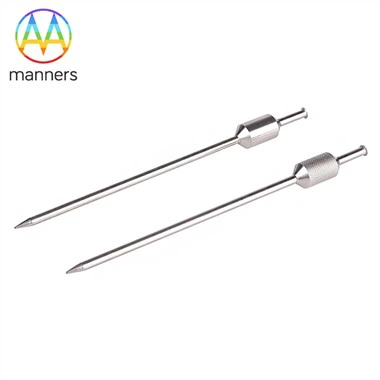
Composite structures and optimised force transmissionA complete biopsy needle consists of an outer sheath, inner stylet and handle transmission mechanism. The outer sheath demands flexibility, often constructed from Nitinol or flexible stainless‑steel braided tubing. The stylet (with sampling notch) requires higher push rigidity and bending stiffness, potentially utilising solid stainless‑steel wire processed with custom heat treatment. Clearance tolerances between the two components are precisely controlled to several microns, ensuring smooth gliding without jamming while preventing excessive gaps that cause tip wobbling or sample leakage during sampling. Handle designs amplify limited human stroke and force via mechanical structures into rapid, powerful linear motion of the stylet.
Comparative Advantages: Engineering Leap from Meeting Specifications to Defining Performance
From an engineer's perspective, gaps in design details translate to generational differences in product performance.
| Comparison Dimension | Conventional Design / Materials (e.g., full 304 stainless steel) | High‑End Materials & Structural Design (e.g., Nitinol + composite structures) | Technical Breakthroughs & Clinical Value Achieved |
|---|---|---|---|
| Passability under Extreme Bending | Poor, prone to permanent bending with significant push‑force loss | Excellent; super‑elastic material restores straightness post‑navigation with high push efficiency | Enables biopsy access to deep regions such as peripheral lungs and pancreatobiliary tracts via natural orifices |
| Puncture Rigidity & Precision | Prone to bending during puncture under high aspect ratios, causing target deviation | High rigidity instantaneously during puncture, enabling precise directional advancement with strong penetration | Improves puncture success rates for hard lesions such as fibrotic nodules and chronic pancreatitis |
| Machining Precision of Micro‑Structures | Limited by conventional processes; inconsistent tip and window shape/size | Precision laser machining enabling complex micro‑structures with micron‑level consistency | Ensures stable cutting performance per sampling with predictable sample quality |
| Friction Coefficient & Surface Finish | High, potentially increasing tissue damage and push resistance | Extremely smooth surface with ultra‑low friction coefficient via specialised polishing or coating | Reduces tissue dragging, lowers perforation risks and improves tactile feedback |
| Product Reliability & Fatigue Life | Prone to metal fatigue and micro‑cracks under repeated bending | Nitinol far outperforms stainless steel in fatigue life, tolerating more bending cycles | Higher reliability for reusable stylets or devices requiring multiple forward‑backward movements during complex procedures |
Conclusion
For medical device engineers, the R&D of endoscopic biopsy needles exemplifies deep integration of micro‑scale material mechanics, precision manufacturing and clinical demands. Success hinges not on stacking expensive materials, but on profound understanding of mechanical environments in clinical scenarios, alongside innovative material applications and structural designs that unify seemingly contradictory performance attributes. Mastery of Nitinol super‑elasticity regulation, micron‑level laser machining and post‑processing, and minimally invasive device system integration enables not only better biopsy needle production but also the forging of an R&D platform capable of tackling more complex, intelligent intraluminal interventional devices of the future. This constitutes the core competitiveness of high‑end active medical device development.