The Ultra-Precision Manufacturing Philosophy For Blood-Drawing Needles Targeted At High-End Medical Device Manufacturers
May 17, 2026
Key words: Ultra-fine processing | Micrometer-level tolerance | Consistency control
Application scenarios: High-precision manufacturing of laboratory animal blood collection needles, production of high-end disposable sterile blood collection needles, processing of special blood collection components for scientific research and diagnostic equipment.
Key selling points: This product provides an in-depth analysis of how a top-quality bloodletting needle is "carved" at the micrometer scale. It focuses on cutting-edge techniques such as 5-axis laser cutting, nanometer-level grinding and polishing, and fully automatic optical inspection, which ensure that the tip geometry, cavity smoothness, and overall size of each needle are nearly perfectly consistent, thus meeting the most stringent requirements for "absolute reliability" and "zero variation" in the most demanding research and medical scenarios.
For Whom Is It Suitable?
This article is intended for manufacturers of high-end medical puncture devices, engineers from precision metal processing enterprises, quality control directors, and project managers responsible for process upgrades. In your opinion, a simple blood-drawing needle is a comprehensive carrier of materials science, mechanical engineering, surface science, and automatic control. When customers (such as top laboratories and diagnostic companies) require that the coefficient of variation of the needle tip puncturing force be lower than 5%, or that the inner cavity be absolutely free of burrs to ensure zero contamination of blood samples, you are facing a "limit manufacturing" challenge at the micrometer scale. What is being compared here is not concepts, but the real hard power of the process.
In-Depth Analysis of Usage Scenarios
Your company has received an order to produce an ultra-fine blood-drawing needle for a top international life science instrument company. The needle is designed for blood collection from the tail vein of transgenic mice, with an inner diameter of 0.1mm. The needle tip is specially designed with a 15-degree ultra-thin-wall inclined surface to minimize trauma and prevent blood vessel collapse.
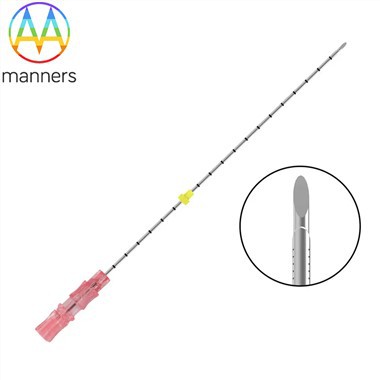
The "micro-engraving" art of needle tips: Traditional stamping or grinding techniques are unable to process such tiny and complex needle tips. You must employ a 5-axis ultra-fast laser cutting system. By precisely controlling the laser focus trajectory in three-dimensional space through computer precision control, the designed needle tip shape can be "eroded" directly from the miniature stainless steel tube. This not only enables ultra-thin wall slopes of 15 degrees, ensuring ultimate sharpness, but also controls the symmetry and eccentricity of the needle tip to the micrometer level, ensuring uniform force during puncture and no lateral deviation, which is crucial for fragile mouse blood vessels.
The pursuit of "mirror-like" internal cavity smoothness: The collected blood samples are used for high-sensitivity genetic sequencing. Any metal particle detachment or protein adsorption would contaminate the sample. After laser cutting, the inner wall will leave a recast layer and microscopic slag. You need to adopt a special micro-channel electrolytic polishing technology, with the electrode inserted into the only 0.1mm inner hole, performing atomic-level electrochemical dissolution, reducing the roughness of the inner wall to below 0.1 micrometers, forming a smooth like mirror surface, completely eliminating sample adhesion and cross-contamination.
Full inspection and "zero defect" commitment: For such high-value core components, sampling inspection is no longer sufficient to ensure quality. You need to establish an automatic optical inspection line. Before each needle leaves the factory, it must be photographed from multiple angles by a high-speed camera, and the AI algorithm will analyze the integrity of the needle tip, the presence of burrs, size tolerance, and may be supplemented by laser diffraction to detect the consistency of the inner diameter. Only needles that pass all inspection items 100% can be used for assembly. This level of process control is the passport for the product to enter the high-end supply chain at a high price.
Comparative Advantage: The Dimensional Leap from "Usable" to "Perfect" in Manufacturing
In the eyes of manufacturing experts, the level of craftsmanship directly determines the competitive position of the product.
Comparison Dimensions:
Conventional manufacturing process (turning + grinding): Can only achieve simple inclined surfaces, with an accuracy of 0.01mm.
Primary precision manufacturing (numerical control machine tools): Can achieve more complex shapes, with an accuracy of 0.005mm.
High-end ultra-precision manufacturing system (as described): Can achieve any complex three-dimensional micro-structure with an accuracy of 0.001mm (1 micron).
Internal surface quality: Has obvious processing lines, requires subsequent polishing, but is difficult to penetrate micro-holes.
Better, but may have microscopic unevenness.
Mirror-like level, uniform throughout the entire cavity, meeting the optimal standard of bio-fluidics.
Batch consistency and coefficient of variation: Large, dependent on worker skills.
Better, but still has fluctuations.
Excellent, through fully digitalized process, variability is reduced to the limit, achieving "products as data".
Capacity to cope with miniaturization and complexity: Limited, difficult to machine inner diameters below 0.2mm.
Has some ability, but costs increase sharply.
Core capability, specializing in processing complex metal components at the micrometer scale.
Quality assurance mode: Dependent on final inspection, sampling risk.
SPC process control plus sampling inspection.
100% critical dimensions full inspection, data full traceability, achieving "zero defect" delivery.
Added value and application fields: Low-end market, general consumables.
Mainstream medical market.
Cutting-edge research, high-end diagnostic equipment, core components of innovative therapies, with huge profit potential.
Conclusion:
For high-end medical device manufacturers, pursuing ultra-precise manufacturing on seemingly basic products like blood-letting needles is not a trivial matter; rather, it is a strategic choice to build a deep technical moat and enter high-value niche markets. This reflects a transition from "mass-scale cost competition" to "premium pricing for advanced performance and quality". The ability to master micro-metre-level metal precision processing is not merely for producing better blood-letting needles; it is also for forging a platform capable of challenging the research and development and manufacturing of more complex and miniaturized medical devices in the future, such as nerve probes and micro-surgical robot end-effectors. Investing in this is investing in the core manufacturing competitiveness of the enterprise in the next medical technology era.