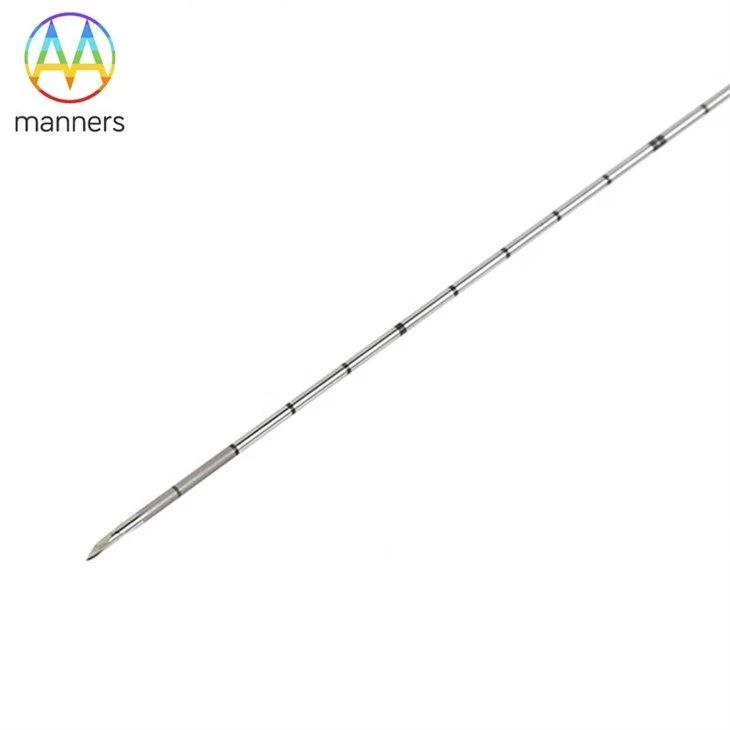
The technique of using trocar
Aug 08, 2022
1. Selection of blood vessels:
Blood vessels with relatively thick, straight, elastic, rich blood flow, no venous flaps, avoiding joints and easy to fix were selected. Common drugs were infused from the distal end and used alternately from the outside to the inside. Infusion of drugs that are strong on vascular irritation and cause decreased vascular elasticity should avoid the expensive veins and their branches of the upper extremity as far as possible, because it is easy to occur phlebitis for strong irritant drugs. Patients with difficulty in venipuncture, especially those with advanced tumors, can choose thoracoabdominal wall venipuncture. Thoracoabdominal wall venipuncture is a small peripheral vein with slow blood flow, low pressure, small activity and not easy to fall off or block the tube. In addition, in the rescue of shock patients, puncture of peripheral superficial vein is very difficult, femoral vein puncture can be used. In patients who are bedridden for a long time, the use of venous indwelling needles in the distal extremities should be avoided as far as possible, and the indwelling time should not be too long, because venous thrombosis in the lower extremities is more common than that in the upper extremities. .
2. Selection of indwelling needle model:
On the premise of not affecting the speed of intravenous infusion, fine and short indwelling needles should be selected, because the relatively small indwelling needles float in the blood vessels after entering the blood vessels of the body, which can reduce mechanical friction and damage to the inner wall of the blood vessels, thus reducing the occurrence of mechanical phlebitis and thrombotic phlebitis. The relatively large type of indwelling trocar should be selected for the injection of high polymer and high concentration drugs and drugs with strong vascular irritation, which does not affect the infusion speed and volume, ensure the timely and accurate infusion of drugs into the patient, does not affect the drug efficacy, and relatively small vascular irritation.
3. Puncture method:
Select blood vessels, routine disinfection of the skin area of more than 8×8 cm. After connecting the infusion line and draining the air in the indwelling needle, clamp it. Loosen needle outer casing pipe rotated to 15 ° to 30 ° Angle line vein puncture, the needle is slow, in order to avoid too prick blood vessel walls, reduce the puncture point, after see h. along the blood vessels on 1 ~ 2 cm, the outer casing tip into the blood vessels, all right hand fixed needle core, left hand pushed outside casing, loosen the tourniquet, transparent dressings, fixed date and time and indicate the puncture. In the case of poor peripheral vascular filling caused by fasting, trauma, blood loss, pain, low ambient temperature, and poor individual circulation, the puncture site can be selected first and then hot compress, and the puncture can be performed after the vessel is filled. The tourniquet can also be tied before puncture. After gently rubbing the skin at the puncture site with your hand, relax the tourniquet for a moment and then tie the tourniquet. The correct way of tube delivery is to place an external cannula while withdrawing the needle core, which avoids the needle core touching the vessel wall, and the external cannula can pass through the skin smoothly with the support of the needle core.
4. Sealing method:
Sealing is the key to successful indwelling. Proper method can prolong the time of catheterization and prevent the occurrence of complications. The positive pressure sealing method is adopted when sealing the pipe. First, 3ml heparin saline solution was injected uniformly, and the extension tube of the indwelling needle was raised by 30 degrees. The extension tube was clamped by the small clip on the extension tube, and then 0.5 ml heparin saline solution was injected to seal the tube. After sealing the tube, the heparin solution in the sleeve is relatively high pressure, so that the fluid can flow into the body.
5. Indwelling time of venous trocar:
There is no uniform standard for venous trocar indwelling time in our country. BD Company recommends 3~5 days. According TO THE STUDY, THE PATIENT WITH NORMAL BLOOD VISCOSITY CAN INDwellING COMMONLY 2~5 days, THE most effective period is 3 days. In clinical practice, it is completely feasible to maintain the local clean, dry and closed fixed environment of the puncture site as long as the attention is paid to nursing, without pipe blocking and leakage. However, in order to prevent the long-term stimulation of blood vessels, chemical phlebitis and small blood clots into the blood vessels to cause blockage, the number of days of indwelling is best not to exceed 7 days.
6. Prevention of common complications:
Common complications associated with the use of venous trocar are phlebitis, fluid extravasation, and cannula blockage. .
1) Prevention of phlebitis ① Strict aseptic operation; ② Reduce mechanical stimulation; ③ Avoid chemical stimulation: disinfection disinfectant should not be too much, and to dry. Flush the tube with normal saline before and after inputting irritant drugs. Avoid inputting strong irritant drugs through trocar as far as possible
2) Prevent fluid extravasation ask client to keep infusion limb level with heart or slightly higher. Clothing above the puncture site should not be too tight to avoid affecting local blood reflux.
3) Prevent clogging of the cannula and seal the tube correctly after each infusion to keep the trocar unobstructed.
7. Nursing of venous trocar: 1. Strictly grasp the scope of use of venous trocar. For patients with large infusion volume, strong drug irritation and long infusion time, the blood vessels with fast blood flow speed, straight and thick, far from the joint and venous valve should be selected for venous indwelling; 2. Correct infusion of drugs and fluids to adjust infusion speed according to the nature of drugs and infusion volume. In the order of medication, the first input of hypertonic or irritating drugs, and then the input of isotonic or less irritating drugs; The normal saline should be flushed before and after the infusion of chemical drugs, and the normal saline should be flushed before and after the infusion of plasma, whole blood and 3L bag. After the infusion, the normal saline should be flushed quickly to reduce the attachment of tangible components and keep the tube unobstructed. 3 Health education should be strengthened during venous trocar. 3.1 Distal limb elevation should be performed during infusion to promote venous return. .. 3.2 During infusion, wet and hot compress the puncture point with towel for 15-20min/time. .. 3.3 After the infusion of fluid, the puncture limb was irradiated with a TDP lamp for 20 to 30 minutes every day. .. Banned bath during 3.4 trocar, prevent infection and spread during the trocar puncture point, if a puncture site redness, swelling, heat, pain, prompt to have phlebitis occurred, should be promptly removed trocar, local with 50% magnesium sulfate or nitrofurazone solution for cold, severe cases need to do physical therapy, vein input antibiotics to prevent infection.
If you have any questions, please contact us. Our company can produce various customized needles, medical needles, puncture needles, hypodermic needles, biopsy needles, vaccine needles, injection needles, syringe needles, veterinary needles, pencil point needle, ovum pick up needles, spinal needles, etc. If you need customized needle products, please contact us. We look forward to your inquiry! The quality of the products manufactured in our factory will surely satisfy you!
Please contact us if you need: zhang@sz-manners.com