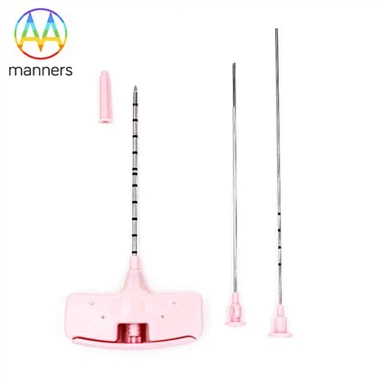
Pencil-point needles
Oct 17, 2021
Once the suggestion that dura fibers are unlikely to be damaged by non-cutting needle points is published, it is only a matter of time before the emergence of completely non-cutting needle points. Kirschner and Rovenstine's needles have lateral orifices, which contribute to the next stage of needle tip design. As with many medical discoveries, those who are believed to have introduced new aspects of device design are not the first to describe it. Hart and Whitacre are usually related to the design of the first closed side-hole pencil-point needle, but the Swedish doctor Haraldson published a paper in 1951 (a few months before Hart and Whitacre) describing a needle he developed To reduce the incidence of PDPH. The specifications of the needle are very fine, with a solid non-cutting cone tip and a hole on the conical surface 2 mm from the needle tip. He cited the non-cutting needle (non-severe) PDPH rate of 9%, while the cutting needle had a PDPH rate of 32% (18% severe). The Haraldson needle failed to get the recognition it deserves, probably because it is produced in small quantities locally, so it won the author of the next description of this needle.
Hart and Whitacre published a paper titled "Pencil Point Needle Prevention of Post-Spine Headache" in October 1951. They acknowledged H. M. Greene's 1923 advocacy of minimizing trauma to the dural fibers. They approached Becton Dickinson with a 20-gauge needle design, where the solid end of the needle was drawn into a point that resembled a finely sharpened pencil. The opening is on the side of the needle, next to the solid needle tip (Figure 11). The original needle was actually a solid tapered tip, attached to the hollow cannula, with the orifice immediately adjacent to the tip. They inferred that the tip separates the longitudinal fibers of the dura and arachnoid without causing trauma to them. When the needle is withdrawn, the fibers return to a tightly juxtaposed state, thereby minimizing leakage of cerebrospinal fluid. They admit that they have no direct evidence, but the reported PDPH rate is 2%, while the PDPH rate of other commonly used cutting needles is 5-10%. In addition, they reported a reduction in the severity of headaches after using pencil-point needles. The pencil-point needle has a more pronounced "dural click."

Figure 11
Whitacre needle (1951).
If you have any questions, please contact us. Our company can produce various customized needles, medical needles, puncture needles, biopsy needles, vaccine needles, injection needles, syringe needles, veterinary needles, ovum pick up needles, spinal needles, etc. If you need customized needle products, please contact us. We look forward to your inquiry! The quality of the products manufactured in our factory will surely satisfy you!
Please contact us if you need: zhang@sz-manners.com