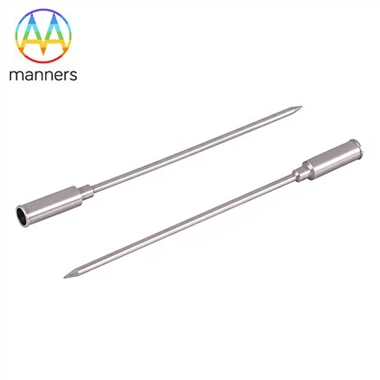
Directional spinal needles
Oct 16, 2021
Since the acceptance of spinal anesthesia needles into modern anesthesia practice, many minor modifications to the incision bevel have been described, but there are still major problems that PDPH and spinal anesthesia solution enter the epidural space. A new design is needed. The next tip design gradually evolved, again with the initial release of the design concept, and minor modifications as the problems encountered and overcome. The next stage of development is a closed needle with a side hole, which forms the basis of the pencil-point needle commonly used today.
Barker is believed to have designed the first directional closed-end spinal needle, but a quotation from 1912 shows that this is not the case... I recently saw a small cannula that claimed to be mine, with a closed end and one that in many cases could only The lateral opening at the point where the solution exits the epidural membrane is short. This is a hopeless error... In fact, in 1932, Kirschner of Germany was the first to publish an article on the use of a closed directional needle. The long side of the bevel is close to this point. He claimed that the side port allows unilateral, cranial, or caudal anesthesia. Despite the support of some recognized workers in the field, Kershner's needles failed to gain wide acceptance.
Rovenstine adopted the closed needle design concept and published a paper describing his spinal needle in 1944. He initially focused on the alternative design of the open bevel needle to overcome the influence of the direction of the bevel in determining the scope of anesthesia. He felt that if the end of the needle was closed, the spread of anesthesia could be controlled through the direction of the orifice. Rovenstine's needle is 19G or 20G (Figure 10). It has a closed short beveled tip with a side hole 2 mm from the distal end of the needle. The mounted stylet has a matching bevel that will block the orifice when seated. The side holes allow directional flow, thereby controlling the diffusion of the local anesthetic. This theory was later overturned, and it was found that the direction of the orifice had little effect on the degree of diffusion of the local anesthetic solution. The distance between the orifice and the needle tip is 2 mm, which means that the needle needs to be inserted into the subarachnoid space deeper than ideal.

Figure 10
Rovenstine needle (1944).
If you have any questions, please contact us. Our company can produce various customized needles, medical needles, puncture needles, biopsy needles, vaccine needles, injection needles, syringe needles, veterinary needles, ovum pick up needles, spinal needles, etc. If you need customized needle products, please contact us. We look forward to your inquiry! The quality of the products manufactured in our factory will surely satisfy you!
Please contact us if you need: zhang@sz-manners.com