Fine Needle Aspiration (FNA) Biopsy for Thyroid Nodules: What to Know
Nov 01, 2024
Introduction
When a thyroid nodule is detected during a health check, many patients wonder: Is a biopsy necessary? Is the procedure safe? These concerns are understandable, and as ultrasound specialists, we frequently address these questions. This article will guide you through the essential information about thyroid fine needle aspiration (FNA) biopsy and explain how it helps in accurate diagnosis.
What Is a Thyroid Nodule?
The thyroid, the largest endocrine gland in the body, plays a crucial role in regulating metabolism. A thyroid nodule is a distinct lump or abnormal tissue growth in the gland, which can be singular or multiple. These nodules may result from thyroid tissue hyperplasia, autoimmune conditions, or long-standing inflammatory processes. Although nodules are common, their characteristics vary, necessitating careful evaluation to determine if they are benign or malignant.
What to Do If a Thyroid Nodule Is Detected
If a thyroid nodule is discovered, it's important not to panic. The majority of thyroid nodules are benign, meaning they don't require treatment beyond regular monitoring. However, malignant nodules, often indicative of thyroid cancer, usually need surgical removal or other interventions like radiofrequency ablation.
Ultrasound imaging is the first-line diagnostic tool due to its efficiency, safety (no radiation), and high accuracy. It helps classify nodules based on their shape, borders, and vascularity. While ultrasound is excellent for risk assessment, confirming the nature of a suspicious nodule often requires a more definitive diagnostic procedure: the fine needle aspiration biopsy.
What Is Fine Needle Aspiration Biopsy?
Fine Needle Aspiration (FNA) Biopsy is a minimally invasive technique to assess thyroid nodules' cellular makeup. Performed under ultrasound guidance, it involves inserting a thin needle (approximately 0.7 mm, even finer than a typical syringe needle) into the nodule to collect a sample for pathological examination. The entire procedure is brief, requires no anesthesia, and causes minimal discomfort, making it a highly efficient method for evaluating suspicious nodules.
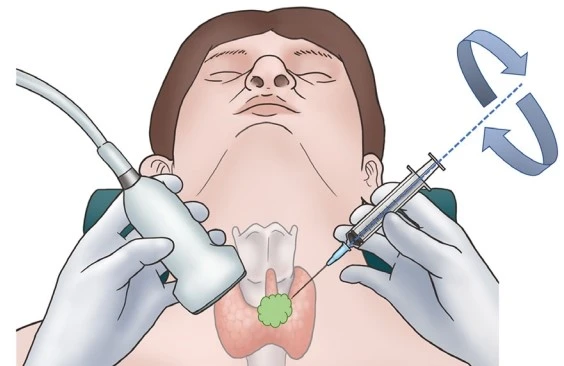
▲ Image of FNA Biopsy Procedure
Which Nodules Need Fine Needle Aspiration?
Certain criteria make a nodule more likely to require a biopsy:
- High Suspicion Based on Ultrasound Features: Nodules classified as TI-RADS or rated as category 4A or above. The higher the category, the greater the suspicion of malignancy.
- Symptoms Indicating Compression: Nodules causing breathing difficulties or a sense of choking.
- Suspicious Lymph Nodes: Evidence suggesting possible metastasis in nearby neck lymph nodes.
- Diffuse Thyroid Disease with Suspicious Nodules: Generalized thyroid inflammation or diseases like Graves' disease that may also present nodules.
- Follow-Up for Treated Thyroid Cancer: Newly detected nodules after surgery for thyroid cancer may warrant a biopsy.
These situations require careful assessment and often result in FNA biopsy to guide treatment strategies.
Is Fine Needle Aspiration Biopsy Safe?
Yes, FNA biopsy is generally very safe. The procedure carries minimal risk, especially when performed by experienced specialists using ultrasound guidance. The thin needle minimizes tissue trauma, and most patients experience only mild discomfort. Serious complications, such as bleeding or infection, are extremely rare.
During the procedure, the patient lies down with the neck slightly extended. The skin is cleaned and sterilized, and the biopsy needle is gently guided into the nodule while the doctor monitors its position on the ultrasound screen. Cells are aspirated, and the entire process is over in a few minutes.

▲ Image of Ultrasound-Guided Procedure Setup
Pre-Procedure and Post-Procedure Guidelines
To ensure safety and optimal results, certain precautions are necessary:
- Pre-Biopsy Preparations: Tests to check coagulation function and complete blood counts are usually recommended. If the patient is taking blood thinners, these might need to be paused under medical advice.
- Post-Biopsy Care:
- Apply gentle pressure to the biopsy site for 20-30 minutes to prevent bleeding.
- Before leaving, an ultrasound check ensures there is no bleeding or hematoma formation.
- Patients should avoid strenuous activities for 24 hours.
- It's common to experience slight bruising or tenderness at the site, but this usually resolves quickly.

▲ Image of Post-Biopsy Care
Additional Information and Emerging Techniques
Recent advancements include liquid biopsy technologies that analyze circulating tumor DNA or cells, offering promising tools for early cancer detection. While not yet standard for thyroid nodules, research in this area continues to evolve, potentially improving the accuracy of non-invasive diagnostics.
Conclusion
Understanding when and why to undergo a thyroid fine needle aspiration biopsy can alleviate fears and facilitate early, effective treatment if necessary. This procedure stands as a critical element in modern thyroid care, emphasizing precision and patient safety. As always, consult with your healthcare provider to determine the best approach for your individual needs.