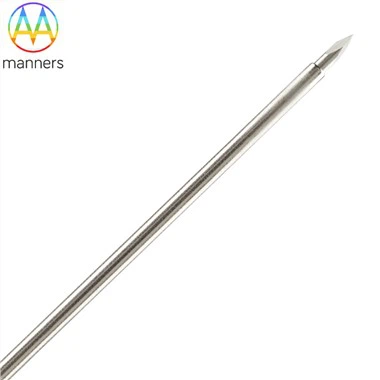
Continuous spinal needle
Oct 19, 2021
Continuous spinal needles have their problems and are technically difficult to use and keep in place. In 1944, Tuohy used a 15G directional spinal needle to insert a nylon ureteral catheter into the subarachnoid space for continuous spinal anesthesia. The needle has a suitable stylet with a matching bevel (Figure 15). The mid-length bevel has a cutting edge. A year later, he published an article describing the improvement of his needle to include a "Huber tip," which allows the catheter to be directed cephalic or caudally as needed. Huber is an American dentist who applied for a patent for the tip design for subcutaneous use in order to reduce the core of the tissue when the needle is inserted. The original Tuohy needle had a sharp inner edge of the bevel, which caused the catheter to be cut, so it was modified. Over the years, other modifications have been made to the Tuohy needle. One modification is the Tuohy Flowers modification, which has a shorter and blunt bevel, and the stylet extends out of the bevel of the needle to facilitate the insertion of the tip through the tough ligament (Figure 16).

Figure 15
Tuohy needle (1944).

Figure 16
Tuohy Flowers needle (1956).
With the emergence of pencil-point needles for single spinal anesthesia, similar needles are inevitably used for continuous spinal anesthesia. Although Tuohy has introduced the idea of using catheters instead of needles for continuous spinal anesthesia, large Tuohy needles and catheters have a significant PDPH rate, so continuous spinal needles are still commonly used. Cappe and Deutsch described a malleable tapered tip in 1953. It has a diameter of 20G, a Whitacre tip and an 18G introducer (Figure 17). The middle part is annealed to make it malleable so that once the tip enters the subarachnoid space, the needle can bend on the surface of the skin. There is an adjustable needle stop to stabilize the needle. They reported that their needle group had a PDPH rate of 6.6%, while the traditional sharp needle group had a PDPH rate of 22%.

Figure 17
Cappe and Deutsch needle (1953).
If you have any questions, please contact us. Our company can produce various customized needles, medical needles, puncture needles, biopsy needles, vaccine needles, injection needles, syringe needles, veterinary needles, ovum pick up needles, spinal needles, etc. If you need customized needle products, please contact us. We look forward to your inquiry! The quality of the products manufactured in our factory will surely satisfy you!
Please contact us if you need: zhang@sz-manners.com