Arthroscopic knee cartilage
Jul 01, 2022
Arthroscopy has little trauma, but good intraarticular field of vision, and can comprehensively and carefully observe various structures in the joint cavity. Other lesions that are difficult to determine by examination, such as articular cartilage destruction, meniscus degenerative tear, synovial hypertrophy, and intercondylar socket stenosis, can be fully understood to determine the extent of intraarticular lesions and injuries. Therefore, selective operation for specific lesions in the joint can make the surgery more delicate and reduce the trauma to the maximum. In limited joint debridement, it is necessary to pay attention to gentle operation for various osteoarthritis lesions, including the removal of separated cartilage fragments and free bodies; Surface wear meniscus to repair smooth planing, meniscus tear to partial excision; Moderate cleaning and grinding of degenerative cartilage surface, emphasis should be placed on cleaning the cartilage flap to be peeled off and polishing the surrounding roughness formed after the peeling of cartilage; For exposed and hardened subchondral bone area after cartilage stripping, kirschner needle drilling method can be adopted. Grind only osteophytes that affect joint movement; The hyperplastic synovial lesions should be appropriately excised to avoid involving normal synovial tissues as far as possible. For patients with patellofemoral joint pain, only the hyperplastic and hypertrophic synovial tissues in patellofemoral joint, femoral tibial joint and intercondylar fossa should be dissected. Therefore, limited arthroscopic cleaning can be used to comprehensively deal with osteoarthritis lesions, and at the same time reduce unnecessary operations in the joint, so as to reduce the disturbance of normal joint life and function, and maximize the advantages of minimally invasive arthroscopic surgery. At the same time, it can reduce postoperative bleeding, reduce the joint response to surgery, and is conducive to shortening and speeding up the rehabilitation process. In this group of 6 cases with poor postoperative results, the author found that 3 cases were caused by excessive intraoperative resection of synovial tissue, which resulted in continuous swelling of the joint after surgery and no obvious pain relief. Among them, 1 case had repeated blood and fluid accumulation of the joint, and the postoperative pain was aggravated.
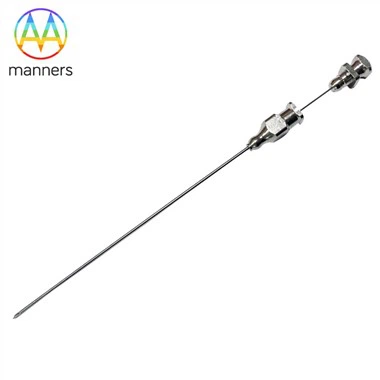
If you have any questions, please contact us. Our company can produce various customized needles, medical needles, puncture needles, hypodermic needles, biopsy needles, vaccine needles, injection needles, syringe needles, veterinary needles, pencil point needle, ovum pick up needles, spinal needles, etc. If you need customized needle products, please contact us. We look forward to your inquiry! The quality of the products manufactured in our factory will surely satisfy you!
Please contact us if you need: zhang@sz-manners.com