Veress Needle Dimension Design: How Length And Diameter Specs Adapt To Diverse Surgical Scenarios
Aug 26, 2026
https://en.wikipedia.org/wiki/Veress_needle
1. Industry and Clinical Pain Points
Unreasonable dimension specification matching is a common hidden cause of Veress needle insufflation failure and surgical complications in clinical practice. Many medical staff ignore the adaptive logic of needle length, outer diameter and inner lumen diameter with patient anatomy and surgical scenarios, and uniformly use conventional standard-size Veress needles for all operations. Too short needle body leads to insufficient penetration of thick abdominal wall, resulting in preperitoneal gas accumulation and pneumoperitoneum failure; excessive outer diameter causes excessive abdominal wall tissue trauma and increased postoperative pain; undersized inner lumen leads to slow gas injection, unstable intra-abdominal pressure and prolonged operation time. Different manufacturers have inconsistent dimension calibration standards, resulting in poor product compatibility. The lack of scenario-based dimension matching guidelines makes it impossible to give full play to the precise application value of Veress needle dimension design.
2. Core Dimension Adaptive Design Principles
The dimension design of Veress needles follows the core principles of anatomical adaptation, mechanical balance and surgical efficiency matching. Needle body length is designed based on human abdominal wall thickness distribution data, ensuring effective penetration of abdominal wall tissues without excessive deep penetration to avoid visceral injury. Outer diameter is matched with tissue trauma tolerance, balancing puncture efficiency and minimally invasive effect, realizing rapid tissue penetration with minimal incision trauma. Inner lumen diameter is designed according to CO₂ insufflation flow demand, ensuring uniform and stable gas delivery, avoiding flow turbulence and pressure fluctuation. The three-dimensional dimension parameters form a collaborative matching system, adapting to the anatomical differences of different age groups, different BMI patients and different surgical complexity scenarios, realizing precise dimensional matching between equipment and clinical needs.
3. Full Specification Dimension Classification
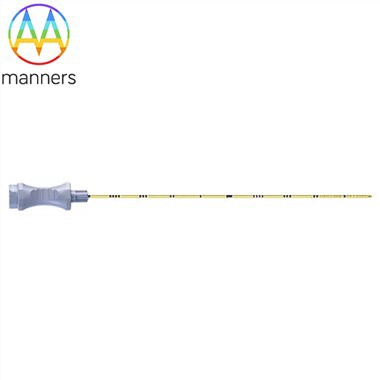
Based on industry unified standards and clinical adaptation requirements, Veress needle dimensions form a complete graded specification system covering all scenarios. In terms of length: ultra-short pediatric type is 80mm, suitable for children's thin abdominal wall; standard adult type is 100–120mm, covering most routine adult surgeries; extended enhanced type is 120–150mm, specially used for obese patients with thick abdominal wall. In terms of outer diameter: conventional type is 2.5–3mm, with balanced trauma and efficiency; enhanced thick-wall type is 3–5mm, with strong penetration for tough tissues. In terms of inner lumen diameter: conventional lumen is 1.5–2mm, suitable for routine low-flow insufflation; enlarged lumen is 2–3mm, meeting high-efficiency gas supply needs of complex surgery. All specifications adopt unified tapered cannula design to ensure low-resistance puncture.
4. Dimension Matching Scenario Operation Guide
Carry out precise dimension specification matching and standardized operation according to patient characteristics and surgical scenarios. Pediatric laparoscopic surgery: select 80mm ultra-short and 1.5mm ultra-fine inner lumen Veress needle, control low-flow insufflation below 0.6L/min to adapt to children's delicate abdominal tissues. Routine adult elective surgery: adopt 100–120mm standard length and 2.5mm outer diameter specification, with conventional 0.8–1.0L/min insufflation flow to ensure stable pneumoperitoneum. Obese and thick abdominal wall patients: use 120–150mm extended long needle and enlarged inner lumen, appropriately increase insufflation flow to compensate for gas supply resistance. Complex long-time surgery: select enhanced outer diameter specification to avoid needle body shaking and displacement during long-term operation. Strictly prohibit cross-specification blind matching to eliminate dimensional mismatch risks.
5. Practical Clinical Dimension Matching Experience
Clinical statistical data proves that standardized dimension matching can increase the primary success rate of Veress needle entry by 92% and reduce pneumoperitoneum instability rate by 88%. Senior surgeons emphasize that dimension matching must take patient BMI and abdominal wall thickness as the core basis rather than fixed operation habits. For patients with BMI higher than 28kg/m², extended long-spec needles must be used to avoid insufficient penetration; for pediatric patients and thin adult patients, ultra-short and ultra-fine lumen specifications are mandatory to prevent excessive trauma and high-pressure injury. In multi-port combined laparoscopic surgery, enlarged lumen Veress needles are preferred to improve insufflation efficiency and shorten operation preparation time. Reasonable dimension matching is the simplest and most effective means to avoid entry complications.
6. Summary and In-depth Sublimation
Graded dimension specification design is the refined embodiment of Veress needle equipment industrialization and clinical precision application. Diversified length, diameter and lumen parameter settings break the limitation of single-size universal application, realizing precise docking with individual anatomical differences and surgical scenario needs. Scientific dimension matching abandons the extensive empirical operation mode, realizes quantitative and standardized equipment application, and effectively solves various clinical problems caused by specification mismatch. It is an important part of the standardized system of laparoscopic minimally invasive surgery and provides basic equipment support for individualized and refined surgical diagnosis and treatment.
7. Industry Development Prospects and Optimization Suggestions
In the future, Veress needle dimension design will develop towards personalized customization and intelligent grading. The industry will unify global dimension calibration standards to eliminate specification confusion among different manufacturers. Manufacturers will launch gradient fine-tuning dimension products to cover more subtle anatomical difference scenarios. Medical institutions will establish BMI-based dimension matching databases to form intelligent specification recommendation systems. With the popularization of precise minimally invasive concepts, full-scenario standardized dimension matching will become the basic operation norm of laparoscopic surgery, further improving the overall precision and safety of abdominal entry technology.