Vascular Access Needle Sets For Difficult Access In Obese Emergency Patients
Nov 20, 2026
Pain Point
Rapid, stable vascular access is the foundation of emergency resuscitation, yet obese patients consistently present one of the toughest clinical challenges. Peripheral veins are often buried under thick adipose tissue, prone to collapse under shock and hypotension, making repeated cannulation attempts time‑consuming and frequently unsuccessful. Central venous catheterization demands advanced skills, takes precious minutes in arrest or shock scenarios, and carries inherent risks of pneumothorax, bleeding and vessel injury. Standard short intraosseous needles, such as 25 mm models, often fail to reach cortical bone when soft tissue depth exceeds their effective working length. As your clinical data notes, obese patients may require extended 45 mm intraosseous needles to achieve successful bone purchase. Meanwhile, intraosseous access carries clear risks: extravasation is the most frequent adverse event, and delayed detection can progress to limb‑threatening compartment syndrome. Other hazards include local cellulitis, soft tissue abscess and osteomyelitis. Clinicians need integrated vascular access needle sets that cover both standard and extended needle lengths, paired with clear protocols for contraindication screening, sterile insertion and timely device removal within 24 hours. Without a complete, tiered needle set solution, emergency teams are forced to improvise during high‑stress resuscitation, raising complication rates and reducing survival chances for high‑BMI critically ill patients.
Working Principle
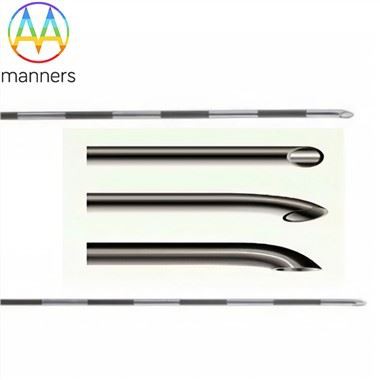
Vascular access needle sets combine peripheral cannula components and intraosseous needle assemblies to establish routes for delivering fluids, blood products and emergency medications directly into the circulatory system. Intraosseous access relies on the marrow's non‑collapsible venous plexus inside long bones. Even during severe shock when peripheral veins collapse, marrow sinusoids remain patent and connect directly to central venous circulation. This is why intraosseous access serves as a reliable salvage route when peripheral and central access cannot be secured. The dimensional difference between 25 mm and 45 mm intraosseous needles addresses soft tissue variation: shorter 25 mm needles suit patients with thin to moderate subcutaneous layers, while 45 mm variants are engineered for obese patients with substantial overlying fat. The stainless steel construction of these needles undergoes precision machining including necking, swaging, grinding, laser cutting, laser marking and electropolishing. Electropolishing delivers a smooth, low‑friction surface that reduces tissue drag during penetration and improves biocompatibility. Necking and swaging lock the cannula and stylet structure together, preventing separation during rotational insertion. Laser marking enables clear permanent identification of gauge and length at the bedside. All intraosseous devices in these sets follow a core safety rule: they are temporary access tools and should be removed within 24 hours once definitive vascular access is obtained, to cut infection risk.
Device Classification
Vascular access needle sets can be grouped by access type, needle specification and clinical application scenario. First, by access route, kits include peripheral IV cannula components and intraosseous needle assemblies. Intraosseous subcategories are further divided by length: standard 25 mm short intraosseous needles and extended 45 mm intraosseous needles for obese patients. Gauge options commonly include 15G, with custom gauge support available on request. By manufacturing feature, standard catalog products adopt fixed dimensions and marking schemes, while custom vascular access needle sets can be developed according to customer 2D drawings, 3D files or physical samples. In terms of machining finish, electropolished stainless steel needles form the premium grade, distinguished from basic ground needles by smoother surfaces and superior corrosion resistance. Regulatory classification defines these products as injection and puncture instruments, requiring full sterility validation. Packaging options include bulk standard export cartons for hospital central supply storage or individually packed sterile sub‑kits for emergency bags, arranged according to buyer requirements. Some sets also contain auxiliary accessories such as antiseptic swabs, securement dressings and flushing syringes for one‑stop resuscitation preparation.
Practical Operation Guide
Before selecting any needle from the vascular access needle set, perform mandatory contraindication screening. Intraosseous access must not be performed at sites with existing long bone fracture, limb vascular injury, active cellulitis, previous orthopedic surgery at the target site, or intraosseous cannulation on the same bone within the prior 24 hours. Assess patient body habitus and soft tissue thickness. Select a 25 mm intraosseous needle for patients with shallow soft tissue; switch to the 45 mm intraosseous variant for obese patients when palpation and clinical judgment indicate thick subcutaneous layers. Prepare the insertion site with full sterile antisepsis to reduce infection risk. Stabilize the target limb firmly to avoid sudden movement during penetration. Advance the needle with controlled axial pressure and rotation until a distinct loss‑of‑resistance sensation confirms cortical penetration. Stop advancement immediately once seated. Extract the internal stylet, aspirate marrow contents to verify intraosseous positioning, then flush with normal saline to check for extravasation. If swelling, leakage or increasing pain develops at the site, extravasation is confirmed; terminate infusion and remove the needle right away. Secure the hub with sterile dressing and immobilize the limb. Continuously monitor for compartment syndrome signs such as tense swelling, disproportionate pain and impaired distal perfusion. Arrange for prompt conversion to peripheral or central venous access, and remove the intraosseous needle no later than 24 hours after placement. Document needle length, insertion time, site condition and any adverse findings.
Real-World Clinical Experience
Emergency and pre‑hospital teams using integrated vascular access needle sets have accumulated consistent practical lessons. The biggest advantage of stocking mixed‑length kits is eliminating the common scenario where only short 25 mm intraosseous needles are available for obese patients, leading to failed attempts and lost resuscitation time. Operators emphasize that the 45 mm extended needle is not a universal upgrade; it carries a longer insertion path, so over‑penetration risk rises if depth assessment is poor. The most prevalent complication remains extravasation. Many providers underestimate how difficult leakage is to detect under thick adipose tissue, so mandatory saline flushing and post‑insertion site checks are non‑negotiable. Teams also report that the electropolished stainless steel finish makes insertion smoother and reduces tissue trauma compared with untreated needle surfaces. Laser marking on the shaft prevents mix‑ups between 25 mm and 45 mm needles during chaotic resuscitation. One common protocol failure is leaving intraosseous needles in place beyond the 24‑hour window, which significantly increases the chance of osteomyelitis and deep infection. Staff must treat intraosseous access as purely temporary, not a substitute for definitive venous lines.
Summary & Reflection
Vascular access needle sets provide a tiered toolkit to resolve difficult vascular access, integrating both standard and extended intraosseous needles to cover average‑weight and obese critically ill patients. The inclusion of 45 mm intraosseous needles directly responds to the limitation of 25 mm short needles in high‑BMI populations. Advanced machining processes including swaging, necking and electropolishing underpin mechanical stability and biocompatibility. Even with high‑quality hardware, safety hinges on strict adherence to contraindication checks, sterile technique, extravasation surveillance and the 24‑hour removal rule. Complication risks are not eliminated by the needle itself; they are managed by standardized workflow. Hospitals that only stock single‑length intraosseous kits will continue to face access gaps for obese patients. Equally, teams supplied with mixed‑length sets but lacking training on selection criteria will misuse extended needles and create new preventable adverse events. Procurement and training must advance together.
Outlook & Recommendations
Moving forward, manufacturers can optimize vascular access needle sets by adding color‑coded hubs to distinguish 25 mm and 45 mm intraosseous needles at a glance, complementing laser marking. Bundled training simulation kits replicating thick soft tissue for obese patient scenarios can be offered alongside bulk orders. Clinical guideline bodies should formalize decision trees for selecting between 25 mm and 45 mm intraosseous needles within vascular access needle sets. Further clinical research should collect comparative data on extravasation, infection and compartment syndrome rates between standard and extended intraosseous devices. Suppliers should preserve flexible custom machining capacity, supporting adjustments to gauge, tip profile and kit composition from customer 2D/3D drawings or samples. Packaging can be upgraded with tamper‑evident sterile wrapping for individual sub‑kits while retaining cost‑effective standard cartons for large‑volume hospital stock. As global obesity prevalence rises, tiered vascular access needle sets with extended intraosseous options will become a baseline requirement for emergency departments and EMS systems worldwide.