Uncovering How Brachytherapy Needle Manufacturers Define The Reliability Of Radiotherapy Precision Through Micrometer‑Scale Manufacturing
May 24, 2026
The creation of a qualified brachytherapy needle represents the ultimate pursuit of micrometer‑level precision and zero‑defect reliability. From a medical‑grade metal tube to a precision instrument that accurately reaches tumor target areas under image guidance and ensures stable dwelling or precise movement of radioactive sources, every manufacturing step embodies the deep integration of materials science, precision mechanical machining, surface science and sterile control technologies. Manufacturers' core competitiveness lies in their ability to translate rigorous designs into mass‑produced products with highly consistent performance and absolute safety. Behind this lies a stringent, coherent and continuously optimized system of precision manufacturing and quality control.
Manufacturing begins with strict screening of medical‑grade raw materials. Whether 316L stainless steel or medical titanium alloys such as Ti6Al4V, complete material certification reports must be provided to verify that their chemical composition, mechanical properties (e.g., tensile strength, yield strength) and biocompatibility (e.g., nickel ion leaching) comply with international medical standards such as ASTM and ISO. The purity and consistency of raw materials form the foundation for all subsequent precision machining.
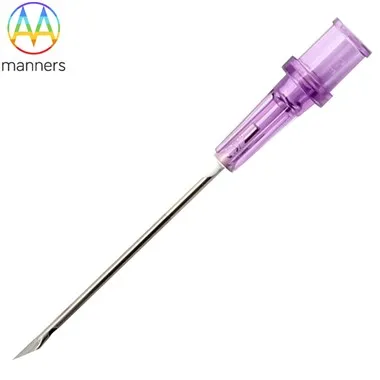
Precision forming and machining are core to shaping the geometric accuracy of needle shafts. For cannulas, multi‑pass precision drawing processes are commonly adopted to gradually machine the outer diameter, inner diameter and wall thickness to micrometer‑level tolerances as required by design (typically within ±0.01 mm to ±0.03 mm). This process must ensure extremely high concentricity and uniform wall thickness. Even minor deviations may cause unpredictable bending of cannulas during puncture or hinder the smooth movement of radioactive sources inside lumens. Tip forming is the soul of the manufacturing process. Needle tips are usually machined into bevels with specific angles to facilitate puncture. This requires multi‑axis ultra‑precision grinding using diamond or CBN abrasive wheels to produce sharp, uniform and burr‑free cutting edges at nanometer‑scale resolution. Angular errors of cutting edges must be kept to a minimum, as angles directly affect puncture force and tissue trauma.
Surface finishing is a critical step to enhance performance and safety. Electrolytic polishing is widely applied to metallic treatment needles. Electrochemical treatment selectively dissolves micro‑protrusions on both inner and outer surfaces of cannulas, significantly reducing surface roughness (typically required Ra ≤ 0.8 μm) to achieve a mirror‑smooth finish. Smooth inner walls greatly lower frictional resistance for radioactive sources (e.g., after‑loading source wires) moving inside lumens, enabling them to reach preset dwelling positions accurately and rapidly - the physical basis for precise dose delivery. Smooth outer walls minimize tissue resistance and trauma during puncture, improving patient comfort. Titanium alloy needles may also undergo treatments such as anodization to enhance surface properties.
Cleaning and sterilization serve as the final line of defense for biosafety. After all components are assembled in clean‑room environments, they must undergo strict cleaning procedures to remove all residual machining oils, metal debris and particles. For single‑use treatment needles, ethylene oxide (EO) sterilization or gamma‑ray irradiation sterilization is adopted following final packaging. Manufacturers must conduct comprehensive sterilization validation to prove that processes effectively eliminate all microorganisms without adversely affecting instrument material performance, dimensional accuracy or packaging integrity. For reusable components (e.g., certain guiding cannulas), validation is required to confirm tolerance to dozens of high‑pressure steam sterilization cycles without performance degradation or corrosion.
Full‑chain quality control provides fundamental assurance for reliability. Top‑tier manufacturers implement quality control throughout every stage of the manufacturing chain: incoming material inspection (spectral analysis of material composition), in‑process inspection (real‑time online monitoring of critical dimensions such as tip angle, inner diameter and straightness), final performance testing (including puncture force tests simulating tissue penetration, smoothness tests ensuring unobstructed radioactive source passage, and leakage tests verifying tightness), as well as sterility testing and packaging integrity testing. Complete traceability records are maintained for every batch of products.
Therefore, what brachytherapy needle manufacturers deliver is far more than a simple metal tube. They provide highly complex and reliable systematic life‑science products, whose value is embedded in every nearly exacting manufacturing step from raw‑material screening to final sterilization and packaging. It is this relentless pursuit of process details and absolute adherence to quality systems that ensures consistent, predictable high performance of every treatment needle leaving the factory. This allows radiotherapy teams to fully trust their instruments and focus entirely on complex dose planning and patient safety. In a field where even tiny dose deviations lead to massive therapeutic errors, manufacturing reliability forms the fundamental prerequisite for treatment precision and safety.