Tuohy Back Cut Needles: ISO13485 Quality Control & Batch Traceability
Nov 17, 2026
Meta description: Tuohy Back Cut Needles implement ISO13485 quality control, stainless steel epidural puncture needles, strict inspection for back-cut tip and annealing.
Pain Points of Unregulated Puncture Needle Production
Neuraxial anaesthesia needles carry a high safety burden, yet parts of the supply base still operate without a systematic quality system. Annealing is run to a house recipe rather than to a validated cycle, so hidden cracks appear at back-cut edges. Back-cut angle drifts between batches, and catheter deflection changes with it, which means a clinician who learned the feel of one lot has to relearn it on the next. Without complete traceability, a defective batch cannot be isolated quickly once an adverse event is reported.
Surface treatment is another weak point. Non-standard polishing leaves micro-burrs that score catheters and irritate tissue, and those burrs are frequently created after the last functional check. Many suppliers also rely on final visual inspection alone, ignoring intermediate evidence for ductility and dimensional tolerance, which is precisely the evidence a hospital audit or a distributor qualification asks for first.
The third gap is change control. A back-cut angle is adjusted to improve catheter feel, the machine is reprogrammed, and the process validation record still describes the previous geometry. Nothing fails immediately, so the change passes unnoticed until an audit samples the file or a complaint arrives. Suppliers who treat a drawing change as a manufacturing convenience rather than a design change accumulate exactly this kind of undocumented drift.
Principle of ISO13485 for Tuohy Back Cut Needles
ISO 13485 sets the framework: risk management, design control, process validation and traceability. For this product the decisive concept is the special process. Annealing and back-cut grinding cannot be verified into compliance by inspecting finished parts alone, because the failure modes they create are internal and intermittent. They must be validated by demonstrating that a defined parameter window reliably produces conforming output, and then controlled by monitoring that window on every batch.
Risk analysis is organised around the failure modes that matter clinically: burr at the back-cut edge, tip cracking after forming, insufficient ductility, incorrect foramen position and dimensional drift at the tip opening. Each item receives a cause, a severity, an occurrence estimate and a control measure with an acceptance criterion. Those controls reach back into raw material receipts and forward into sterilisation, which is how a component becomes a documented device rather than a machined part.
The framework also requires the supplier to define who owns each control. A validated anneal window is meaningless if the furnace is loaded by one team and released by another with no shared criterion. Assigning the parameter, the record and the release signature to named functions is what converts a quality manual into a process that behaves the same on a night shift as on a day shift.
Product Specification & Quality Inspection Items
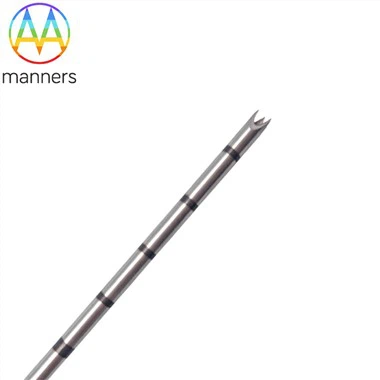
The product is made of medical stainless steel in diameters from 0.25 mm to 30 mm, with custom sizes available. Two configurations cover the clinical range: with or without a dorsal foramen, used for injection and puncture in epidural and combined spinal epidural anaesthesia. Customisation follows 2D or 3D drawings or samples, and packaging is either a standard carton or a customer-specified sterile configuration.
Key inspection items are raw material certification, annealed ductility sampling, back-cut angle and opening measurement, surface roughness, burr detection, catheter compatibility friction, biocompatibility and sterilisation validation. Each item has a method, a sample size and a record location. The inspection plan is written before the first production batch rather than assembled afterwards, because a plan built around available data tends to omit exactly the properties that decide performance.
Inspection items are drawn from risk rather than from the drawing sheet alone. Back-cut angle and opening size come from the drawing; edge condition, lumen cleanliness and catheter compatibility come from the failure modes the drawing does not describe. Listing both in one plan is what makes a batch release meaningful, because a part can meet every dimension and still shear a catheter.
QC Operation Flow for Mass Production
Incoming inspection verifies the material certificate, tube straightness and wall thickness distribution. Annealing is monitored with a continuous temperature record, and ductility samples are taken from each furnace load at the position that runs coolest. After back-cut forming, automatic optical inspection scans tip geometry and edge condition, and electropolished batches are sampled for roughness and for residual burr.
Finished needles pass through lumen cleaning and particulate inspection before packing. Each package carries a batch number that links material lot, annealing log, drawing revision, test report and sterilisation record, so a complaint can be traced to a furnace load within hours rather than days. Non-conforming material is quarantined and dispositioned by the quality function, and the disposition itself is recorded, since an undocumented scrap decision is indistinguishable from a shipment.
Batch size is another variable that needs a rule. A furnace load mixes diameters, and a large load produces a long thermal lag, so the ductility result depends on where each basket sat as much as on the recipe. Defining a maximum load, recording position and sampling the coolest location turns that variable into a controlled one instead of a source of intermittent rejects that no single adjustment explains.
Practical Experience of ISO13485 Audit
The most frequently audited area for these needles is special process validation for annealing. Auditors look for evidence that the parameters can reliably prevent back-cut cracking, not merely that a batch passed. We therefore separate validation protocols by diameter range, because a very fine tube and a large-bore tube respond differently to the same furnace profile, and a single protocol covering both would be indefensible.
A drawing change must trigger design review and re-validation. Many non-conformities arise because a back-cut angle was adjusted without updating the risk file, leaving the documented risk controls describing a geometry that is no longer produced. We also retain simulated puncture records for each custom variant, showing that the tip works with the matched catheter, because the most important claim a supplier makes is not dimensional conformance but safe threading.
Training records are the other item auditors examine closely. A special process is only as controlled as the person who sets it, and a signed qualification for furnace operation and for back-cut inspection is a simple, credible control. Where a supplier cannot produce that record, the audit conclusion is usually not that the process is wrong but that the supplier cannot demonstrate it is right, which has the same commercial effect.
Summary of ISO13485 Value
The ISO 13485 framework standardises the whole lifecycle of a Tuohy Back Cut Needle. It controls the critical risks of back-cut machining and annealing, reduces batch-to-batch fluctuation and makes every release traceable to its material and its process records. That is what allows a clinician to trust the second lot as much as the first.
Consistent quality is also the commercial argument. Medical OEMs and hospitals qualify suppliers on evidence rather than on samples, and a supplier who can produce that evidence supports both standard and custom needle supply without a separate quality conversation for each programme.
Future Compliance Trend
Global regulation is tightening, and the European regime in particular aligns with risk-based thinking that ISO 13485 already describes. Real-time monitoring of annealing and back-cut machining will replace periodic sampling, because intermittent checks cannot characterise a process whose failures are internal. Digital traceability will link individual needles to production data rather than linking batches to summary reports.
That change raises the entry cost of the category, and it also stabilises it. Suppliers with instrumented processes and complete records will find audits routine, while those who assemble evidence retrospectively will find each new market harder to enter. For buyers, the practical test is simple: ask for the annealing curve of a specific lot and see how long it takes to arrive.
The practical implication for buyers is straightforward. Ask for the special process validation file with the quotation rather than after the first order, because a supplier who already holds that evidence can support a new geometry in weeks, while one who assembles it afterwards will ask for months.