Tuohy Back Cut Needles: Custom Manufacturing Based On 2D & 3D Drawings
Nov 17, 2026
Meta description: Tuohy Back Cut Needles support custom production from 2D/3D drawings or samples, stainless steel epidural needles, ISO13485 certified for CSEA kits.
Pain Points of Standard Needle Limitation
Off-the-shelf Tuohy needles cover a limited set of gauges and tip specifications. Many device developers need a specific back-cut depth, foramen position, shaft length and hub structure to match a CSEA kit, a thoracic approach or a long-term epidural programme, and none of those requirements can be met by choosing a catalogue number. When a supplier cannot read an engineering drawing precisely, the finished tip drifts from the design intent, and the drift shows up clinically as catheter resistance rather than as a dimensional non-conformance.
Sample-based customisation has its own failure mode: without a structured reverse-engineering process, the second batch does not match the first, and the customer discovers the difference in a functional test rather than in a dimensional report. Ultra-fine needles below half a millimetre add a further constraint, because back-cut grinding on a thin wall tolerates very little variation in material condition before the edge begins to chip.
Lead time is the commercial constraint that follows. A custom tip usually needs a new grinding program, a new annealing setting and a fresh catheter compatibility run, and each of those consumes weeks when the supplier treats the request as a special project rather than as a routine route. Buyers then either accept a standard size or take on a development programme they did not plan, and the design intent erodes in the compromise.
Principle of Drawing-Driven Customization
Custom Tuohy Back Cut Needles begin with a full review of the 2D drawing or 3D model rather than with a quotation. Our engineers check dimensional tolerance, back-cut angle, wall thickness, foramen layout, hub geometry and material specification, then flag features that cannot be produced repeatably at the requested tolerance and propose an alternative before tooling is made. That review is the step that prevents a prototype that works from becoming a production line that does not.
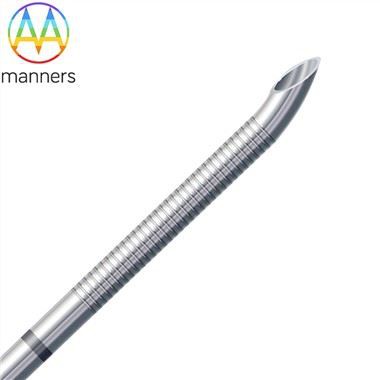
The controlled feature is the back-cut geometry. The curved tip profile decides catheter deflection direction, the foramen area decides drug dispersion, and the wall thickness at the edge decides whether the tip survives polishing and sterilisation. CNC parameters are programmed from drawing data rather than from an operator's judgement, and annealing is scheduled to the ductility that the drawing requires. Sample confirmation comes before mass production, with the customer testing the part against the catheter it will actually be used with.
Reviewing a drawing also means reviewing what the drawing does not say. A back-cut needle drawing often omits the inner edge condition, the polish allowance and the acceptance method for the tip opening, and those omissions are where disputes begin later. Where the customer cannot supply the missing criteria, we propose them from the intended function, then have the customer approve them as part of the drawing rather than as an assumption on the shop floor.
Specification Range & Custom Feature Menu
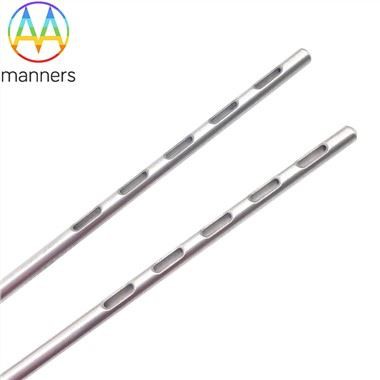
The base material is medical stainless steel, with diameters from 0.25 mm to 30 mm and custom shaft lengths throughout that range. Two core variants exist: back-cut with dorsal foramen and back-cut without, covering combined spinal epidural and single epidural use respectively. Because these are injection and puncture instruments rather than closed systems, the customer retains control of the catheter, the spinal needle and the hub interface.
Customisation covers drawing-based production, sample reverse engineering and modification requests that combine an existing body with a new tip or hub. Packaging is a standard carton or a sterile pouch configuration specified by the customer. Every project carries a design history file, process validation record and batch release documentation under ISO 13485, so a custom tip is not a deviation from the quality system but an entry within it.
Standard Customization Operation Process
The process opens with technical communication: the customer supplies drawings, STEP files or physical samples, and our team responds with a manufacturability review. That review typically returns a list of risky features, such as a back-cut wall under a defined thickness, together with tolerance suggestions that preserve function while remaining producible. Drawing approval then fixes the revision that all subsequent records will reference.
Raw tube is cut and annealed to the target ductility, the CNC cell forms the back-cut tip and, where required, punches the foramen, and electropolishing removes edge burrs before inspection. Prototype samples are delivered for functional testing with the customer's catheter. On approval, formal production begins with in-line dimensional inspection on every batch, followed by cleaning, packing and release under the agreed quality regime.
Inspection planning belongs to the same process. Before the first batch we agree what will be measured, on how many parts and by which method, so that acceptance is not renegotiated after the parts exist. Where a customer asks for a capability on a feature that the process cannot hold, the conversation happens at drawing approval rather than at delivery, which is the only point at which a tolerance can still be changed cheaply.
Practical Experience for Drawing Custom Projects
The most common pitfall is treating a drawing change as a machining change. A deeper back cut removes more material from the tip, so the steel needs a larger ductility budget, and a revision that alters the tip without altering the anneal will produce cracked edges even though every dimension on the drawing is met. We therefore lock the annealing recipe to the drawing revision number and re-verify whenever that revision moves.
For sample reverse engineering, we scan the original part, rebuild the CAD model and compare the measured back-cut angle with what the customer actually expects from the design. Catheter compatibility is tested on every custom variant, because a deviation of a few hundredths of a millimetre at the back-cut opening is enough to shear a catheter. Version control of drawings is treated as a quality control, not as an administrative convenience, since mixed revisions are the most common source of a batch that fails for no visible reason.
Communication cadence matters as much as technical review. A short weekly update during the sample phase, with photographs of the tip at a defined magnification, prevents the situation where a customer first sees the geometry after it has been packed. When a deviation is unavoidable, it should be raised with the drawing owner while the parts are still on the machine, not in an inspection report that arrives with the shipment.
Summary of Customization Value
Drawing and sample customisation removes the constraint of standard Tuohy models. It lets medical OEMs develop differentiated CSEA kits and specialised anaesthesia consumables without building their own forming capability. Combined with controlled annealing and precise back-cut machining, custom needles hold their mechanical performance across batches rather than only in the prototype.
ISO 13485 design control is what makes that offer credible, because it gives each variant a documented origin, a validated process and a traceable batch. Customisation then becomes a repeatable service rather than a series of engineering exceptions, which is the difference between a supplier who can support a product line and one who can only support a sample request.