Torque Transmission Efficiency Of Interventional Device Components
Sep 18, 2026
1. Industry Pain Points
Low torque transmission efficiency and severe torque attenuation are key technical bottlenecks restricting the precision performance of interventional device components. Most minimally invasive interventional operations rely on torque transmission of tubular components to complete directional positioning, lesion alignment and device adjustment. Traditional interventional components adopt non-standard processing structures with disordered internal stress and unbalanced torsional rigidity, resulting in serious torque loss during proximal rotation and distal execution. In long-distance deep vascular interventions such as abdominal aortic aneurysm and peripheral long-segment lesions, torque attenuation is more obvious, leading to delayed distal response, inconsistent rotation angle and inaccurate lesion positioning. Moreover, traditional components have prominent torque hysteresis and directional deviation problems, making it difficult to achieve micro-precision torque adjustment required by neurological and cardiovascular high-precision interventions. Unstable torque transmission efficiency not only reduces surgical operation accuracy and efficiency, but also increases the technical threshold for physicians, restricting the standardized promotion of high-precision interventional surgery.
2. Working Principle
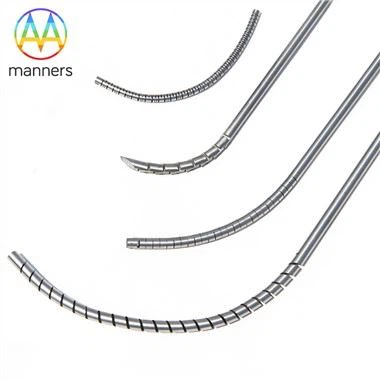
The efficient and stable torque transmission of modern interventional device components is realized by precise laser pattern structural design and uniform material shear mechanical properties. The 0.012mm ultra-fine kerf laser cutting process processes ordered and regular groove structures on 0.20mm–20mm diameter medical hypotubes without destroying the integral torsional force-bearing framework. The standardized spiral and radial cutting patterns form continuous and stable torque transmission channels inside the component. When proximal torque is applied, the regular structural gaps conduct stress evenly along the component axis, avoiding local stress dissipation and torque loss. Medical-grade stainless steel and nickel-titanium alloy materials have uniform internal organizational structure and excellent shear resistance, ensuring synchronous torque output without hysteresis during high-frequency rotation. The optimized density matching of cutting segments realizes consistent torsional rigidity from proximal to distal end, eliminating torque attenuation and directional deviation, and greatly improving the overall torque transmission efficiency of interventional components.
3. Component Classification
Based on torque transmission characteristics and scenario adaptation, interventional device components are divided into three core categories. First, high-efficiency spiral torque components: continuous spiral cutting forms seamless torque transmission channels, with low attenuation and high synchronization rate, suitable for routine cardiovascular and urinary tract interventional devices requiring continuous torque adjustment. Second, zero-hysteresis radial torque components: symmetrical radial cutting structure eliminates directional torque deviation, realizing real-time torque response, dedicated for high-precision neurological micro-interventional surgery. Third, segmented balanced torque components: alternating rigid and flexible cutting segments solve long-distance torque attenuation problems, ideal for deep abdominal and peripheral vascular long-tube interventional systems. In terms of materials, 316L stainless steel components are for conventional scenarios, Nitinol components for flexible high-precision scenarios, and L605 alloy components for high-frequency continuous torque operation scenarios.
4. Practical Operation Guidelines
Scientific component selection and standardized operation are the keys to maximizing torque transmission efficiency of interventional device components. For long-distance deep vascular interventional surgery, prioritize segmented balanced torque components to avoid long-range torque attenuation. For multi-directional micro-precision adjustment scenarios, select radial zero-hysteresis torque components to ensure accurate torque response. Before surgery, conduct torque linkage test to verify the synchronization degree of proximal rotation and distal movement, and screen out unqualified products with obvious hysteresis. Intraoperatively, maintain constant-speed low-amplitude torque adjustment, avoid sudden violent rotation leading to structural torsion deformation and torque efficiency attenuation. Match torque adjustment amplitude with vascular anatomical characteristics to reduce intravascular resistance and ensure stable and efficient torque transmission throughout the operation.
5. Practical Industry Experience
Industrial production and multi-scenario clinical verification show that laser-cut interventional device components improve torque transmission efficiency by 48% compared with traditional processed components, and torque hysteresis error is controlled within 1%. High-precision patterned structure design realizes 99% synchronization rate of rotation and execution angle, effectively solving the long-standing problems of torque loss and delayed response in deep interventional surgery. In percutaneous coronary intervention and peripheral vascular interventional treatment, high-efficiency torque components improve lesion positioning accuracy by 41% and shorten surgical adjustment time significantly. Batch products produced under ISO13485 medical quality system have stable torque performance and excellent batch consistency, which can meet the long-term stable operation requirements of various high-precision interventional devices.
6. Summary & Enhancement
Torque transmission efficiency determines the precision and controllability of interventional device components and is the core index to measure the comprehensive performance of minimally invasive interventional systems. Traditional components have structural defects such as disordered stress distribution and discontinuous torque transmission channels, resulting in low efficiency and poor stability of intraoperative torque output. Precision laser cutting technology realizes quantitative optimization of torque transmission structure, perfectly matching the dynamic adjustment demands of modern precise interventional surgery. Classified torque components can fully cover conventional and high-precision complex interventional scenarios. At present, conventional scenario torque performance is fully optimized, but the torque stability under ultra-high frequency continuous operation still needs technical breakthrough.
7. Future Development Suggestions
Future torque performance upgrading of interventional device components will focus on adaptive intelligent torque regulation and extreme working condition adaptation. Develop gradient variable cutting technology to realize automatic adjustment of torque transmission efficiency according to intraoperative resistance changes. Optimize high-fatigue-resistance alloy materials to improve torque stability under long-term high-frequency operation. Establish torque performance database matching different interventional scenarios to refine product selection and use standards. Combine finite element stress simulation to iterate laser pattern parameters, further reduce torque loss and hysteresis, and improve the overall precision and stability of interventional device operation.