The Veress Needle In Laparoscopic Surgery — How Precision Structure Enables Safe Access
Jul 11, 2026
https://en.wikipedia.org/wiki/Veress_needle
The distinction of the Veress needle as the "first cut" in laparoscopic surgery stems from its exquisite three-part structural design. Far from a simple assembly of metal tubes, it represents a systems engineering integration of fluid dynamics, material mechanics, and histobiology. A standard Veress needle comprises a hub, a cannula, and a core internal assembly (spring-loaded stylet and valve flap).
The Hub serves as the surgeon's interface, typically molded from medical-grade polypropylene (PP) or stainless steel. Premium hubs incorporate an internal one-way valve system, ensuring unidirectional gas flow into the abdomen and preventing reflux. The terminal Luer Lock connector guarantees an airtight seal with CO₂ tubing. Selected hub designs feature a transparent window to facilitate the hanging drop test, allowing the surgeon to observe meniscus movement as an indicator of negative intraperitoneal pressure.
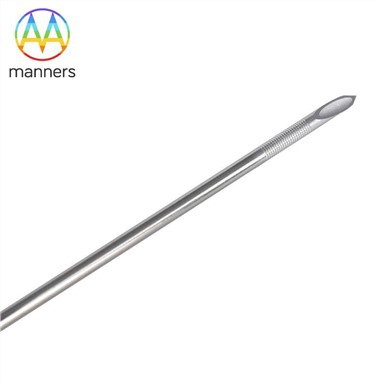
The Cannula forms the needle's primary shaft, commonly fabricated from stainless steel tubing with an outer diameter of 2.5 mm to 5 mm (14G–18G). The tapered tip undergoes precision CNC grinding to create a sharp bevel, typically angled at 15°–25°. This geometry is meticulously calculated: an overly obtuse angle renders the tip dull and ineffective against fascial layers, whereas an excessively acute angle risks uncontrolled deep penetration. Electropolishing reduces surface roughness (Ra < 0.2 μm), significantly lowering insertion friction. The most critical structural feature is the Side Port, positioned approximately 1–2 cm proximal to the tip. Upon peritoneal entry, this port resides securely within the abdominal cavity, directing CO₂ centrally rather than into the abdominal wall planes.
The Spring-Loaded Stylet constitutes the soul of the Veress needle. Its tip is characteristically blunt-rounded and, under constant spring tension, protrudes beyond the sharp cannula bevel at rest. Encountering dense tissues like the fascia, increased resistance forces the stylet to retract, exposing the cutting edge. Once the peritoneum is breached and resistance vanishes, the spring instantly re-deploys the blunt stylet, physically shielding the sharp tip. This "blunt-sharp-blunt" sequence is the fundamental safety guarantee of the Veress needle.
It is this highly integrated precision architecture that enables the Veress needle to establish pneumoperitoneum safely and efficiently without direct visualization. In laparoscopic surgery, the Veress needle functions not merely as a tool, but as the first critical line of defense for patient safety.