The Return Of A Legend: The Menghini Needle’s EUS-Era Revolution And The Tissue Revolutio” In Pancreatic Biopsy
Apr 30, 2026
In the diagnostic labyrinth of pancreatic diseases-especially solid pancreatic lesions-obtaining high-quality tissue specimens is the only beacon illuminating pathological truth and guiding precision therapy. Endoscopic Ultrasound-Guided Fine-Needle Biopsy (EUS-FNB) stands as the pivotal technology wielding this beacon. Over decades of evolution, the history of biopsy needles has essentially been an unceasing "tissue revolution" dedicated to harvesting more intact, adequate core tissue strips. At the heart of this revolution, a classic design from the mid-20th century-the Menghini liver biopsy needle-has undergone modern refinements and reclaimed the spotlight in endoscopy, emerging with unique potential to challenge existing paradigms. This is no mere "retro revival"; it represents a perfect fusion of timeless design philosophy and modern precision manufacturing, establishing a new paradigm of stability, accuracy, and purity for tissue acquisition in solid pancreatic lesions.
I. Echoes of a Classic: The Intelligent Migration from Percutaneous Liver Biopsy to Endoscopic Puncture
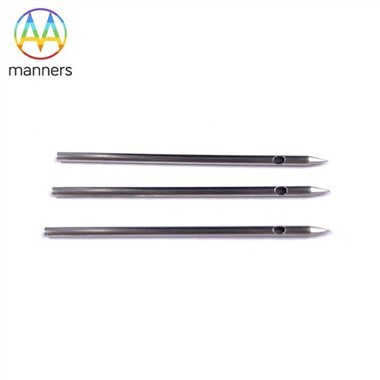
The traditional Menghini needle, invented in 1958 by Italian physician Giorgio Menghini, was initially designed for percutaneous liver biopsy. Its design hinges on two core features: a sharp inner-bevel tip and a side port connected to a syringe for negative pressure. During use, the needle is rapidly inserted into the liver while simultaneous syringe aspiration generates strong negative pressure, "sucking" tissue into the needle groove and shearing it off. This design was revolutionary: it yielded strip specimens for histological diagnosis (not just cytological smears) in a relatively controlled, minimally traumatic, and efficient manner.
When adapted for EUS-FNB, this classic design's core advantages were reimagined and amplified. EUS-guided puncture of the deep pancreas through the gastrointestinal wall presents unique challenges: confined space, curved trajectories, and target motion (from respiration, heartbeat, and vascular pulsation). The modified EUS-specific Menghini biopsy needle retains the soul of its inner-bevel cutting mechanism, optimizing the physics of puncture and tissue dissection.
II. The Physics of the Tip: Why an "Inner Bevel"?
To grasp the Menghini needle's strengths, its tip design must be contrasted with other mainstream needle types:
Reverse-bevel needles: The opening is lateral, with cutting edges on the outer needle wall. Tissue is obtained primarily via "pushing and tearing," potentially causing significant crush artifact and incomplete tissue strips.
Crown needles: Three symmetric cutting edges resembling a miniature triangular file. They excel at "anchoring and rotary cutting," harvesting tissue from multiple directions via needle rotation, with high retrieval rates.
Fork-tip needles: Bird-beak-like design intended to "hook and grasp" tissue during puncture.
The Menghini needle's inner-bevel design delivers a unique mechanical advantage:
Reduced puncture resistance: The recessed bevel creates a sharper, more penetrable tip. Theoretically, less force is required to traverse the tough pancreatic capsule or fibrotic tissue, minimizing needle wobble and enhancing accuracy.
Gentler tissue dissection: Unlike external pushing/tearing, the inner bevel acts like an internal "coring" motion post-penetration. Combined with moderate negative pressure, it cleanly draws a cylindrical tissue core into the needle groove, reducing crush artifact and preserving architectural integrity for pathologists.
Potential hemostatic benefit: Hypotheses suggest the inner bevel creates a more regular tissue defect, altering patterns of microvascular injury and potentially reducing needle tract bleeding-though this requires further validation.
III. Efficacy in Solid Pancreatic Lesions: Challenges and Opportunities
2023 review evidence confirms the novel Menghini needle demonstrates clear advantages in diagnosing solid pancreatic lesions. Direct comparisons with conventional FNA needles show superior sample quality and diagnostic accuracy, validating its design for retrieving diagnostically viable tissue.
However, head-to-head studies against other leading modern FNB needles (e.g., Franseen, Fork) yield more cautious conclusions. A network meta-analysis of four novel needle types ranked Franseen and Fork needles highest in cumulative scores, with the Menghini needle outperforming anterograde-bevel needles but slightly trailing the top two. This defines its current market position: a highly effective, reliable FNB needle, yet not yet a comprehensive leader in the critical metric of tissue retrieval rate.
This finding is far from final; instead, it highlights unique clinical opportunities:
Balancing quality and quantity: For dense, fibrotic pancreatic tumors (e.g., some ductal adenocarcinomas or masses in chronic pancreatitis), excessive focus on "quantity" may over-disrupt tissue. The Menghini needle's gentle coring preserves intact core strips-critical for interpreting immunohistochemical staining.
Potential for specialized lesions: Diagnosing autoimmune pancreatitis (reliant on hallmark histology: storiform fibrosis, IgG4-positive plasma cell infiltration) depends on intact, minimally crushed tissue strips. Early studies show Franseen needles excel here; the Menghini needle, with its tissue-preserving design, may offer similar promise-awaiting dedicated trials.
Learning curve and ergonomics: For operators familiar with traditional negative-pressure aspiration, the Menghini needle's logic (simultaneous puncture and aspiration) is intuitive, with a gentler learning curve. Its consistent performance supports widespread adoption of high-quality EUS-FNB across diverse clinical settings.
IV. Future Outlook: A "Tissue Platform" Beyond Diagnosis
Modern pancreatic oncology has entered the era of molecular subtyping, where next-generation sequencing and drug sensitivity testing require abundant, high-quality tissue. The architecturally intact tissue cores harvested by the Menghini needle are ideal for these advanced analyses. Its design enables it to meet not just basic diagnostic needs but also serve as a robust tissue supply platform for refined diagnosis and personalized therapy guidance.
Conclusion: The Modern Value of Timeless Wisdom
The Menghini liver biopsy needle's renaissance in the EUS era stands as a remarkable case of "classic reinvention" in medical device history. It proves that designs rooted in profound physical insights and clinical needs can transcend time, revitalizing on new technological platforms. In the competitive FNB needle market, the Menghini needle may not be an all-around "champion" in data rankings, but it delivers a differentiated, high-performance solution defined by tissue integrity and operational reliability. It reminds us that technological progress is not just about bold innovation, but also the continuous rediscovery and refinement of time-tested wisdom. In the pursuit of pathological truth for pancreatic lesions, the Menghini needle and its design philosophy will remain an indispensable, vital force.